Dear Valued Clients and Friends –
Before we get too deep, a special shout-out to TBG client, Nathan Church, on first first-ever major league home run! An 11th round draft pick out of UCI, biding his time in triple-A ball the last three years, he was called up over a week ago and has been getting the job done for the St. Louis Cardinals with the ESPN Catch of the Week, and now this homerun! Working hard and persistence pays dividends …
Dividend Cafe did a deeper dive not into Fed interest rate policy, but the past, present, and future of the Fed’s balance sheet policy. There may be a few things being overlooked that matter a lot. The written version is here (my favorite), the video is here, and the podcast is here.
Off we go with the standard Monday “around the horn” …
|
Subscribe on |
Market Action
- Markets opened down nearly a hundred points today and went progressively lower throughout the day.
- The Dow closed down -349 points (-0.77%) with the S&P 500 down -0.43% and the Nasdaq down -0.22%.
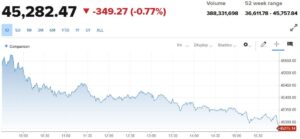
*CNBC, DJIA, Aug. 25, 2025
- The big market rally on Friday mostly just made up for what the S&P and Nasdaq had been down earlier in the week, but markets did close positive on the week after what had been a volatile week. It was one of the first weeks in a while with a pronounced advantage for defensives and value vs. momentum and growth.
- 91% of companies listed on the NYSE were up on Friday (only five days in two years with this breadth), and the advance-decline ratio in the Russell 3000 was 14-to-1.
- Over 80% of companies saw positive revisions in the last three months in forward earnings. This is more sentiment-oriented than fundamental, but the breadth is what is noteworthy.
- The ten-year bond yield closed today at 4.28%, up two basis points on the day.
- Top-performing sector for the day: Communication Services (+0.44%)
- Bottom-performing sector for the day: Consumer Staples (-1.62%)
- Talk of “seasonal” September challenges is reaching a fever pitch.
- Shanghai’s stock market is making a ten-year high.
Public Policy
- The White House closed a deal to take a 10% equity interest in Intel this weekend. The government also received a warrant to buy an additional 5% of the company at $20 per share.
- National Economic Council Director Kevin Hassett said this morning that the government plans to continue doing more deals like the Intel one, essentially creating our own [deficit-funded] sovereign wealth fund. He stated the government will be looking to own different companies across different industries.
- I will be writing about the above two bullet points in this Friday’s Dividend Cafe.
- President Trump announced that the U.S. is looking to impose “significant tariffs” on imported furniture in the coming fifty days. National security has a whole different meaning than it did when I was a kid.
Economic Front
- The trade deficit in the first six months of the year increased by 38% over what it was at the mid-point of 2024, from $421 billion to $583 billion. And it certainly is my opinion that the tariff policies of the administration (a) won’t ultimately do anything to reduce the trade deficit, and (b) don’t need to do anything about the trade deficit because there is nothing wrong with the trade deficit. But that said, those looking at the 38% increase in the trade deficit year-over-year and saying, “wow, by their own standards this is a disaster,” are you actually missing the point? The trade deficit skyrocketed because of front-running imports, whereby companies accelerated import orders to try to get in front of the tariffs.
Housing & Mortgage
- One thing I missed in the NAHB Housing Index was that 66% of builders reported using incentives to get a transaction done, the highest level since May of 2020.
- New Building Permits also dropped for the fourth month in a row, so while multi-family new starts had a good rebound, the leading indicator of permits for new single-family construction continues to be very depressed.
- Existing home sales increased +2% in July and saw the median price of an existing home drop. The annual pace of home sales remains well over a million homes less than we saw PRE-COVID, and about 2.5 million homes less than we saw POST-COVID.
- New home sales, on the other hand, were down -0.6% month-over-month. The average price of a new home sold is down -5% versus a year ago.
- Per Redfin, July was the slowest sales month in over a decade, with the average home now on the market for 43 days (longest in over ten years), and supply up to five-year highs. Only 29% of homes went for above their asking price, the lowest number in over six years.
Federal Reserve
- Markets (stock and bond) rallied substantially on Friday as Jerome Powell made it as clear as can be that a rate cut is coming in September. But with futures already over 70% probability for such going into the chairman’s Jackson Hole speech, it is unlikely that markets rallied merely because of something they already knew, anyway. More likely, the overall posture indicated more cuts to come and markets rallied on (a) The removal of hedges from actors concerned a September cut was not coming, and (b) Expectations for marginally more accommodative policy by the end of the year.
- His exact sentence to note: “With policy in restrictive territory, the baseline outlook and the shifting balance of risks may warrant adjusting our policy stance.”
- This issue of Fed Governor Lisa Cook, possibly being fired for cause, does open up the possibility that four of the seven seats on the Board of Governors would be Trump appointees (actually, Powell was, too, but I am not counting him, given the adversarial relationship). The Board of Governors can fire reserve bank presidents “at will,” whereas the President can only fire “for cause.” It should be said, though, that this has never been done.
- The Atlanta Fed seems at least open to the possibility that a tariff-induced elevation in prices may prove sticky.
Oil and Energy
- WTI Crude closed at $64.73, up +1.68% on the day.
- Midstream was up about +1% last week, and energy stocks were the top-performing sector on the week.
Ask TBG
| “With the possible impact on global liquidity that sustained tariff policies might cause and if this practice of government equity ownership in private companies were to continue, just how might that impact TBG strategy and specifically how might it impact strategy for someone approaching the end of high earning years?” ~ Greg W. |
| There is “newness” across policy and economic conditions right now, no doubt, but various economic vulnerabilities, volatilities, and even policy abuses are not at all new. In fact, they are the norm. The specifics twist and turn, yes, but the basic underlying reality of some economic and policy vulnerability is incredibly common. With that said, one of the basic profundities of dividend growth investing is that it is reasonably agnostic about economic vulnerability and policy madness. Particular companies may have particular impacts we have to manage for (and always have), but the general thesis is to replace the risk and reward of macro bliss with the risk and reward of individual companies sustainably growing their dividends. The macro things I address are not going to change our investment philosophy, and your age and stage benefit from our approach – so we would not be abandoning it over the headlines of the day. |
On Deck
- Nvidia releases earnings after the market close this Wednesday, the 27th. At an 8% weighting of the S&P 500, this is the first time in history a company at that level of representation in the S&P 500 is announcing earnings.
- As mentioned above, my Dividend Cafe this Friday will look into market implications of the government’s new aspiration to own stakes in American public companies
Summer is officially over (not the solstice, the practicality) as school has officially begun. I make a trek myself into the classroom tomorrow, where I will teach an elective course on Economics at Pacifica Christian High School in Orange County. I hope all you parents survived your summers, and I just have to say that fall is absolutely my favorite time of year!
With regards,
David L. Bahnsen
Chief Investment Officer, Managing Partner
The Bahnsen Group
www.thebahnsengroup.com
The Dividend Cafe features research from S&P, Baird, Barclays, Goldman Sachs, and the IRN research platform of FactSet.