Dear Valued Clients and Friends –
The biggest news of the weekend was the President’s Friday-morning announcement of Kevin Warsh as the new Federal Reserve chair, to replace Jerome Powell when his term ends in May. Much more on all things Warsh and Fed below in the Fed section. My CNBC Squawk Box hit talking about Warsh is here, and their article on the matter, quoting me, is here.
I was also on Varney/Fox Business for the opening hour this morning with a short highlight reel here.
Dividend Cafe looked at the pivotally important practice of portfolio rebalancing and how it fits into an ecosystem of behavioral discipline. The written version is here (my favorite), the video is here, and the podcast is here.
Off we go …
|
Subscribe on |
Market Action
- Markets opened down this morning and rebounded significantly throughout the day
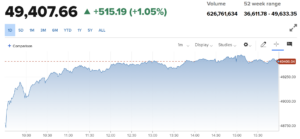
- The Dow closed up +515 points (+1.05%) with the S&P 500 up +0.54% and the Nasdaq +0.56%
*CNBC, DJIA, February 2, 2026
- One thing worth saying about the “rotation” theory of the market – I liked it a lot better when I was one of the only ones saying it. That it has now become a consensus view does not make it wrong, but it does make it less attractive (and closer to a point down the line of being wrong). This is a tenet of contrarianism, and unfortunately, it has a high batting average.
- So speaking of rotation, the equal-weight S&P was up +3.3%, much more than the cap-weighted +1.4%. Small-cap was up +5.3% vs. S&P +1.4%; value was up +4.4% vs. growth down -1.5%. The top sectors for the month were Energy, Materials, and Consumer Staples; the bottom were Technology and Communication Services
- The Nasdaq has not made a new high since October and now has 40% of its constituents trading below their 200-day moving average.
- As questions continue to come in about which sectors benefit most from a weaker U.S. dollar, the simple rule of thumb is that the more international sales, the more of a benefit. Utilities are an example of a sector with virtually NO foreign revenue; the entire sector is largely U.S. consumers paying for U.S. gas and electricity with U.S. dollars. But then Technology, Materials, Consumer Staples, and Energy have a much higher percentage of foreign-based revenues. Now, does that mean it is as simple as just saying, “The dollar is weaker, therefore those sectors will now do better?” No, because there is a pesky little problem here … Markets already have known about the weaker dollar, and discount into the present what they believe about the future. In other words, it only has to fundamentally materialize, but it has to do so without the market having already priced it in. Therein lies the rub.
- The ten-year bond yield closed today at 4.28%, up four basis points on the day
- Top-performing sector for the day: Consumer Staples (+1.58%)
- Bottom-performing sector for the day: Energy (-1.98%)
- One thing that apparently doesn’t benefit from a weaker dollar (some will have to change their marketing literature): Bitcoin/crypto. Bitcoin is now down -13.3% YTD and -38% over the last three months, after what was apparently a large leveraged owner having to sell over a billion dollars over the weekend.
- I know everyone wants me to comment on the gold/silver action of late, but it just isn’t material to the way we believe in managing money. If someone thinks the spike up in those things has occurred in recent weeks was rational, then so be it. And if someone believes the biggest one-day drop since 1980 on Friday is normal, so be it. The idea that someone has a play here – an explanation – a sensible way to unpack it – is a myth. And it’s not for us.
Top [Market] News Stories
- Elon Musk is reportedly in advanced talks to combine SpaceX with xAi, according to numerous reports. There are also reports of blending a combined SpaceX/xAi with Tesla, but those talks seem less developed.
- Oracle announced it would be tapping capital markets (debt and equity) to raise $50 billion for its AI project computing capacity needs, and the stock sold off in response. The stock is down 50% from its September high. I bring this up (we do not own it) because it is the largest name in the AI space openly discussing the need to raise money for these massive AI aspirations, and the market is not smiling upon companies needing to lever up, sell other assets, or lay off massive amounts of employees (or a combination of those three) to fund speculative AI projects
- Market reports suggest that the previously announced $100 billion deal between Nvidia and OpenAI is “in trouble.” We know the two companies are so intertwined that some massive economic intersection is inseparable (the circularity of their commitments requires it), but it appears that the “memorandum of understanding” for a straight $100 billion equity injection is now unlikely. All these financial deals between various actors in the AI infrastructure space will be increasingly scrutinized going forward, as markets have begun to read the fine print.
Economic Front
- The Producer Price Index rose +0.5% in December, well above the +0.2% expected. Producer Prices are up +3% versus a year ago.
- ISM Manufacturing rose to 52.6 in January, with New Orders and Production leading the way. One month does not make a trend, but give me two or three months of this, and I am going to be very happy. The one thing still contracting in the Manufacturing data … EMPLOYMENT!
Housing & Mortgage
- Don’t look now, but New Leases fell -0.2% on the month (in price) per Apartment List and are down -1.4% year-over-year. Rents are still being tracked in CPI data as if they are growing +4% per year.
Federal Reserve
- On Friday, President Trump announced former Fed governor and former Morgan Stanley economist Kevin Warsh would be the new Federal Reserve chairman. Dividend Cafe readers know that I not only long hoped it would be Kevin Warsh, but have also been adamant in saying that it would be. The truth is that I knew there were some in Treasury advocating for him, and I knew that a couple candidates being discussed in the media actually had no chance (I find it laughable – utterly laughable – that as of a week ago prediction markets really believed President Trump was going to pick a BLACKROCK executive who donated to NIKKI HALEY, but what do I know).
- Why do I like Kevin Warsh for this role? Well, first of all, for those who can find things Kevin has said in the last year that I would disagree with, I did not make a list of people who were not candidates and were never going to be, and compare Kevin to them – I believe Kevin was the best of the actual candidates. As soon as I get a magic wand, I will expand my list. But as for intellectual gravitas and monetary policy POV, I believe Kevin’s early warnings about QE were among the most prescient I have read regarding the dangers of experimental monetary policy. I also believe he will be far more serious about genuine institutional reform than any other candidate. Essentially, people may like or not like what he does or doesn’t do with interest rate policy in the year and years ahead, but I see his perspective on the Fed’s balance sheet and on limiting the Fed’s role in accommodating governmental excesses as being very important for economic stability.
- To make clear the mechanics here: Warsh is being appointed to replace Stephen Miran now, since Miran’s term now ends. This gets Warsh on the Fed before Powell’s term ends, and then he would have expedited chairman confirmation from there. I presume the President’s attention is to nominate Miran for the seat vacated when Powell steps down (not as chair but a regular voting member), but we do not know that Powell will step down.
- I am doing a deep dive in the Friday Dividend Cafe on all things Kevin Warsh and the new Fed chair.
Oil and Energy
- WTI Crude closed at $62.19, down 4.6% on the day
- With a h/t to Chris Collie, MLPs are up +72% over the last 3.5 years, while oil is down -53% in that time period. Going back to the beginning of 2021, MLPs are up +217% while oil is up just +18% (but it has been all over the map in between these five years). We used to joke that Oil and MLPs were not correlated, because when oil was down, MLPs were down, and when oil was up, MLPs were down … But when we were being serious, we just knew that oil and MLPs were not actually correlated in fundamentals, even though they sometimes were clearly correlated in investor sentiment and flows. Seeing this reversal of fortune where midstream has done quite well even as oil has been range-bound negative for years is fascinating, but also fundamentally explainable. The sector has less leverage, better distribution coverage, and a better focus on capital discipline. And this facilitates more thoughtful allocation than correlation to oil.
- Midstream was up another +2.5% last week to close out a +8% month of January. Oil prices were up +6.8% and despite a big drop last week as the storm ended, natty gas was up +18% in January.
Ask TBG
| “Do you view cash as an intentional position at any point, or only as a residual of rebalancing and income flows? Put differently, is there ever a role for consciously holding dry powder as a response to some market event?” ~ Karl W. |
| Very minimally, and the residual is often from just portfolio ebb and flow – and not to a point where the marginal happenstance of cash would qualify as market timing.“Boring bonds” provide that same dry powder component in extreme left-tail risk events. |
On Deck
- A massive portfolio holdings update for clients on Wednesday morning
- Friday Dividend Cafe is exclusively about the Fed and its new chairman-to-be
Jumping on plane from 3 degrees to 76 degrees …
With regards,
David L. Bahnsen
Chief Investment Officer, Managing Partner
The Bahnsen Group
www.thebahnsengroup.com
The Dividend Cafe features research from S&P, Baird, Barclays, Goldman Sachs, and the IRN research platform of FactSet.