Dear Valued Clients and Friends –
Almost all of today’s Dividend Cafe is dedicated to the subject of the Supreme Court ruling on Friday, striking down the IEEPA rationale for tariffs, and what it all means going forward. It’s a special Dividend Cafe outside our normal programming, but we still have a robust market summary before we dive into all the tariff analysis.
Dividend Cafe on Friday looked at the state of the economy, what to expect from inflation, the impact of tariffs, and what it all means for economic growth in 2026. The written version is here (my favorite), the video is here, and the podcast is here.
Off we go …
|
Subscribe on |
Market Action
- Markets opened more or less flat this morning, went up for a brief minute, and dropped a lot the next hour or two and stayed down from there throughout the day.
- The Dow closed down -822 points (-1.66%) with the S&P 500 down -1.04% and the Nasdaq down -1.13%
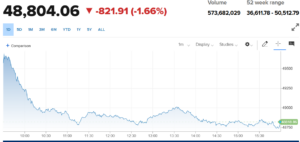
*CNBC, DJIA, February 23, 2026
- I believe the markets knew all weekend long of the President’s threats to find other ways to institute tariffs, and actually, I think markets have known the White House would say all of this and try some of it, for months (the Supreme Court ruling was hardly a surprise). The market drop today was much more related to ongoing market rotations and jitters than it was to the tariff dynamic. In fact, the market was up on Friday, and every bit of tariff news today was also known on Friday.
- The ten-year bond yield closed today at 4.03%, down five basis points on the day
- Top-performing sector for the day: Consumer Staples (+1.46%)
- Bottom-performing sector for the day: Financials (-3.33%)
- Hyper-scaler commitments for AI capex in 2026 alone now total $650 billion (just five companies, spending $650 billion, in one year). This is the total GDP size of entire countries (Sweden, Argentina, Singapore). It is more than the combined military spending of Germany, France, the UK, Japan, Italy, and Canada. h/t Torsten Slok
- When all was said and done, Nvidia appears to be investing $30 billion into OpenAI, not the $100 billion announced last fall. The $30 billion that Nvidia is investing in OpenAI? It is to be used to … buy chips from Nvidia.
- I will use the Daily Recap tomorrow to talk more about the ongoing software sell-off and the alternative asset manager sell-off. Today is a special Tariff issue!
All About Tariffs
- The ruling came in 6-3 from the Supreme Court, with two of the three justices appointed by President Trump himself ruling that the President does not have the Constitutional authority under the International Emergency Economic Powers Act to unilaterally impose tariffs. I will avoid piling on my own legal commentary since you are not here for that. I have long believed that this ruling was coming, and never wavered an inch that this was the ruling that should come. I had hoped for a 9-0 ruling for the sake of overwhelming clarity (and believe it should have been 9-0), but I do think 6-3 with such support from Trump-appointed judges is a stronger statement than a 5-4 ruling would have been.
- Certain questions were left unanswered, and the administration’s response was less strategically planned and prepared than I had been led to believe. With the gift of a few days now behind us, here is what we do know …
- Though it is a lower rate, the President shifted to a “Section 122” rationale (never used before). This is allowed for “short-term emergencies” and cannot be used for long-term trade policies. I will let readers decide what they believe is the “short-term emergency” here, and what risk there may be in public policy to call things emergencies that are not (I assure you this is a bipartisan problem). But Section 122 will only allow tariffs at a 10% rate and for only 150 days. I suspect the 150-day limit adds to uncertainty and does little to provide economic stability and certainty in capex and decision-making. Section 122 was created to protect the currency during a balance-of-payments emergency (something that does not exist here at all). I do suspect attempts to continue “gaming” things with Section 122 (as opposed to, you know, going to Congress and passing a law) could also result in judicial review, further exacerbating the uncertainty of things.
- None of this is to say that tariffs cannot happen. Article I, Section 8 of the United States Constitution clearly gives the power to tax to Congress, and if there is a policy priority for the administration to increase taxes on American importers, the hair on the whole thing around rates, time periods, rationales, judicial review, and all that kind of stuff, can easily be eliminated by … passing a law. The Republicans hold a majority in the Senate and the House. That said, whether or not a tax increase bill would gain passage is dubious, ironically because Democrats (usually fans of any tax increase bill in front of them) would oppose it, while many Republicans (most of whom signed a pledge not to increase taxes when they ran for office) would support it. We live in interesting times.
- Beyond the smaller and shorter-term stopgap of Section 122, the President plans to increase the use of Section 301, whereby the U.S. Trade Representative would have to run a process country-by-country to determine where the U.S. is the victim of “unfair trade practices” and then impose tariffs from there (and at any rate they want). As was discussed very frequently post-Liberation Day, the challenge here is that many of the new tariffs imposed last year came in trade arrangements with countries that have no tariffs on U.S. exporters whatsoever, or lower tariffs than the U.S. imposes. Section 301 is cumbersome, and in some cases, there will be no path to use it, but it will allow some of the IEEPA tariffs to try to move under this bucket.
- Finally, where possible, they will seek to increase the use of Section 232 to replace some tariffs (a sector-by-sector claim around “national security” concerns). This is the rationale used for the current steel and aluminum tariffs, for example. Under Section 232 Tariffs, steel and aluminum are subject to 50% tariffs (except for UK steel and aluminum imports, where the rate is 25%). Auto imports sit at 25%, but there are different rates on auto imports for different countries. Lumber tariffs are all over the map, depending on the product and the country. Pharma imports are delayed, and a million exemptions have been applied.
- The 10% rate already imposed under Section 122 is still a massive reduction from what the costs were under IEEPA-imposed tariffs (the ones struck down by the Supreme Court). Exports from nearly all Asian supply chain countries, Europe, Japan, South Korea, and India will now see a cut in tariff cost relative to the prior rate. But the biggest beneficiaries are companies importing from Mexico and Canada, as the new 10% rate cannot be applied to them under USMCA. The IEEPA tariffs were over 60% of total tariff revenue in 2025. Our friends at Strategas Research estimate that the net-net impact (what goes away versus what the administration tries to put back on) is still a $70 billion savings for the economy.
- The question of whether or not refunds are coming to those who paid these taxes over the last 6-9 months was not settled by the Supreme Court. The analysts I trust most on this issue believe that $130 billion in tariffs paid under IEEPA could be eligible for a refund. The Court of International Trade will likely move quickly to assert that these refunds are due, but it will not have the legal authority or mechanism to force U.S. Customs to issue rebates. Legal fights are coming, which makes me think those with legal and lobbying forces will get refunds, and others will not. If the number rebated is the full $130 billion, it would be wildly stimulative for economic growth. If it ends up being $50-100 billion, it is still mildly stimulative. If it ends up being sub-$50 billion, it will have less economic consequence in the big picture.
- Good friend and brilliant trade economist and lawyer, Scott Lincicome of the Cato Institute, had this to say about how American importers could practically and conveniently receive refunds:
“The Supreme Court’s ruling in Learning Resources v. Trump is welcome news for American importers, the U.S. economy and the rule of law. But the tariff fights have only begun. Invalidating the tariffs President Trump imposed under the International Emergency Economic Powers Act will eliminate the most potent and unchecked instrument in his tariff tool kit, boosting certainty and predictability in the U.S. market. It will also immediately set off a battle over the tens of billions of dollars that the federal government has unlawfully collected from American importers since the spring. These refunds could be remarkably easy: With almost all duty payments now made electronically, and with every IEEPA-related import assigned a specific tariff code, U.S. Customs and Border Protection could return most of the money owed to importers, with interest, at the push of a button. In several past cases, CBP has issued automatic blanket refunds covering many years and billions of dollars, and duty refunds in general are a daily occurrence. Yet unless Congress mandates the easy approach, the Trump administration will probably make the refund process as burdensome as possible, requiring every importer to file mounds of paperwork, if not a lawsuit, to get its money back. That process would demand significant time and money that American businesses won’t be able to devote to their core operations—and that smaller importers might be unable or unwilling to commit. Government resistance would therefore be a costly travesty as a matter of both economics and fairness. Unfortunately, it’s also widely expected.”
- What will happen with the USMCA review of Canada/Mexico trade deals in July seems to be an increasingly big deal right now. Ironically, things seem to have gotten better in U.S.-Mexico relations but worse in U.S.-Canada relations, so how that will all play out is hard to say. Five months is a long time, but if this were being done tomorrow, I would not be surprised if the U.S. pursued a bilateral deal with Mexico and froze Canada out of discussions.
Economic Front
- As Friday’s Dividend Cafe covered, the Q4 annualized real GDP number came in at a very disappointing +1.4%, well below the +2.5% expected. The PCE deflator being higher than expected put downward pressure on the real number (that is, inflation made the gap between nominal growth and real growth larger than expected), but nominal growth itself underperformed expectations. The government shutdown in Q4 was a factor in government outlays. The benefit the Q3 number saw in declining imports (versus the front-running of imports in Q2) went away in Q4.
- All in, the full-year real growth number for 2025 was +2.2% (subject to revision). In 2024, the number was +2.8%.
- In the ingredients, capex barely contributed +0.5% (most of that in intellectual property). Consumption added +1.6%.
- I am in agreement with those who say that the largest source of downward pressure on the Q4 number was declining government spending, and that this is not really a forward-looking concern for productive growth. I also agree with those who say predictions of 5% (or even 7%???) growth were just insane.
Housing & Mortgage
- Single-family residence sales volume declined -1.7% in December.
- The median price of new homes sold was down -2% from a year ago.
.Federal Reserve
- The odds of a rate cut before Chairman Powell’s term ends are now just 18%. Expectations in the federal funds rate futures market are for 2-3 cuts between May and the end of the year. A terminal rate of 3% or so seems increasingly likely (and I would venture to say, optimal).
Oil and Energy
- WTI Crude closed at $66.39, pretty flat on the day
- Oil prices were $56 not two months ago, and they are $66 now. Yes, some of the recent increase is related to increased tensions with Iran. But if you had been told at any time over the last ten years that the U.S. was considering an exhaustive military strike on Iran, would you have guessed that $66 oil would be the outcome, or something more like $86 (if not higher)?
- Midstream enjoyed its fifth consecutive positive week with U.S. corporations doing best, followed by MLPs, followed by Canadians. For those wondering why I cover all three sub-categories of midstream energy the way I do, it is because our strategy and exposure in the space is purposely diversified into all three.
Ask TBG
| “Can you explain ‘Reaganomics’? Or being a ‘Reaganite’? I know a lot of people who think negatively about it, but it seems more like a positive thing to me, so I would like to hear more about it from someone who thinks it was a good thing and maybe go into why some people thought it was so bad?” ~ Chad S. |
| Well, when I use the term “Reaganite” or “Reaganism,” I am referring to a loose term to describe traditional conservatism – a Burkean approach that in the 20th century was largely known as the three-legged synthesis of free market defense, social conservatism, and strong national defense (particularly in the context of an anti-Communist ideology in the Cold War). It is often used to contrast traditional conservatism from populism and economic nationalism.
But the term “Reaganomics” is more commonly thought of as the belief in supply-side priorities – using tax cuts and deregulation as incentives to drive more supply-side growth. Reagan’s economic ideology was also strong dollar, it was pro-energy independence, and it advocated for price stability. The 1982 and 1986 tax bills are widely thought of as the two most sweeping tax bills in American history, which reinforced the concept of Laffer’s curve (lower federal tax rates creating a higher amount of federal revenue as marginal tax rate reduction incentivized more growth and productivity). Some critics say (errantly, in my view) that Reagan was the beneficiary of lucky timing after 1970’s stagflation, and that 1980’s growth would have happened no matter who was there. I find that peculiar. Others believe that reduced marginal tax rates favored high earners and therefore undermined the progressive nature of the tax code. Again, I find that peculiar, and note that the flatter tax rates (passed on a bipartisan basis) drove job growth, wage growth, and lower tax burdens for lower-bracket taxpayers. |
On Deck
- The State of the Union address is tomorrow night (the 24th)
- Clients will receive their Weekly Portfolio Holdings Report on Wednesday per usual
- Clients will also be receiving a special report on alternative asset managers, Blue Owl Capital and Blackstone, in the next 24 hours
If you are in the northeast, stay warm and safe. This former Southern California “kid” has not seen a lot of things like today’s weather here in NYC.
Reach out with any questions, any time.
With regards,
David L. Bahnsen
Chief Investment Officer, Managing Partner
The Bahnsen Group
www.thebahnsengroup.com
The Dividend Cafe features research from S&P, Baird, Barclays, Goldman Sachs, and the IRN research platform of FactSet.