Dear Valued Clients and Friends –
2026 is officially here! I cannot tell you how much I have been awaiting this date. Like anyone, I do love the holidays, and I do love the week after Christmas, and yet I do start to get very, very antsy about getting back into the grind. The grind and the routine are back, and I know everyone at TBG is amped up for the new year (we had an all-team meeting this morning to launch it, as a matter of fact). Welcome to 2026, and thank you for being a part of the Dividend Cafe!
There is plenty to say today about the dramatic events in Venezuela over the weekend. In fact, coverage made its way into about four categories of today’s Dividend Cafe. It was a major topic of discussion during my appearance on today’s The Big Money Show.
The big thing I want to put out in the universe today is that this coming Friday, the Dividend Cafe will be the annual Year Behind, Year Ahead white paper that I have done every year for about fifteen years now (if memory serves). I was bunkered away reading and writing all of last week, and the final product is now off with the design team, getting it ready for publication. I think you will find it worthy of dedicating some time for this coming weekend, and as always, it will come to you in the Dividend Cafe with a link to a printable and readable PDF. I believe the themes for 2026 are provocative, the analysis of 2025 is comprehensive, and the takeaways for investors are informative. And I believe it is worthy of forwarding to everyone in your address book =).
Off we go …
|
Subscribe on |
Market Action
- Markets opened up today and immediately moved higher from there. The Dow would be up over +800 points at the high before closing up nearly 600 points.
- The Dow closed up +595 points (1.23%) with the S&P 500 up +0.64% and the Nasdaq +0.69%
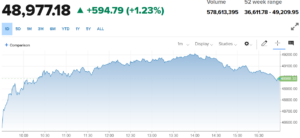
*CNBC, DJIA, January 5, 2026
- A lot of what happened in markets Friday and will continue to impact for a few days into the new year is “window dressing” and “maintenance” … This may involve selling things one wanted to sell last year but waited to do so until this year for tax reasons, and it may involve the opposite (buying back things now that were done for tax reasons last year). Just our relatively small business has hundreds of millions of dollars in tax-oriented trades that have to be unwound (and will be in our pending rebalance)
- Today, though, was all about the cyclicals. Much more to say on that “economic upside” thesis in this Friday’s Dividend Cafe!
- The Chinese yuan has moved up against the dollar consistently for two weeks, and for some reason no one is really talking about it. It is worth repeating that a major consideration for how emerging market bonds and stocks do for U.S. investors is the U.S. dollar. A weak dollar in 2025 helped drive EM returns to one of the best-performing asset classes, and this may be set to continue in 2026.
- The ten-year bond yield closed today at 4.16%, down three basis points on the day.
- Top-performing sector for the day: Energy (+2.67%)
- Bottom-performing sector for the day: Utilities (-1.16%)
- The average age of companies going public is 14 years, according to Apollo’s most recent annual report on the matter. This is a MEDIAN age, meaning clearly there are companies staying private much longer than that (not to mention those that just stay private forever). The average age of a company going public in the late 1990s was 5-7 years, so less than half what it is now. This dynamic has societal consequences to consider (I did so in a recent Capital Record podcast), but it also has investment implications, too.
- I read a lot of other strategists’ “yearly preview” pieces over the last few days and was a little taken aback by how many themes and forecasts there are that represent the status quo of what took place in 2025, or emerged as themes in late 2025. Now, to be sure, there is nothing magical about the ball dropping on New Year’s Eve, and no digit change in the year on our calendar alters markets. However, the presumption that “what was winning will continue to win” or “what was losing will continue to lose” does not have a lot of historical weight behind it, and really requires a more thematic or fundamental rationale. Are commodities to stay strong in 2026? And more of the same from late-year cyclicals? And Japan as international leader? And AI capex to continue at the same pace or higher? Well, sure. All those things could happen. But is our 2026 analysis going to look like a repeat of 2025’s actuals? No, it is not. You’ll see more Friday.
Venezuela
- The world woke up Saturday morning to the news that the U.S. had conducted a large-scale military action in Venezuela and captured President Nicolas Maduro. He was subsequently taken into U.S. custody. The U.S. has stated, for now, that it does not intend to replace the whole regime, and no further military action is expected.
- What happens next? I like Louie Gave’s breakdown of three major options:
- The current regime, ex-Maduro, keeps power. They behave friendlier to the U.S. and likely cut off activity with China, but there is no major change.
- They do decide to have a new election and to transfer power to whoever wins. This is far more complicated than I understood it to be based on eight million Venezuelans having left the country over the last twenty years.
- Infighting happens in the country, the U.S. stays out of it, and refugees increase substantially.
I also agree with Louie that the most likely scenario of the above three, and the one that those reading between the lines of Trump administration communications over the weekend most heard, is the first.
- For those looking for broader analysis or longer-term expectations of what this weekend’s events mean, I would humbly suggest that we may be in the first or second innings. It would be impossible for anyone to game out what to expect from here when so many unknowns persist.
Public Policy
- Getting a clear picture of the U.S. oil company assets in Venezuela, what the events of the weekend mean for the opportunity there, and how it will shake out for both global oil markets and the profit potential for the companies in question will all take a little time. The administration has indicated that the upside is there for the companies to go in, clean up infrastructure (much of which belongs to them from decades-old investments that were seized from them), and begin producing. However, the risk/expense/cost is theirs (as it should be) if the upside is to be theirs, and that risk and cost are problematic until there is more clarity on the future of political stability. The infrastructure there is in desperate need of repair and replacement. The reason I have this section in Public Policy (there is plenty more to say below in Oil & Energy) is that I believe it is entirely possible the administration will end up using the Export-Import Bank and/or the IDFC (International Development Finance Corp) to incentivize risk and investment. I do not mind adding – I would be vehemently against the administration doing so, even if it were to benefit companies we are invested in.
Economic Front
- In a further admission of the impact tariffs have on prices, the White House has delayed tariffs on imports of furniture and kitchen cabinets for an entire year.
- ISM Manufacturing had another month of contraction in December, coming in at 47.9 (less than the 48.2 of November). The “expansion” line of 50 has not been hit basically in over three years.
Housing & Mortgage
- While home price appreciation was barely up for the 20-city Case-Shiller Index in 2025 (+1.3% for the aggregate index), what is most interesting to me is that half of the twenty cities actually saw negative price appreciation. As you will see in the Dividend Cafe Year Behind, Year Ahead paper on Friday, I expect this to be a theme nationally in 2026.
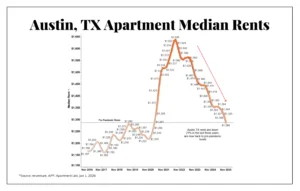
- When a market is under-built for needed supply in either single-family or multi-family residential relative to job demand and population growth, rents fly higher. That strong demand and high rent opportunity is a signal to developers to go profitably build new supply there (stop me if I need to explain this more slowly). But then, of course, the new supply absorbs all the demand, and then prices reach equilibrium, and if demand slows or supply gets to a point of excess, prices come down. Rinse and repeat. It is a reasonably basic concept in economics around supply and demand curves, yet seems to be totally ignored when it comes to understanding national housing policy. A case in point of this process playing out, in both directions, is Austin, Texas, where rents are now down 21% from their 2022 highs.
Federal Reserve
- There is only an 18% chance of a Fed rate cut in January per the federal funds rate futures market, but there is a 50% chance of another rate cut by March.
Oil and Energy
- WTI Crude closed at $58.39, up +1.87% (+$1.07)
- Major U.S. integrated oil companies were up +6-7% pre-market this morning and closed up +5% or so. The oil services companies rallied +8-9%. While the developments seem quite opportunistic, the challenge is whether or not oil prices sitting between $55 and $60 give the upside incentive to companies for billions of dollars of investment to repair the dilapidated state of Venezuela’s energy infrastructure.
- It should be said that while Venezuela is in OPEC+, it is not even in the top twenty of the world’s largest oil producers. While they produced 3.5 million barrels of oil per day fifty years ago, they barely produce one million barrels per day now.
- Midstream (and all energy stocks) ran into the new year with big gains on the first trading day of 2026 on Friday. Midstream was up +1.9% on the week.
- For 2025, MLPs ended the year up +9.8% and the fifth year in a row in positive territory.
- You know how much I hate even sharing things like this, but January has been positive for the MLP/midstream space in 24 of the last 30 years.
On Deck
- The client’s Weekly Portfolio Holdings Report on Wednesday is a comprehensive summary of the 2025 actual portfolio strategies, holdings, review, and outlook. There will also be a video for those who prefer that medium.
- And in case I haven’t hyped it enough, the Friday Dividend Cafe is our annual Year Behind, Year Ahead white paper!
I’d guess I will have a lot more to say tomorrow in the Daily Recap. The new year is off with a bang, not a whimper …
With regards,
David L. Bahnsen
Chief Investment Officer, Managing Partner
The Bahnsen Group
www.thebahnsengroup.com
The Dividend Cafe features research from S&P, Baird, Barclays, Goldman Sachs, and the IRN research platform of FactSet.