Dear Valued Clients and Friends –
So we know that the U.S. launched a successful bombing mission on Iran’s nuclear capacity Saturday night, and we know that Iran fired some missiles at a U.S. base in Qatar today (that were successfully intercepted). What we also know is that markets ended up rallying today. But there is plenty we do not know, and we will cover some of that in today’s Dividend Cafe.
Dividend Cafe on Friday looked again at the national debt picture, this time focusing on “what happens if we do nothing.” It was a bit less “Dave-land” than the issue from three weeks ago and a bit more realistic. The written version is here (my favorite), the video is here, and the podcast is here.
Off we go …
|
Subscribe on |
Market Action
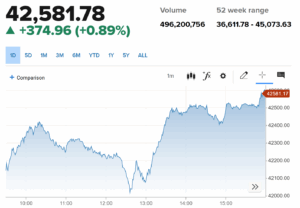
- Futures had opened down just -200 points last night, not nearly as volatile as some had been expected after the U.S. military action of Saturday night. By this morning, futures were actually up fifty points on the Dow. The market opened up today, went higher, dropped into negative territory (bottoming on word of an Iranian missile strike at a U.S. base), rallied after that effort failed, and ended up closing much higher. Keep in mind, these early-day up/down movements were a hundred points here and two hundred points there, not just normal volatility, but for many days, below-average volatility. It was like the events in Iran didn’t happen at all.
- The Dow closed up +375 points (+0.89%) with the S&P 500 up +0.96% and the Nasdaq up +0.94%.
*CNBC, DJIA, June 23, 2025
- Bonds will likely benefit as a safe haven (they were up again today). The upside for risk assets like equities is if some long-term left-tail risk proves to be removed (i.e., threat of a nuclear Iran), and the downside for risk assets is short-term enhanced volatility around retaliation and the possibility of something more prolonged.
- A VIX < $20 is not exactly the stuff war-time risk-off is made of.
- So for all the absurd claims that the U.S. bond market was in disarray, and that foreign investors were running for the hills as panic over Treasuries took over global financial markets, the total net reduction of foreign ownership of U.S. Treasuries in April was … wait for it … $40.8 billion (out of $29 trillion outstanding). 0.014% of outstanding debt. And foreign central banks were net BUYERS of Treasuries (meaning the minimal sales that took place were all private owners). Japan was a net BUYER. The UK was a net BUYER. This is the chart that we were told would show Canada was messing with our bond market. Yes, they really seem to be running from U.S. Treasuries … (ay yi yi) h/t Peter Boockvar
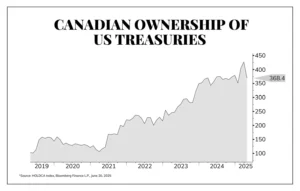
- I should add – foreign ownership of U.S. stocks is at an all-time high.
- The ten-year bond yield closed today at 4.34%, down 3.3 basis points on the day.
- Top-performing sector for the day: Real Estate (+1.49%) and Consumer Staples (+1.3%)
- Bottom-performing sector for the day: Energy (-2.51%) – the only negative sector
- I think the biggest thing to watch in the coming days for markets is what, if any, impact all of this Iran “stuff” has on U.S.-China discussions. Could China take a more conciliatory approach with Iran than the U.S. wants, and have that jeopardize progress in the trade war? Perhaps. My sources do not suspect that it is the base case, but it is the area I want to watch most.
Top News Stories
- Obviously, the biggest, if not only, story of the weekend was the U.S. attack on Iran’s nuclear facilities. The mission appears to have been a success, and satellite imagery appears to indicate monumental damage to Iran’s underground nuclear sites. Whether or not some stockpiles of uranium had been moved prior to the bombing is not clear, and what retaliatory measures Iran may attempt are also unknown.
- Congratulations to the NBA champion Oklahoma City Thunder, who won Game 7 last night to win their first ever NBA championship.
Public Policy
- With all the Iran action, some have forgotten that this is possibly a make-or-break week for the “big, beautiful bill.” The Senate Parliamentarian is hearing a lot of substantive arguments now regarding what should and should not be included under the Byrd rule, and while a few smaller rulings have already been made (some helping the GOP and some not), the bigger ones are still to be determined.
- The so-called PTET deduction that allows pass-through entities to pay state tax bills through the LLC or S-corp entity and then deduct from the federal reportable income that is passed along to the entity principals is removed from the House version of the bill, and in the Senate version it limits the deduction to the greater of $40,000 or 50% of the benefit of the workaround. So while many are focused on the headline amount of the individual SALT deduction cap, something immaterial to the 85-90% of tax filers who do not itemize within the proposed income limits, the small business ramifications will prove far more material in the end, with a wide open outcome at this present time.
Economic Front
- The U.S. Census Bureau asked 1.2 million firms if they were using AI to help produce goods or services, and 9% responded that they were. That number may seem low, but it is actually even lower when you consider that it includes not just machine learning and language processing, but even more routine things like voice recognition and virtual agents. AI bulls may look at this and say, “Look at all the room for growth,” while AI bears may look at it and say, “That’s it?” What you should say is, “We’ll see; maybe it is less about how many use AI in their process and more about the magnitude of efficiency it builds in the aggregate.”
Housing & Mortgage
- Existing home sales increased +0.8% in May even as sales are down -0.7% from where they were a year ago. The median price of an existing home is up +1.3% from where it was a year ago (a third as much as the CPI shelter indicators)
Federal Reserve
- The Bank of England left rates unchanged last week, but by a 6-3 vote, as pressure for additional rate cuts continues.
- Don’t look now, but futures have creeped up to a 23% chance of a rate cut next month.
Oil and Energy
- WTI Crude closed at $67.19, down -9%. Oil had hit $77 Sunday night (up +4%), but that didn’t stick. I think it will take disruption to supply out of the Strait of Hormuz to see oil get near $80/barrel, and after today’s action, markets may not think $70 is on the table, let alone $80.
- Expectations that Iran might close the Strait of Hormuz have not yet come to fruition. Many indications are that China is exerting some influence to keep Iran from disrupting oil flow out of Hormuz, but I would be hesitant to draw any firm conclusions at this time.
- The President’s jawboning today that “everyone should keep oil prices lower” should be taken as, well, jawboning. Markets set prices. There was a time when I got upset about Presidents or political figures trying to do prices, but I have (a) become desensitized to such things, and (b) don’t take this all that seriously.
- What drove oil prices down so much, so quickly, late today? Iran’s half-hearted response with its feeble and failed missile launch seemingly gave markets confidence that Iran’s ability (and willingness) to throttle world oil markets may not be living up to the hype.
Ask TBG
| “How can S&P 500 company earnings be forecasted to grow at 15% when nominal GDP growth is likely to be 4% to 5%?” ~ Simon H. |
| S&P earnings have averaged 6-7% growth per year, not 15%. This year, the expectation is 12-14%, but that is an outlier.
Earnings in five hundred companies can and often do outpace nominal GDP growth when some companies are outcompeting others and when margins are expanding. Nominal GDP and corporate earnings have very little annualized correlation over a hundred years. |
On Deck
- President Trump will be in Europe tomorrow for the annual NATO Leaders Summit.
- The New York City mayoral primary is tomorrow, where the top two candidates are socialist Zohran Mamdani and former New York Governor Andrew Cuomo.
- This Friday’s Dividend Cafe will be devoted to the subject of the Middle East, to market response to war and geopolitical instability, and to all those adjacent topics.
RIP to Federal Express founder and American hero Fred Smith, who passed away Saturday evening at age 80.
I am in our new Grand Rapids, Michigan office for the next few days before returning to New York City Thursday afternoon. Reach out with questions anytime, and God Bless America.
With regards,
David L. Bahnsen
Chief Investment Officer, Managing Partner
The Bahnsen Group
www.thebahnsengroup.com
The Dividend Cafe features research from S&P, Baird, Barclays, Goldman Sachs, and the IRN research platform of FactSet.