Dear Valued Clients and Friends –
It was another day of intra-day volatility, another day of prior winners losing and prior losers winning, and a whole weekend of news and info that makes today’s Dividend Cafe around the horn quite worthwhile.
I was on Varney/Fox Business for the opening hour of market trading this morning, and a highlight reel can be found here.
Dividend Cafe on Friday looked at this bull market we have been in (regardless of when you think it started), and talked about the “data purgatory” in the things that might end it. The written version is here (my favorite), the video is here, and the podcast is here.
Off we go …
|
Subscribe on |
Market Action
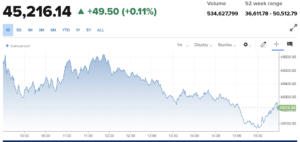
- Markets opened up +350 points this morning and slowly gave it up throughout the day, with the S&P and Nasdaq going negative mid-day …
- The Dow closed up +50 points (+0.11%) with the S&P 500 down -0.39% and the Nasdaq down -0.73%.
*CNBC, DJIA, March 30, 2026
- The Nasdaq was down over -10% entering today, and the S&P was right behind it. Most of the Mag7 stocks are down over 20% (Microsoft and Meta are down 35%. Bitcoin is down almost 50%, and the Bitcoin Ponzi stocks like MicroStrategy are down nearly 80%. The most well-known AI stocks are down from 20% (Nvidia), or 35% (Palantir), or much more (Oracle and CoreWeave). Some of this can be attributed to the Iran war, at least to the extent that the Iran war has exacerbated a “risk off” posture that makes the highest-valued stocks most vulnerable. But no, I am not convinced this is an “Iran story,” as all of it was in motion to some extent well before the military operation began.
- One thing I will say is that few people are talking about if the current market volatility expands or prolongs to a more significant point … There has been a massive expectation for the IPO calendar for some of the most expensive and high-profile unicorn private companies in history in 2026. From SpaceX to Anthropic to OpenAI to slightly lower-tier but significant companies like Databricks and Shein (and others), trillions of dollars in market capitalization are expected to get a public valuation in 2026, with hundreds of billions of dollars of that valuation expected to end up in the hands of public investors. But IPO’s have a very funny way of disappearing when markets act sketchy enough for long enough.
- The ten-year bond yield closed today at 4.35%, down nine basis points on the day.
- Top-performing sector for the day: Financials (+1.10%)
- Bottom-performing sector for the day: Industrials (-1.61%) and Technology (-1.49%)
- Of all the predictions I refuse to do, the one I most want to do but won’t is that the long end of the yield curve is too high and that the term premium is unlikely to last once some certainty/stability/clarity is found in Iran and with oil prices. In fact, markets being discounting mechanisms as they are, may very well reprice sooner than that. The short end is what it is, and inflation will be what it will be, but real growth is not high enough to warrant a 4.5% 10-year, and the spread between where the fed funds rate is or will be and what the 10-year is is just too high.
- It is no surprise to see what has performed well since the war began (commodity producers, railroad stocks, refineries, energy and energy-adjacent, materials, and industrials). It is likewise no surprise to see that rate-sensitive sectors have not done well (REITs, Utilities, Financials) because rates have crept higher. But for some rates, going higher is a surprise (upside oil prices have beaten out what would often be a “flight to safety”move). And for others, gold (and other “safe haven” thoughts) dropping as they have is a surprise. What I would suggest for investors in this fifth week of the conflict, as a rather clear case for not disrupting what was hopefully a cogent investment plan before the operation began, is this: Many things that seem like obvious investment implications to something are not so obvious after all; consensus is wrong all the time. AND, many things that were obvious already materialized, and investing in them four or five weeks later may be a fool’s errand.
- The market may be down over the last month, but the relative performance of equal-weight over cap-weight, value over growth, and broad market over Mag7 has all continued (albeit with marginally negative absolute performance, but continued positive relative performance).
Iran War
- It remains very unclear to mere pedestrians like us what negotiations are taking place between the U.S. and Iran, if any. My best guess from as much inquiry as I could muster is that talks are happening, with Pakistan involved, but Iran’s public denial of such talks is necessary for their own domestic propagandist reasons. I also suspect the talks are superficial at best, with time being used to get U.S. ground troops into the region. But this morning the President said that the U.S. is “in serious discussions with a new and more reasonable regime.”
- What the U.S. intentions are with Kharg Island remains one of the biggest questions in the current state of the operation.
Public Policy
- There may be a deal to secure funding for TSA employees and address lines at certain airports, but the overall DHS funding stall continues.
- The Department of Labor released its proposed rule to enhance access to private markets inside company 401 (k) accounts.
- David Sacks, the Silicon Valley billionaire who has been the Trump 2.0 administration’s “crypto and AI czar,” is no longer in that role. It is not clear to me if this is because the President is looking to separate from some of the direction Sacks has recommended the administration take in these domains, or simply because his time was up.
- A federal judge ruled with Anthropic late last week, temporarily blocking the Pentagon’s attempt to label the AI language modeling company known for Claude as a “national security risk” and “supply chain risk.” The Trump administration is appealing the ruling.
- In what would make me one happy guy, there is talk that the President will withdraw his nominee for Surgeon General, Casey Means, after the nomination stalled in the Senate as irreconcilable.
Housing & Mortgage
- Traffic of prospective buyers of new homes remains at extremely low levels (NAHB)
Federal Reserve
- Futures right now reflect an implied probability of 79% that rates end the year where they are now (in the fed funds rate) with a 7% chance of a quarter-point hike and a 14% chance of a quarter-point cut. I’m predicting the latter.
- I wrote about financial conditions in Friday’s Dividend Cafe. A 10-year that is 40+ basis points higher than it was a month ago (though it was lower today), high-yield bond spreads that are the highest they have been in over a year.
Oil and Energy
- WTI Crude closed at $104.19, up +4.6%.
- Midstream again had a quite positive week in a quite negative equity week, with midstream up well over +3% on the week (and now +25% on the year), even as the S&P was down over -2% again last week.
- For all of the talk about the damage done by Hormuz’s closing, and oil prices going from $70 to $100 is a big story, one could argue the even bigger story is that they have not gone up much more. Middle Eastern oil benchmarks have traded well above $150/barrel. It appears that the vessels Iran has let through to get oil to Pakistan, China, and India are making some difference, and certainly on the U.S. side, our massive production capacity has kept this as “a huge problem” rather than “a fatal catastrophe.”
- The Wheatstone LNG facility in Australia incurred significant damage from last week’s cyclone and will be largely offline for a couple more weeks, impeding Australia’s domestic production needs and impacting global supply. All limits around global LNG production have been a boon for (a) U.S. LNG exporters, and (b) Russia.
Ask TBG
| “There are two areas you should talk to experts on even if the war does not escalate over the next two weeks. Australia’s diesel shortage and Taiwan’s LNG shortage appear to me to be the first real breaking points in the global economy. Since the war started 10 year yields have gone up by 50bps and the negative correlation between U.S. government bonds and risk assets has broken down. If these do not reverse in the next two weeks you will see financial markets really begin to buckle. Markets really move not when people want to buy or sell, but when they need to.” ~ Name Withheld |
| The 10-year has not moved 50bps, but it was over 40bps (less after a huge bond rally today), and there normally would be a correlation between risk-off and bond yields dropping. However, the problem with his assessment is that the 10-year moved … to a whopping 4.4% – the average it has been for about four years now!!
That financial markets break when there is forced selling is a tautology. And there has not been much forced selling, yet. But if the question is, “if markets drop further, will there be forced selling and is forced deleveraging bad?” the answer is … yes. But whether or not we get there, and when and how severe it is if we do, are all the actual operative questions that no one knows the answer to. Most of Australia’s damaged production capacity is relevant only to its domestic needs, according to all the research I have done. The impact at Wheatstone is primarily about their LNG production, and all limits around global LNG production have been a boon for (a) U.S. LNG exporters, and (b) Russia. |
On Deck
- Q1 comes to an end at the close of trading tomorrow.
- Clients will receive their standard Weekly Portfolio Holdings Report on Wednesday morning, but the quarterly review version will have to come the following week.
- The end-of-week Dividend Cafe will come on THURSDAY (not Friday) due to the Good Friday holiday and Easter weekend.
Reach out as needed, and may it really be true that spring is here in NYC.
With regards,
David L. Bahnsen
Chief Investment Officer, Managing Partner
The Bahnsen Group
www.thebahnsengroup.com
The Dividend Cafe features research from S&P, Baird, Barclays, Goldman Sachs, and the IRN research platform of FactSet.