Dear Valued Clients and Friends –
Just jumping right in this week …
Dividend Cafe did a deep dive into private markets, looking at the state of private credit and private equity, and seeking to answer the question many are asking: Is there systemic risk building that many will ignore to their own peril? The written version is here (my favorite), the video is here, and the podcast is here.
Off we go …
|
Subscribe on |
Market Action
- The market opened flat today, dropped over 400 points early, retraced half of that, and then stayed level from there the rest of the day.
- The Dow closed down -226 points (-0.48%) with the S&P 500 up +0.17% and the Nasdaq up +0.49%.
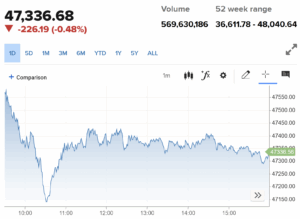
*CNBC, DJIA, November 3, 2025
- This seemed interesting to me:
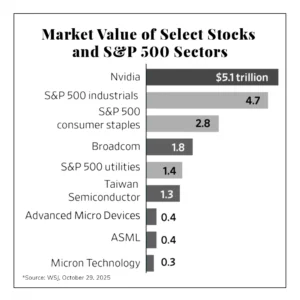
- I have my own opinions about the valuation of current “big cap growth” companies, mainly those tied to the AI capex narrative, but it is worth noting that the “equal weight” S&P 500 is doing just fine (an all-time high last week). Now, everything may be over-valued, and some things may be more over-valued than others (I’ll take that one), but there is hardly a technical or internal weakness (at this stage) in the S&P 500 ex-AI capex, either. In 1999, everything else was breaking down long before the March 2000 collapse of the Nasdaq. Plenty of things can and will be different this time, but the history is worth noting. That said, just 56% of the S&P 500 is currently above its 200-day moving average, which is not terrible in terms of internal strength but is hardly good, either.
- Speaking of history and all that jazz, 2025 has been the 20th best “first ten months” in performance in the last eighty years. In 24 of the top 25 years, the Nov/Dec performance was positive. For whatever that is worth.
- The ten-year bond yield closed today at 4.10%, flat on the day
- Top-performing sector for the day: Consumer Discretionary (+1.70%)
- Bottom-performing sector for the day: Materials (-0.56%)
Top News Stories
- Consumer staples giant Kimberly-Clark announced the largest consumer goods M&A deal of the year (and the third-largest transaction of any sector), buying Kenvue for $48.7 billion (in a combination of stock and cash). I do want to thank the plethora of doctors and scientists who reached out after my coverage of the absurdities recently stated by the administration about Tylenol, supporting my position with extensive science and analysis. I learned a lot from what you sent, and became even more appalled at what just transpired. I think it is safe to say that Kimberly-Clark’s medical and legal teams have reviewed the matter, too, and have agreed with you!
Public Policy
- Most of what I want to say today in the Public Policy realm concerns the U.S.-China “deal,” and I have a lot to say there. But I am dedicating the whole Dividend Cafe to it this Friday and believe that will be a good place to absorb the whole thing with proper detail and understanding.
- The Supreme Court hears the appeal this Wednesday on President Trump’s claim of an “economic emergency” to justify tariffs imposed unilaterally by the President without involving Congress. While the court will not rule this week, it is possible we will get an “indication” of where it is headed by the questioning the judges offer.
- President Trump continues to push hard for an end to the filibuster. Thus far, it appears there is nowhere near the support needed to do such a thing from other Republican Senators (thank God)
- There are elections tomorrow in this weird off-year deal for New York mayor, Virginia Governor, and New Jersey Governor (amongst others).
Economic Front
- ISM Manufacturing declined to 48.7 for October, marking the eighth consecutive month of contraction for the sector. New Orders, Production, and Employment were all negative, with only Supplier Deliveries in positive territory. 12 of 18 sectors were negative.
Federal Reserve
- So Jerome Powell poked the bear of the White House last week by hinting that “they may not cut rates in December,” and the futures market swooned from near 100% to something closer to 55% (in terms of odds of one more rate cut this year). As of now, that number sits at 67%.
- It is clear there was ample dissent at the meeting, with Stephen Miran again voting for a 50bp cut, and one Fed president (Schmid) voting against a cut.
- So the Fed funds rate sits in the 3.75%-4% range, and quantitative tightening is officially over, with the Fed planning to freeze its balance sheet at its current level of $6.6 trillion. They have successfully reduced $2.5 trillion of the $5 trillion COVID expansion they previously enacted, which I freely admit is more than I thought they would reduce without causing conniptions in credit markets. I think this quote from my good friend, Brian Wesbury, of First Trust, summarizes things perfectly:
“At $6.6 trillion, the Fed’s balance sheet is multiples larger than it was before the Fed’s decision to begin quantitative easing back in 2008, shifting the financial system from a scarce reserve system to an abundant reserve system where the Fed paying banks – not the banks bidding based on demand – dictates rates. We could debate until our faces turn blue the many unintended consequences and policy mistakes associated with QE, but for now the Fed is moving toward a more ‘neutral’ stance with regard to their holdings, and by keeping the balance sheet size constant, it will gradually shrink as a percent of total financial market assets.”
Oil and Energy
- WTI Crude closed at $61.01, pretty much flat on the day.
- Oil was flat on the week, and natural gas rolled from its November to December contract (up +3% or so). Midstream was pretty flattish on the week.
- With midstream now having had three months in a row of negative returns, I do notice a lot more midstream companies announcing stock buyback plans than normal (adding to distribution plans, not replacing them). This makes a lot of intuitive sense to me, given current valuations.
- OPEC+ agreed to another small output increase for December but said it will pause additional output hikes from there for the next three months. Supply has built enough, and demand has been constrained enough that this appears to be ample in terms of policy objectives.
Ask TBG
| “When you say that the Fed funds rate decreased to a range of 3.75 to 4.0%, please explain what that means to us laymen. Does it mean that what the Fed charges the banks can move within that range? Is the reason for the range to allow for more flexibility? If so, when does the Fed charge the lower rate and when would it charge the higher rate?” ~ Rod M. |
| The Fed has to leave flexibility for reserves, and by setting a tight range, it leaves operational bandwidth. The primary tool the Fed uses to effect interest rate policy is open market operations, and they can’t ensure that every single transaction happens at the exact same yield, so a range gives bandwidth and allows them to use their “open market operations” (buying and selling) to effect that range. Banks lend reserves to each other overnight, and the Fed sets the target they want achieved, but market forces can move things within a small range, so they set the target within their desired range to allow that flexibility. |
On Deck
- I will be doing a “Daily Recap” per usual tomorrow and Wednesday, but there will not be a podcast on those days. Thursday, there will be no Daily Recap email or podcast. And on Friday, there will be all the usual Dividend Cafe releases, with this week’s topic being everything going on between the U.S. and China! The reason for a few edits to the normal content calendar is that our entire TBG team is in Dallas, TX, for the rest of the week for our annual off-site, major team meetings and bonding events, which means travel and various schedule adjustments, and slightly modifies what we can produce and release. It is a very special (and productive) week for TBG and all ~90 of our employees (our last team off-site had 67 people, so we have grown a bit since then). Thank you for understanding!
- Clients will receive their usual Weekly Portfolio Holdings Report on Wednesday morning.
And with that said, on this fine Monday night, Go Cowboys!
With regards,
David L. Bahnsen
Chief Investment Officer, Managing Partner
The Bahnsen Group
www.thebahnsengroup.com
The Dividend Cafe features research from S&P, Baird, Barclays, Goldman Sachs, and the IRN research platform of FactSet.