Dear Valued Clients and Friends –
There is enough market action to cover today that I skipped the “top news,” but there really is a lot today in the Dividend Cafe.
On Friday, Dividend Cafe looked at the Energy investment story we believe in at TBG. The written version is here (my favorite), the video is here, and the podcast is here.
Off we go …
|
Subscribe on |
Market Action
- Markets opened down -300 points this morning, got a bit better at one point mid-day, but sold off to the low range of the day by the close.
- The Dow closed down -347 points (-0.67%), with the S&P 500 down -0.77% and the Nasdaq down -0.92%.

*CNBC, DJIA, September 28, 2026
- The markets seem great, right? The S&P 500 is not far from an all-time high, right? In what is perhaps the strangest sentence to write in a long time in a Dividend Cafe, 60% of the names in the S&P 500 are down 20% or more (bear market), with 60% below their 100-day moving average, even as the S&P sits very near an all-time high. This is nearly the worst breadth we have seen (not quite).
- But wait, there’s more … Friday was the ninth day in a row – nine consecutive days – of more 52-week lows than highs – while the index is within a whisker of its all-time high. And this stat can be deceiving, but it is still mathematically correct (and crazy!): 430 companies in the S&P 500, put together, are currently down -21.7%. Now, some in that 430 are down more, and some are down less, so it is not true that 430 companies are in a bear market, but the weighted average of 430 companies is not just down, but down -21.7% – while the total market is very near an all-time high.
- So, you ask, why does that matter? Well, maybe it doesn’t. It is true that the only times the statistical (lack of) breadth described in the above bullets has ever been seen before were 1973 and 1999, but a skeptic of this market concentration and market valuation like me would not claim that there is a timing mechanism here, or an assurance of historical repetition. But I will say I am grateful for chapter three of my new book.
- The ten-year bond yield closed today at 5.23%, up five basis points on the day.
- Top-performing sectors for the day: Consumer Staples (+0.40%), Health Care (+0.29%), Energy (+0.22%)
- Bottom-performing sector for the day: Communication Services (-1.67%)
- Nvidia announced a $150 billion stock buyback authorization as an addition to the current buyback authorization, bringing the total to $235 billion. In the last two years, they have issued 300 million new shares to employees (roughly half of what they have bought back). They HAVE reduced share count, but since 2024, with massive stock buybacks, the share count is just down a tad.
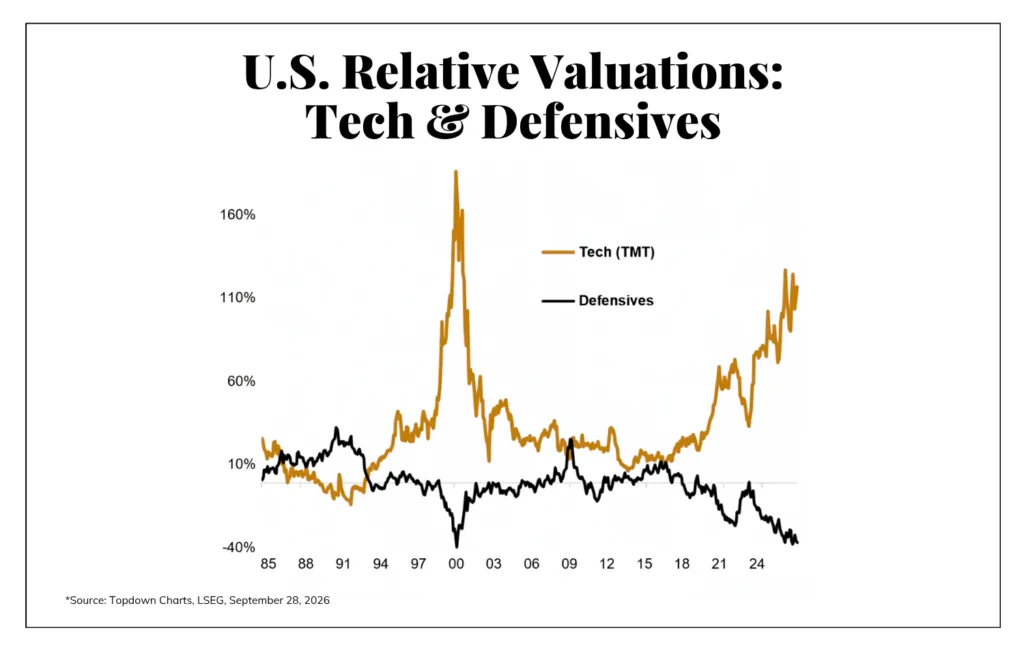
- The market action over the last few weeks is not hard to describe … Yield-sensitive spaces got hit while the AI/mega-cap trade came on strong. Every move this year has been rotational, not risk-on or risk-off. Utilities and Financials are the two most oversold sectors. What is overbought doesn’t even need to be identified. But it is very important to point out (for those of us in a long-period of sideways range-bound movement school of thought) – the big beneficiaries of the last couple of weeks have largely been consolidating for quite some time. The recent move in the consolidation has been to the upside, but if you look at the YTD or trailing-12 moves for most (not all) of the ten largest names, the returns are often negative or “flattish” … These rallies inside a multi-year consolidation are very, very common.
- Valuations matter. Relative valuations matter. Callum Thomas calls this a Relative Value Rubber Band … He’s not wrong.
Public Policy
- The meetings with China last week were fascinating for how much things have changed in tone and tenor, and how little things are changing in substance and policy. The tone and tenor have become dramatically friendlier and more cordial, and things like China playing a role in ending conflicts in Iran and Ukraine have not moved at all. The current trade levels have all been extended, and a softening of certain restrictions is expected in the months to come.
- The national press coverage of the Republican prospects in the midterms has grown so negative, and the prediction market odds have moved so much against the Republicans that the contrarian in me almost feels like it can’t possibly go as badly as is being anticipated. Kalshi now has odds at 62% of a Democrat majority in the Senate. Republican strategists are not claiming things are better behind the scenes. What I do know is that the money advantage for the GOP in the final 4-5 weeks is substantial, but if polls, prediction markets, internal surveys, and general sentiment are to be believed, the general direction of what is coming is already known. That said, margins matter, and if I cared about these things, I would be advising both sides to start playing the expectations game. But moderating expectations is not the stuff clicks and ratings are made of.
- I will add this … and maybe I am just dead wrong about how bad for the GOP it will be in five weeks … I am totally open to the idea that Texas might flip its Senate seat (I by no means believe that is a done deal, but I think anybody saying it can’t happen are ignoring significant empirical evidence to the contrary; but it does require overcoming some very challenging headwinds). However, reports that Senate seats in South Carolina and even Mississippi are up for grabs are, well, I suspect, not serious. Again, if a blue wave proves that dramatic, then it means a lot more than people think. But those are the kinds of things I am talking about when it comes to “expectations.” That is “black swan event” type stuff in the political universe.
Economic Front
- Durable Goods Orders for August were unchanged, and down a little when factoring in past months’ revisions. Orders are up +8.5% year-over-year.
Housing & Mortgage
- 20% of listed homes saw a price cut in August, the highest percentage in a single month since 2020.
- There are now 1.5 million homes for sale, up 46% since 2023. Time to sell has risen to 50 days (on average).
- There are 58% more sellers than buyers right now, the highest delta we have ever seen since this data began being nationally tracked in 2013.
- A quote from a great Bloomberg article on the state of the commercial office market:
“Occupied space has climbed in parts of Dallas, Atlanta and Miami along with growing populations and corporate relocations, according to a July report by Capital Economics. On the flipside, Chicago, Los Angeles and Portland, Oregon, are among the metro areas where vacancies continue to grow.
New York has seen robust office demand from finance, legal and tech companies that are competing for new or renovated spaces near major transit hubs. Manhattan is on pace for its strongest leasing year since 2000 if the momentum continues, according to real estate services firm Colliers. San Francisco, while still home to one of the country’s highest office vacancy rates, has seen a real estate resurgence thanks to an artificial intelligence boom“
Federal Reserve
- The Fed’s proposal on bank supervision will be to raise the asset thresholds for large banks to become subject to stricter oversight, reindexing the threshold for the most stringent of requirements to $960 billion (currently $700 billion). They will also be raising the threshold for the lowest tier from $100 billion to $150 billion.
Oil and Energy
- WTI Crude closed at $93.06, up +0.70%
- While Friday’s Dividend Cafe was an extensive evaluation of the energy sector, inclusive of supply-demand dynamics playing out in the Persian Gulf, it is worth noting that Secretary Bessent claimed over the weekend Iran is down to 15 million barrels on the water, and that their final deliveries to China are about to happen, with nothing left beyond that. It is, of course, impossible to know what is true and not true, but that leverage changing would likely catalyze at least a page turning in this rather boring saga.
- High rates caught up with midstream last week (and all yield-sensitive sectors – Utilities were down over 3% on the week, etc.) Oil prices were down -8% but I think the upward pressure in bond yields was a bigger factor in midstream being down -4% on the week.
- Refinery stocks, which we do not own, were hammered last week on the absurdity of the diesel export ban talk
- On the diesel fuel ban talk, we have gone from “yes, we are doing it” to “no, we are not looking at that” to “yes, it is back on – but maybe not” all in the past five or six days.
Ask TBG
| “One assumption in your bullish view of energy is the demand for natural gas, which you view as abundant. I am curious if you have a thought about those who claim natural gas supply (proven reserves, current and future contracts, etc.) is well known and we are largely at full product? If demand is so high and supply constrained, won’t prices skyrocket?” ~ Andrew A. |
| It’s as intelligent as peak oil forecasts 20-25 years ago. I do not believe natural gas supply is constrained or near constrained, yet I do believe demand is high and going higher. |
On Deck
- President Trump is hosting the leading AI lab executives at the White House tomorrow.
- Q3 will come to an end after two more trading days, and we will officially be in the final quarter of 2026.
- Next week is TBG’s annual Money Manager Week, and Brian, Kenny, and I are set to meet with ~20 of our major money manager partners in the city. We are all fired up for the discussions, and per usual, we will do a Dividend Cafe recap of all the discussions.
More to Chew on
- If you didn’t think it was perfect, you haven’t seen Dario talk
- For those into rocket launches and things like that
- When you need a bodyguard from your bodyguard
- Cook Political Report adjustment of House race forecasts
**********************************
I am speaking at an investment conference at the end of the day today and headed back to NYC early tomorrow morning, where I will be for the rest of the week. Reach out with any questions anytime, and make it a great evening!
With regards,
David L. Bahnsen
Chief Investment Officer, Managing Partner
The Bahnsen Group
www.thebahnsengroup.com
The Dividend Cafe features research from S&P, Baird, Barclays, Goldman Sachs, and the IRN research platform of FactSet.