Dear Valued Clients and Friends,
Today’s Dividend Cafe is not about the investment merits of Artificial Intelligence. It is not about the euphoria in the space, the investment setup from which returns are coming right now, or why a fiduciary investment advisor should not be changing how they manage money in this current AI moment. It is also not about the increasing risks for hyper-scalers or the valuations of those providing computing power. It is not an investment manual for or against AI. All of that was last week. If you did not read last week’s Dividend Cafe and the last few sentences are of interest to you, I recommend reading last week’s edition first. All of that context is important before reading this week’s Dividend Cafe.
If this week’s Dividend Cafe is also AI-centric but is not “investment” focused, what exactly am I talking about? And why should anyone read it if there are no investment implications, and this is an investment commentary? Well, truth be told, there are absolute investment implications from this week’s Dividend Cafe. In fact, there is significant macroeconomic relevance to this week’s subject. One of the growing arguments in this AI moment is that, even apart from the investment moment (whether it be a “revolution” or a “bubble”), a paradigm shift is coming that will leave tens of millions of people unemployed. The AI moment is considered by some (very, very often the same people) to be (a) an investment opportunity that we should be buying with both hands without asking questions, and (b) an economic hurricane that will decimate labor markets everywhere. I addressed that first issue last week and will address the second one this week.
I freely admit that my vision of a free market economy is one that maximizes opportunity for gainful employment. I have a tad bit of historical support on my side throughout the history of classical economics. Something that leaves (most of?) society unemployable is not something I would consider good for economic growth. And there is so, so, so much wrong with the school of thought predicting this economic calamity that it warrants this complete Dividend Cafe treatment.
Let’s once again allow history to illuminate our path and properly inform our understanding of the future. It may very well cheer you up, but I didn’t write it for that purpose. This week’s Dividend Cafe is meant to remind all of us about some very important first principles. If that kind of thing cheers you up, so be it. Let’s jump into the Dividend Cafe …
|
Subscribe on |
The AI Revolution
The fear at hand is quite simple: Generative artificial intelligence can do so much that, over time, it will severely diminish the need for human beings in various economic tasks. Functions like data entry, customer service, content creation, administration, bookkeeping, and financial modeling are most frequently cited as highly vulnerable to the improved efficiency that AI represents.
Ironically, the reports about what jobs have already been replaced by AI seem incredibly low and undramatic compared to the reports of job displacement predicted for the future. The best studies I found indicated that, to date, job losses directly attributable to AI number in the tens of thousands, not even close to the millions some are fearing. The latest report from Challenger, Gray, & Christmas put the year-to-date number in the entire United States private sector at 17,375, while other reports indicate a figure of 27,000. Even Goldman Sachs, which you will see below, has contributed a report to the “long-term job deterioration from AI” thesis, estimates that this AI transition period (short term) is only going to increase unemployment by half a percentage point. While there is no need to downplay future projections, it is important to note that we are discussing a predictive story, not a descriptive one.
And on that descriptive front, the hand-wringing is pretty severe. I have read reports suggesting that 30% of the workforce will be replaced, while other reports indicate that 50-60% will require major adaptation. Whether it is Goldman Sachs, McKinsey, or the World Economic Forum, there is an abundance of institutions sounding the alarm of global job displacement. And while many of these organizations are proposing somewhat different numbers, dates, and specific vulnerabilities, the common thread is that AI is going to “re-shape” the labor market, and not in a positive way.
At first glance, it seems pretty underwhelming to merely state that increased automation limits the need for certain, let’s say, customer service functions. Automated reservation systems and other digitized solutions have been replacing human agents for a long time, now, well pre-dating AI. I will let you answer how much you have appreciated or enjoyed that. But outside of customer service functions, there is no question that the recognition and capture systems of AI will provide an enhanced data entry capability that changes the way these kinds of functions are done (to the betterment of the companies using it and the customers these companies serve). Other public-facing examples of automation (kiosks, self-checkout counters, etc.) are works already in progress, also predate AI, and, yes, are sure to accelerate as AI optimizes their performance and makes for an even better (and more profitable to the company) customer experience.
The bigger claims of the “AI is coming for your jobs” crowd are not in the obvious categories where automation was already evolving. More “behind the scenes” roles are said to be evolving, with generative AI able to do things quicker and better (and cheaper) than humans can do them. The back-end operations and logistics of inventory management are considered low-hanging fruit for AI to work its magic. I have already seen elements of financial modeling that are substantially enhanced by AI, leading to components of credit analysis and deal underwriting that are less human-intensive than they used to be.
Other claims are more speculative. We know that AI can generate all sorts of content, but whether or not writers, musicians, and video makers are all on the chopping block remains to be seen. I don’t want to go down this rabbit hole because I know many have strong opinions on the subject, but it is at least a prima facie consideration as to what functions in content creation will become less human-intensive. And by the way, this forecast has even been made regarding actors and actresses that will be “replaced” by AI characters … Again, these speculative allegations are less concrete than the aforementioned categories, but I mention them because the concerns about future joblessness go deep and wide.
Some have said AI’s impact will be felt far beyond the more “entry-level” or “lower pedigree” jobs of customer service and data entry. Certainly, many attorneys have turned to utilizing AI as a research resource, but let’s just say it hasn’t always gone well. I mean, sometimes it can be funny, but it doesn’t give one the impression that ChatGPT is about to replace our legal counsel any time soon. I would rather root for UCLA in a football game than use any AI tool to actually write material for me, but I certainly have found the speed and depth of certain AI tools’ capacity to be useful. White collar professional jobs are going to be impacted, too, though perhaps less through more replacement and more through enhancement. The jury is still out on some of this (see what I did there).
In summary, AI represents functionality that is already altering the landscape of certain professions for the simple reason that it can do some things better than humans can, and it can do some things cheaper than humans can. A lot of the forecasts regarding future AI impact on labor are speculative, and indeed, many are imaginative and dubious. Regardless, the fact that AI presents, and will continue to present, a disruption and displacement moment in various labor categories is indisputable.
History’s Rhymes
The Industrial Revolution created the same level of hand-wringing that AI is now. For one thing, the Industrial Revolution did render millions of jobs obsolete, so there was plenty of reason to accept those concerns at face value. But I would suggest that the AI concerns of 2025 are similar to the Industrial Revolution in this sense: They are flawed not for what they do predict, but for what they fail to address. They deal with certain visible concerns, but not invisible opportunities.
Scores of books have been written that elaborately document this truth, so I will lean into simplicity and succinctness when I say that the Industrial Revolution restructured the economy to require less agricultural labor and more industrial labor. A less impressive way to put it is that many things previously done by hand are now done by machines. Of course, those machines had to be built, operated, repaired, installed, and managed, and so all at once, mechanization was (a) doing things better and quicker, and (b) still requiring ample human labor.
There was a transition, and a lot of people didn’t like it. It did increase unemployment for a time, particularly in jobs related to functions now performed by machines that humans previously did. If one were a person displaced during the Industrial Revolution, the macro point I am about to make might have seemed less relevant. But what we know about total employment is that the workforce went from 18.1 million people in 1880 to 40.5 million people by 1920.
That is right. This period of “unprecedented job loss” actually saw the total number of jobs more than double.
This did not happen easily. I am not belittling the social angst it created, and I am certainly not minimizing the temporary strain it surely generated for individual people and families. The vast amount of new jobs created often required new training and, in some cases, relocation. Fortunately, the country was highly dynamic, and that economic dynamism resulted in a mobility that served this transition well.
It is fundamentally dishonest to claim that computers have not displaced jobs before. It has been happening for decades now. The displacement has proven to be much more of an alteration than a removal, though. Computers have been altering the work humans do for a long, long time, and no one I know can even imagine society without this having happened. Not only is the notion of AI machine learning not the first time computers have entered the fray as agents of change, but the very introduction of computers was hardly the first time that technology itself became disruptive in how we work. I will go so far as to say that, properly understood, history is largely a case study of how new technologies and advancements change but do not replace human endeavor.
I was unable to reach the cavemen I wanted to interview for my research project, but I am confident that the empirical data is sufficient to demonstrate how improvements in the way we produce goods and services have not only made our standard of living better, but have also employed more people. This was true when the wheel was invented, when ancient Egyptian assembly lines were fine-tuned, and when the steam engine transformed factories, transportation, and the like. And yes, in the 20th century, and now into the 21st century, this has become exponentially true with computers and digital technology.
Since I was in Kindergarten, the United States has created an astounding 68.7 million net new jobs. I went to Kindergarten in 1979. We had 3 million people employed in the digital economy in 2008 (not exactly ancient history). There are 28.4 million employed there now. In less than twenty years, we have created over 25 million new jobs as a result of one sector’s growth and innovation. 56 million of those 68.7 million net new jobs over the last 45 years are new components of the service sector. We experienced robust job growth in our total services sector as changes created by digital age disruption created new needs and opportunities. Whether it be food or hospitality, health care, social assistance, recreation, warehousing and storage, financial services, education, or any number of vital areas of the U.S. economy, brand new positions, needs, and functions were born as digital technology rendered scores of other positions obsolete.
The story of the industrial revolution was repeated in the digital revolution. And I caution you against ever uttering the words, “this time it’s different.”
Some Jobs are Safer than Others
We have heard for years and years that no one wants to work with their hands—that “learn to code” is the new job advice—that technologization has trumped skilled trades. Now many are suggesting that AI is the least threatening to the very jobs long believed to be nearly obsolete – construction, electrician, plumbing, maintenance, repair, installation, etc. I would suggest that these jobs were never obsolete, but rather part of a wider cultural challenge that had more to do with workers than jobs (sound familiar?). But I also would say that even these jobs will be impacted by AI (beneficially) to the extent AI can drive efficiencies and enhanced productivity in their processes. A language bot is not going to physically lay concrete or repair pipes, but where AI can improve systems and preparation in various functions, this will be a positive thing.
The Most Important “First Principle” Out There
Human needs and wants are infinite, my friends. Anyone who does not understand this has a flawed anthropology. The simple reality underlying our approach to this subject is that as long as human wants and needs are unlimited, so is the number of jobs required to meet them. Yes, there is absolutely no question that technology like Artificial Intelligence can and will enable production to meet our wants and needs more cheaply and efficiently. However, this expansion of demand also increases employment.
Dr. Alexander Salter, a good friend and utterly brilliant economist, has said that:
“Far from eliminating work, AI will fuel the creation of new jobs to satisfy our endless wants … The doomsayers see only labor replaced. They miss the flip side: labor augmented. Growth creates jobs. AI won’t destroy employment — it will expand it.”
But Alex is too good of an economist to merely point out this counter to the “zero sum” fallacy (essentially, the AI-will-destroy-jobs mistake is believing that there is a fixed amount of work to be done, so if AI is doing more of it there will be less of it for humans to do; it misses the fact that the work which is to be done is, itself, immeasurable). If all people like myself and Dr. Salter were pointing out was that, it ought to be enough. But he takes it further. He points out the tremendous opportunity from the AI moment:
The premium it creates for those who don’t just merely do tasks (like ones AI can do), but for those who understand decision-making, and who possess and use wisdom.
So we not only have the economic understanding that AI is not replacing labor, but it is augmenting it; we also understand that such augmentation expands the opportunity set of the “really human things.”
That Which is Irreplaceable
I am more open to the idea that a substantial re-thinking of how young people are prepared for an adult professional life than I am to the idea that young people are doomed from having an adult professional life. For one thing, doomsdayism is batting 0.0000% as a lifetime batting average, and that is not even good enough to get you a spot in the Anaheim Angels starting line-up. But even apart from the permanent wrongness of the professional doomsdayers, who are always and forever members of either a grifter camp or an imbecile camp, there is a ghastly error in even what the doomsdayers are trying to address.
I have borrowed an analogy I picked up from the great Austrian economist, Peter Boettke, some time ago. Alien observers in Grand Central Station can detect patterns of trains coming and going, as well as the flow of passengers around these events. They can infer things over time with enough observations of both outcomes and patterns. But they cannot fully understand motivations, deliberations, or unexpected interruptions to the usual patterns. At a deeper human level, we discover that we understand the more meaningful aspects behind such movements. There is great practical value in what observations can produce, but there is even more value in the additive element of human interaction.
I believe those worried about AI replacing human beings fail to account for the created order of things, that human beings are uniquely made with characteristics and capacities the rest of the natural order lacks. This is an ontological statement. The very being of humanity contains irreplaceable and vital elements for market functionality. Wisdom, judgment, decision-making, empathy, and virtue are but a select sample of the “really human things” that cannot be substituted or replaced. AI can and will contribute to the information from which human beings derive understanding, but it cannot create or replicate the characteristics that absorb the information and make applications of substance from it.
The irreplaceable differentiators need to be the sole focus of this discussion: Judgment, wisdom, and virtue.
I do believe the phrase “emotional intelligence” is overused (and often misused), but it is certainly an important concept that fits in this subject. Significant components of managerial positions are fundamentally ones of guiding human beings (or are at least supposed to). The threat AI has to positions that require a high EQ seems minimal. To the extent managers are forced to fine tune their own value propositions away from the more mechanical and towards the more “human things,” that may very well prove to be a huge positive.
Consciousness and personhood are real things. In fact, they are superior to AI capabilities (and if we really want to dig deeper, AI capabilities do not exist apart from human consciousness and personhood). Critical thinking is a created by-product of the dignity of mankind as an image-bearer of God. I am sorry, but AI cannot replace such characteristics, try as they may.
We have a choice as we think about AI job dislocation: to fret over the inevitability of technology that has been creating net new jobs for thousands of years, or to cultivate virtue and the differentiations of our humanity in our lives and careers. I emphatically vote for the latter.
When Timing Doesn’t Align
The area where AI optimists like myself have to wrestle is with the disconnection between the two processes in terms of speed. First of all, by AI optimist, I mean my belief that AI will not systemically destroy jobs on a net basis over the years, but rather will create more jobs than it displaces. But the timing of how jobs are made obsolete and new jobs and opportunities are created is a challenge, and it would be overly simplistic to suggest that these things can or will happen in perfect tandem. They will not. I have no doubt that some sectors, professions, and therefore individuals and families, will encounter struggle.
Our approach to this challenge should not be based on the idea that permanent deterioration of work is inevitable, but rather on recognizing an opportunity (my word) or need (some other people’s word) for transition, re-training, and a different approach to job market preparation. Institutions of higher learning would be wise to end their multi-decade practice of ignoring the need to instill virtue, wisdom, and judgment in our young people. Our society would be wise to end the elitist mindset that people who work with their hands are second-class citizens.
We cannot make the timing of all this happen without friction, but we can take the tasks at hand seriously: leaning into strengths and opportunities, and preparing as if we take this seriously. The macro opportunity is great, regardless, but a sober re-prioritization of these elements I describe would limit the micro collateral damage.
Conclusion
To lay this out in executive summary form:
- Many jobs can be done better and cheaper using AI tools than humans, and therefore those jobs are likely to be displaced (and already are being to some degree)
- Many jobs cannot be done by AI at all, and those jobs are likely to be in even greater demand in the years to come
- The economic fallacy is the failure to see how the capacity for work is infinite because human needs and wants are infinite. AI can do more work, which gets more done, but the capacity for work is not a fixed pie. Many jobs will be replaced, and many more jobs will be created. History is clear here, not just in the lessons of the industrial revolution, but in the much more recent and adjacent lessons of the digital revolution.
- The tremendous opportunity here is the premium it places on what cannot be displaced by AI. I would categorize these things into the buckets of human judgment and then virtue and empathy. The idea that machines will substitute elements of human wisdom and deciphering lacks grounding in reality. The idea that machines will replace positions where human touch, trust, and relationships are paramount lacks an understanding of humanity.
- The AI moment is more likely to reduce the time spent on repetitive tasks throughout the economy and increase the results of real, strategic, substantive, and valuable activities.
Extracting value out of this is something we fully intend to do. In fact, to that end, we work. But before we can do that in an investment portfolio, we must be committed to the underlying concepts in our own lives. Being people of wisdom, judgment, virtue, and empathy is more important to us than data collection and analytics. And it will generate better results for our clients. And the whole concept will make for a better society. You’ll see.
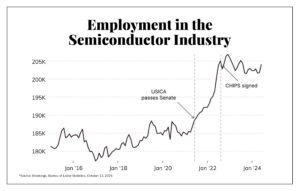
Chart of the Week
For those who believe all other sectors are dead for job creation, but the computing power of AI is the place to be …
Quote of the Week
“To live is not to hold the lost redoubt. To live is to maneuver.”
~ Whitaker Chambers
* * *
I attended a symposium this morning in New York City with my long-time advisor and mentor, Nick Murray. He began doing these symposiums in 2009, and I have never missed a single one. I have been reading Nick religiously since 2001. He says this is the last symposium he will be doing. All I can say is, I have gotten 25 lifetimes of value out of 25 years of learning from Nick. And I am filled with gratitude.
I am off to Nashville from NYC this afternoon and have more travel next week before returning to both NYC and then CA by next weekend. Somewhere in there, I will be writing next week’s Dividend Cafe on the impact of indexing on markets. “These are not your parents’ index funds” is the working title, and I cannot wait to do the writing (and I am sure you are thinking, “I can not wait to do the reading.”)
In the meantime, may USC beat the Irish, and may we all have a wonderful fall weekend. I can’t say enough about how much I love this time of year. And I fully believe that will be true for years and years to come, as there’s nothing AI can do to take it away.
With regards,
David L. Bahnsen
Chief Investment Officer, Managing Partner
The Bahnsen Group
thebahnsengroup.com
This week’s Dividend Cafe features research from S&P, Baird, Barclays, Goldman Sachs, and the IRN research platform of FactSet