Dear Valued Clients and Friends,
In this week’s Dividend Cafe, we look at:
- Why the President picked Kevin Warsh to be the next chair of the Federal Reserve
- What are the things that most matter to us about Warsh as the Fed chair, from QE, to interest rates, to reform, to price signals, to the Fed’s “footprint on the economy”
- How it matters for investors, and what it means going forward
Let’s jump in to the Dividend Cafe …
|
Subscribe on |
Why I Thought Kevin Warsh Would, and Should, Get the Pick
President Trump was hardly subtle when he announced his pick of Kevin Warsh to be the next chairman of the Federal Reserve. He alluded to his looks in the announcement, and then actually used the phrase “central casting.” Most who know the President’s process for key picks, especially ones that will be in the public eye, know of the priority he places on the “aesthetic” of the matter. But Kevin Warsh did not merely appeal to the President because he “looks like a central banker” (whatever that actually means). Warsh’s proximity to Treasury Secretary Bessent, both of whom formerly worked with hedge fund manager Stanley Druckenmiller, always gave him an edge. I believe the President somewhere deep down outside of the “central casting” concern also knows that having someone who has (a) Been at the Fed before and knows how the large and complex organization works, and (b) Is respected by financial markets as an economic and finance mind – not a politico – would be important for the credibility of this pick. At the end of the day, I don’t much care why President Trump picked him – I am just glad that he did.
But why do I favor Kevin Warsh for the pick? Well, I am happy to start and end by just contrasting him to the other candidates, two of whom I thought were deeply flawed, and one of whom (Waller) I do not believe the President was ever seriously considering. But it is not my style to pile on, so I will just say that even apart from Kevin Warsh’s relative strengths, on an absolute basis, there are a number of things I believe argue for his selection.
I fervently disagree with those who believe that the Fed’s mistakes over the last few years have been “political.” The basic, indisputable, empirical facts of all that simply do not allow for such a conclusion. But that is very different from saying the Fed has been doing the right things. My concern is not politicization at the Fed, but excess, intervention, and mission creep. I believe Warsh is by far the most conscientious of some form of reform-driven marginalization. It can’t come soon enough.
I will get into the specifics of Warsh and “quantitative easing” in a moment, but his past critique and concerns about QE are not merely about what I believe (or he believes) regarding the trade-offs involved in the Fed’s use of its balance sheet as a policy tool. The point in those policy weeds is that Warsh sees some of these things as evidence of a too-large “Fed footprint” in the economy. That is the element I hope to see reformed (at least incrementally) in a Warsh-led Fed. I do believe that he sees fiscal policy as the job of Congress and the Treasury Department, and monetary policy as the job of the Fed. When the Fed uses monetary policy to essentially conduct fiscal policy, it creates a drift in the Fed’s mission that is problematic.
Most importantly, Warsh is an anti-Phillips Curver, and that is the component that should be most prioritized. The explicit belief for many, which is an implicit belief for many more, that growth creates inflation is a preposterous notion that needs to be left on the ash heap of history (where candidly, I thought the 1970’s had left it). Productivity can and does grow incomes without sparking inflation. Warsh is, in my estimation, one committed to price stability (as all central bankers should be), yet does not make the mistake of confusing productive growth with a threat to the price level.
The Easy Part
There are not many people who wonder what the new Fed chair’s posture towards interest rates will be, at least in the first few months of his new reign in the second half of 2026. Markets currently price the expectation of 2-3 cuts (i.e., reducing the rate from its current 3.5-3.75% range to around 2.75%) with a 65-75% likelihood. As most people can deduce, the idea of this President appointing a Fed chair who does not cut rates, given the public conversation on that topic in recent months, seems slim to none.
The Juicy Part
What is far more interesting, given its uncertainty, is the new Fed Chair’s plans for the Fed’s $6.6 trillion balance sheet. Warsh has been a public critic of the Fed’s ballooning balance sheet over the years, and was a prominent voice in the ear of then-Fed chair Ben Bernanke about the unappreciated trade-offs that QE (quantitative easing) created back when the practice was first implemented post-GFC. Now, in fairness, being critical of the rapid expansion of the Fed’s balance sheet is very different from advocating for a rapid reduction of the balance sheet, and Warsh has said nothing to indicate he wants to conduct “shock and awe” on the present asset level of the Fed. There is almost nothing he could do to rapidly shrink the balance sheet without straining liquidity in financial markets, and I would be surprised if something dramatic were implemented.
But that is different from saying he will do nothing. Warsh may argue that the tightening of further balance sheet reduction gives him more room for easing with lower interest rates. That combination, if it played out with stability and efficiency, which is a big if, might have the benefit of playing well with both the public and the President, who understand the simplicity of what lower interest rates mean, but don’t instantly grasp the complexity of things like “balance sheet expansion” and “quantitative tightening vs. easing.”
Where I am in wholehearted agreement with the new Fed chair is that the Fed’s “footprint in the economy” should be minimized, and that a bloated balance sheet is a symptom of excessive Fed intervention. That philosophical take is exactly correct, but the question of how Warsh should or will address it is more complicated.
What is Warsh’s (and my) Criticism of QE?
Warsh believed that there was an emergency function for QE in the very troughs of the credit crisis in the fall of 2008. His criticism came when he believed the practice was being overrelied upon and had evolved into something far outside its initial emergency liquidity function. That the practice shifted from an urgent tool for liquidity in the banking system in the fall of 2008 to a permanent mechanism for holding borrowing rates down is reasonably indisputable. The behavioral byproduct of this practice, whether people believe it was intentional or an unintended consequence, was to facilitate excessive risk-taking by investors and excessive spending by Congress. Again, “reasonably indisputable” seems fair.
Where We Are Now
Reducing the balance sheet once it has swollen to its current level is easier said than done, given its impact on money markets. I am on record as saying that Chairman Powell’s success in getting nearly $2.5 trillion off the balance sheet (from a 2022 peak of $9 trillion to roughly $6.6 trillion now) without severe disruptions is a surprise, and also a good thing. Managing the liquidity needs in money markets while reducing the balance sheet’s size has not proven to be easy.
My belief is that Warsh will attempt to do two things at once: increase shorter-maturity Treasury holdings on the balance sheet to meet the banking system’s liquidity needs, while reducing longer-dated bonds on the balance sheet. Some attempt at greater alignment between the durations of its assets and liabilities could allow Warsh to have his cake and eat it too. This is theoretical for now and may face the realities of practical implementation (not to mention building consensus with the Federal Open Market Committee).
Regardless, I do not expect the era of “ample reserves” to end under Warsh, but I do expect “ample” to be re-defined, and for this to be a good thing in reducing that “Fed footprint” in the economy.
A Fed Chair Who Understands Price Signals
I don’t normally pull an excerpt from someone else’s work that is this long, but these three brief paragraphs from Peter Boockvar really needed to be quoted verbatim. I am in 1,000% agreement with Peter and truly believe this is one of the most important things about our new Fed chair.
“One more thing on Kevin Warsh and why I think he’s the right person for this job. It’s his experience in markets working for Stan Druckenmiller and his knowledge of them before he even got to the Fed. I saw Kevin speak about 10 years ago and he told a story when he first got to the Fed in 2006 and arrived at his office at the Eccles Building for the first time. He requested a Bloomberg terminal so that he could follow the markets but immediately learned that there was just one in the entire building. Until one was eventually hooked up for him about three weeks later, he used Yahoo Finance to get his market quotes which at the time was not providing him credit default swap markets. I’ll add that it was in 2006 that the credit markets started to show shaky legs when market signals started to emanate that something was going on.
The market knowledge and having an ear out for market messaging and signals is also why I’ve always appreciated the opinions of other market savvy former Fed officials like Richard Fisher (ran a hedge fund), Robert Kaplan (Goldman Sachs alum and now back), for sure my former boss Larry Lindsey (macro/market consulting firm for 25 years) and a current one Beth Hammack (Goldman Sachs alum) because they were not interested in running monetary policy just by econometric modeling and instead integrated a broader matrix of knowledge which markets were an important part of.
I bring this up in part because I heard Fed Governor Stephen Miran on CNBC’s Money Movers on Friday who when asked about what he thinks about the rising price of gold (outside of Friday’s selloff), he said the increase was “not informative” to him. As a monetary metal for thousands of years, ignoring what gold does is a mistake I firmly believe and it is not an answer that Kevin Warsh or the others I mentioned would have ever given.”
Alan Greenspan was an academic economist and more of a think-tanker than a capital markets guy, but he really did believe in market signals, until he didn’t. Bernanke was a textbook academic economist who too often thought, “I wonder what markets are getting wrong since our models tell us XYZ.” Janet Yellen was as status quo as any Fed chair we will ever have. Powell has capital markets experience (at Carlyle) but has, to a fault, believed in Fed models over market signals. Warsh is by far the most market-oriented of any Fed chair we will have, as Peter’s anecdotal story illustrates. If 1,000 Ph.D economists put together have no need to know the state of credit default swap markets in formulating monetary policy, we have the wrong monetary policy, period.
Is Warsh Really a “Hawk”?
I suppose some vocabulary is in order. A “dove” is considered to be someone who easily defaults to accommodative monetary policy, and a “hawk” is said to be someone with a strong bias for tighter and more restrictive monetary policy. Presumably to try to troll President Trump after the appointment, many in the media attempted to create a narrative that Warsh was a “hawk” and would not want to lower rates because of his history as a tight-money fanatic, etc. It was good commentary for unserious people uninterested in the truth, which is true of most people who report news these days, and even more true of most people who read news these days. Here is what I would say about the “hawk,” Kevin Warsh:
- People calling him this will help him with the Senate confirmation. “Are you going to lower rates just to appease President Trump?” “Hey, I thought I was a big bad hawk? Which one is it?”
- Believing that sometimes rates are too low does not make one a hawk.
- Believing that sometimes rates are too high does not make one a dove.
- Warsh has, at different times and in different economic cycles, believed both. So I guess he is neither a hawk nor a dove.
- Limiting the size of the Fed’s balance sheet and believing the fed funds rate can be lower if economic growth is of the productive variety (non-inflationary) is neither hawkish nor dovish. It is a nuanced view that, in the right situation, could theoretically be a very wise policy mix, but certainly cannot be compartmentalized into one box.
But Why Limit the Fed’s Balance Sheet if One is Not Tightening?
Expect to hear this term a lot in the months and maybe years ahead: “Privatization of the Fed balance sheet.” I believe Warsh’s vision is for the Fed to play a smaller role in financial market liquidity and to use deregulation to enable the private sector to do more of this itself. Less stringent capital requirements for banks allow their balance sheets to grow even as the Fed’s balance sheet shrinks. It is a deregulation and sensible capital-reserve tool that can facilitate greater bank lending (assets to banks) without spiking systemic risk, while allowing the Fed to reduce its balance sheet without undermining liquidity.
In a nutshell, reducing the Fed’s ownership of Treasuries without raising interest rates means increasing banks’ ownership of Treasuries, and there are a few ways the Fed can do that through deregulation. The one I have talked about most over the last year is the Supplementary Leverage Ratio (SLR), which, in a nutshell, provides an incentive for big banks not to hold Treasuries by setting a minimum capital requirement without consideration of a risk weight. Fully exempting Treasuries from this would be a significant step toward incentivizing banks to increase Treasury ownership. Another tool is the Liquidity Coverage Ratio (LCR), which requires banks to maintain 30 days of high-quality, high-liquidity assets above regulatory capital requirements for crisis situations. The way non-Treasury assets are considered in this formula can move the incentive to hold Treasuries up or down, so in a nutshell, decreasing the weight given to non-Treasury assets in the calculation of the LCR could promote Treasury ownership by banks. There are also options on the table with the Standing Repo Facility (SRF) and the G-SIB surcharge, but I don’t want to get too into the weeds here. My point is only that Fed policy tools to drive heavier relevance to bank balance sheets and less relevance to the Fed balance sheet can be done without damaging system liquidity or interest rates.
Privatizing the Fed’s balance sheet is good for economic growth and capital allocation, and it starts with sensible deregulation. More to come!
The Future of Interest Rates
I think it will be better for Warsh if Powell does NOT cut rates again between now and May. It gives Warsh a “freebie” for one rate cut, and then whatever cuts are deemed appropriate between now and the end of the year. The notion that “inflation is still above target and interest rate cuts stoke inflation” is simplistic and, in many ways, inaccurate. There are all sorts of reasons rate cuts could become a bad idea, but that they automatically work against price stability is ridiculous. The issue in weighing various risks right now is whether the cost of money is promoting price appreciation. I believe the data on housing and rents, and the idiosyncratic NON-MONETARY causation behind various price increases (insurance, steel, aluminum, etc.), render that opposition to rate cuts fallacious.
But I also fear a Fed that goes too far, which is not the right way to put it. They will go too far, because they always do.
But with this selection of a Fed chair, I am less worried about that than I was before.
Process Ahead
Stephen Miran’s interim appointment to the Fed has now ended, and technically, Warsh has been selected for that seat. When Powell’s term as chair ends in May, the President will name him for that. Warsh will have to get Senate approval now to sit on the Fed (Miran will stay in the seat until Warsh is approved), and then Warsh will have to get approval again as Fed chair in May. Neither should be a problem (though Sen. Thom Tillis of North Carolina has said he will not advance any nominees until this preposterous “DOJ investigation” threat over Jerome Powell has been formally put to bed). At that point, there will be another Fed seat to fill, assuming Powell steps down as has been the tradition since 1948 for Fed chairs to do when their chairmanship comes to an end.
Conclusion
Until they make a smart kid’s algorithm on his or her laptop, the Fed chair (a guy can dream), or, better yet, stamp “NGDP targeting” on their forehead (IYKYK), there is going to be discretion and intervention in the conduct of monetary policy at the Federal Reserve. My dream of a rules-based framework (honest weights and measures) is not imminent. But having a Fed chair with credibility in markets, who understands price signals, who believes that there is such a thing as non-inflationary growth, and who has the gravitas to navigate a complex and multi-dimensional position, is the best thing I can hope for on this side of it all. I think we got the best man for this job of all the available candidates.
And I pray he doesn’t make me eat my words. But truth be told, they usually do.
Chart of the Week
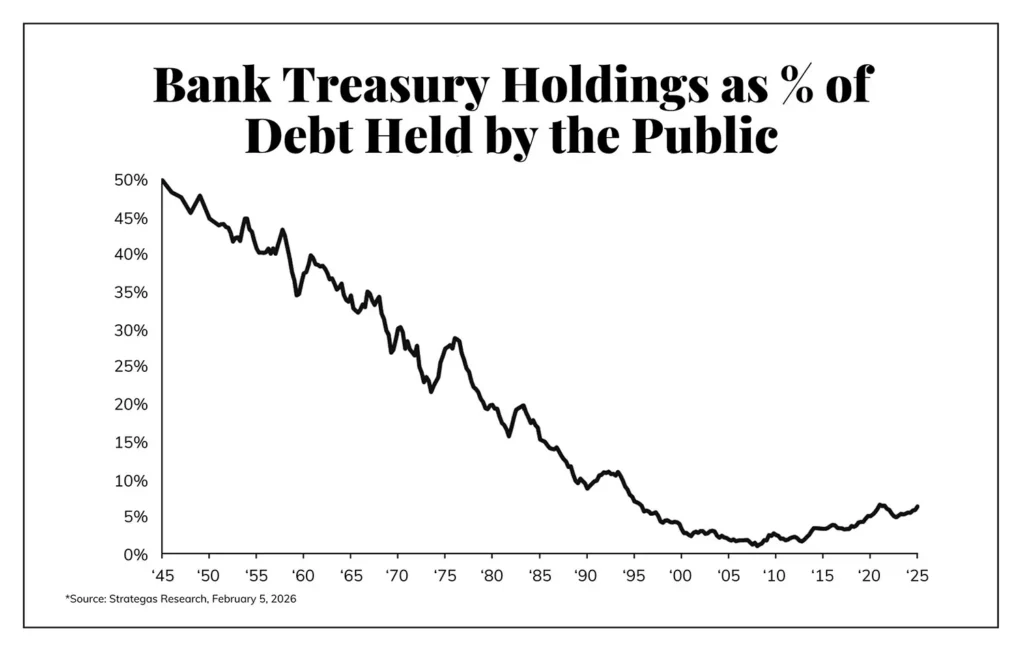
Treasury holdings at U.S. commercial banks have risen from $700 billion to $1.9 trillion over the last decade, but that still barely reaches 5% of U.S. debt held by banks.
Quote of the Week
“I am confident that any attempt to influence inappropriately the conduct of Fed policy would yield a strong and forceful rebuke by Fed officials and market participants alike.”
~ Kevin Warsh, 2010
* * *
I don’t know about you, but every now and then, I think a little monetary-policy-focused Dividend Cafe is about as fun as one can hope to have. I look forward to your feedback and welcome your questions.
Now, as to something even more important, for you Seahawks and Patriots fans, I wish you all the best this Super Bowl weekend. I am not a fan of either, per se, but I do love San Clemente’s pride and joy, Sam Darnold, and wish this little Trojan the Super Bowl trophy he deserves for embodying the spirit of fight on as he has. And to my many friends in Minneapolis, where TBG has now had an office for five years, I simply say … “Really? You let him go because of one bad game?”
Have a wonderful weekend, and fight on, Sam!
With regards,
David L. Bahnsen
Chief Investment Officer, Managing Partner
The Bahnsen Group
thebahnsengroup.com
This week’s Dividend Cafe features research from S&P, Baird, Barclays, Goldman Sachs, and the IRN research platform of FactSet