Dear Valued Clients and Friends,
This is a fun (and risky!) one to write. I am purposely hitting submit to send this to my team for final set-up before market action begins on Friday. I want this to be read (and written) with no influence whatsoever as to what actually happens if and when SpaceX begins trading on Friday. So you are reading it after trading has begun (assuming there have been no technical or legal delays), but I wrote all of this before trading began. Why is that important? Because today’s Dividend Cafe is not about something so stupid and trivial as how a hot IPO trades on its first day of trading … Today’s Dividend Cafe is about something far, far more important.
No matter what one thinks about SpaceX or the other AI companies about to go public, no matter what happens in post-IPO trading today or next week, no matter what plays out with these massive AI labs trying to find their way into the S&P 500, there are numerous reasons this subject matters to all investors. And I am here to unpack those reasons today, believing it to be of critical importance!
Let’s jump into the Dividend Cafe …
|
Subscribe on |
Not Just a Rocket Ship Company Anymore
If all went according to plan, SpaceX (ticker: SPCX) should be trading as a Nasdaq-listed company by the time you are reading this. The plan as of press time was for the company to raise $75 billion at a $1.78 trillion valuation (so a 4% float, give or take) in public markets. This may not technically be the smallest float in IPO history (some weird SPAC or foreign listing you have never heard of may have had smaller once or twice), but for a big-cap, high-profile company, it is not far and away the most unprecedented teeny-tiny float, ever. Even for founder-controlled tech IPOs, the floats are generally 20% of the company, and certainly over 10%. But this is not just about the very small percentage of the company being made available to the public – it is about the de minimis float relative to the massive size of the total company. A very tiny amount of tradeable stock supporting that size of a market capitalization means that massive volatility is possible – maybe up, maybe down, maybe both.
I want to talk more about these technical factors that some seem to think sound really enticing and exciting, but from a more fundamental perspective, the company initially raised funds as a rocket ship company*, then had a commercial satellite strategy, then angled to provide transportation services to space, then added the Starlink communications strategy, then merged with Twitter and xAI (Grok), and now has added aspirations for orbital data centers. So the company has been a lot of things and now wants to be a lot of other things, but it is hard to describe it in one succinct sentence.
*Full disclosure: through a special purpose vehicle, I am an owner of SpaceX equity, as are various clients who were eligible to purchase in earlier fundraising rounds a few years ago through this particular SPV. The equity in this special purpose vehicle will be locked up for one year, at which time the entire position can be sold, or shares distributed, which would then be subject to a longer lock-up. If my interest in the SpaceX SPV could be sold now, I would be selling. At the one-year mark that starts today, I will be selling.
One can love all of these things, some of these things, none of these things – believe they will happen, hope they will happen, not know if they will happen – trust Elon Musk implicitly, not trust Elon Musk at all – there are a wide array of options as to how an investor can think about this company. But if we are here to talk about the company that is to begin trading today, not a one-day or one-week “pop” – or a one-day or one-week “drop” – if we are talking about a real company and real investment – then suffice it to say, it is a tough one to coherently know anything.
More on both of these considerations in a moment.
And for a Second and Third Act …
SpaceX may be all the rage right now, but Anthropic and OpenAI have also filed for IPOs. Both are expected to be valued at around $1 trillion, and Anthropic recently completed a funding round at a $965 billion valuation. The Anthropic listing is expected to happen sooner, but both names are in need of massive amounts of capital, and public markets eventually become a quicker and deeper source of capital than continued private fundraising rounds.
Should all three of the aforementioned IPOs proceed, at the valuations being discussed, roughly $4 trillion in market cap will enter the public markets within a few months of each other. There is almost no way to exaggerate the size, and scope, and scale of what is going on. Saudi Aramco is the national sovereign wealth state oil company of, ummmm, Saudi Arabia. Its market cap was $1.7 trillion at the time of its IPO, yet it raised just $25 billion. But the better way to put it is this: The market cap of the entire IPO/tech wave of 1995-2000 (adjusted for inflation!!!) was $3 trillion; just these three companies will lap that entire era put together by almost $1 trillion. We are talking about HUNDREDS of companies that, combined over six years, were nowhere near the alleged value of these three companies.
And maybe, just maybe, not entirely healthy.
You Get a Car, and You Get a Car
So before I get to the heart of the matter, let’s ask if it is true that “access to IPOs means free money for those who participate” … Here is some real truth:
| 1 Week | 1 Month | 3 Months | 6 Months | 12 Months | Year 1 Max Drawdown |
|
|---|---|---|---|---|---|---|
| -17% | -18% | -45% | -42% | -31% | -54% | |
| 0% | 0% | 11% | -32% | -10% | -58% | |
| Alibaba | -4% | -6% | 18% | -9% | -30% | -49% |
| Shopify | 7% | 38% | 14% | 9% | 2% | -52% |
| Block | -9% | -6% | -24% | -28% | -7% | -44% |
| Twilio | 27% | 42% | 125% | 20% | 3% | -66% |
| Snap | -7% | -8% | -13% | -39% | -26% | -56% |
| Okta | 4% | 1% | 0% | 18% | 64% | -20% |
| MongoDB | -3% | -7% | -9% | 20% | 103% | -26% |
| Dropbox | 10% | 2% | 18% | -7% | -24% | -54% |
| Spotify | 4% | 14% | 13% | 21% | -3% | -46% |
| Lyft | -5% | -23% | -16% | -46% | -65% | -79% |
| Zoom | 5% | 45% | 54% | 9% | 142% | -40% |
| 18% | 9% | 6% | 5% | -28% | -70% | |
| Uber | 1% | 3% | -4% | -34% | -21% | -68% |
| CrowdStrike | 33% | 22% | 19% | -18% | 64% | -67% |
| Cloudflare | 10% | -13% | 0% | 6% | 90% | -32% |
| Datadog | -14% | -16% | 1% | -15% | 128% | -42% |
| Snowflake | -14% | -5% | 30% | -9% | 27% | -52% |
| Palantir | 5% | 13% | 164% | 132% | 153% | -53% |
| DoorDash | -17% | -19% | -28% | -28% | -13% | -47% |
| Airbnb | 2% | 3% | 37% | 0% | 25% | -39% |
| Affirm | 9% | 44% | -29% | -40% | -26% | -65% |
| Roblox | 10% | 2% | 31% | 22% | -40% | -69% |
| Coupang | -11% | -7% | -23% | -36% | -65% | -64% |
| Coinbase | -5% | -19% | -30% | -24% | -55% | -57% |
| Robinhood | 46% | 35% | 2% | -64% | -74% | -90% |
| Rivian | 45% | 15% | -36% | -77% | -67% | -88% |
| Arm Holdings | -18% | -20% | 11% | 106% | 132% | -43% |
| CoreWeave | 20% | 5% | 300% | 217% | 87% | -65% |
| Median | 3% | 1% | 4% | -9% | -9% | -54% |
| Average | 4% | 4% | 20% | 1% | 14% | -55% |
| % Positive | 57% | 57% | 57% | 43% | 43% | n/a |
*Truist, June 3, 2026
Now, a few of these did pretty well right out of the gate. A lot of them got destroyed. Some did well, THEN got destroyed; some got destroyed, THEN did well. The point is that barely half were up a week later; less than half were up six months later; and the dispersion of results from some names to others is just massive. The mythology of IPOs as “free money” belongs in the ash heap of history.
Even longer term, while the entire S&P 500 has been up 11.8% per year since I was in Kindergarten, the average U.S. company IPO was up +6% per year in the first three years of being a public company – basically half of the return of the market (*Jay Ritter Study, IPOs: Updated Long Run Statistics). Of course, the dispersion of results within this statistic is massive, but it points all the more to how many losers there have to be up against the various winners to blend to a very sub-optimal result when taken in aggregate.
“But This One Can’t Lose!”
If by the time you are reading this the SpaceX IPO has traded way higher on day one, the primary reason will be that there are a lot of people who want to buy it, and not a lot of shares available to buy, and in the FOMO of the moment (fear of missing out), smaller investors paid a lot of money to bigger investors to take some of their shares. That could very well happen, and there is a supply/demand issue in the trading technicals of this offering that may create a squeeze to the upside. Supposedly, just BlackRock alone placed a $5 billion order. Just that one order is the same size as the ENTIRE IPO of the largest IPO so far to date! If it does happen (or has already happened by the time you are reading this), its staying power is not particularly clear (to anyone). One day? One week? No one knows. But I would not say that it won’t or can’t happen. Nor would I say that the stock couldn’t jump 25% for an hour or two, then drop all that (and then some?) by the end of the day.
One element that people have pointed out may “prime the pump” for these IPOs is “forced buying” by the index funds racing to include it. Several index fund families (Russell, Vanguard, Nasdaq 100) bent their own rules to get the name in sooner than later. Now, its weighting in the index is supposed to be adjusted for its FLOAT, so rather than 2% or so of $1.7 trillion, it is based on the $75 billion number. But across the size of some of these index funds, that is still no small potatoes. Most notably, though, the S&P Dow Jones Indices decided not to fast-track inclusion as they had been considering. They may change their mind later, but this took out billions and billions of dollars in price-taking (i.e., non-price-sensitive buys) in the very short term.
Regardless, there are people who believe that these things represent “free money” – that the buyer’s appetite for the stock is so much larger than the amount for sale. I can say that whatever causes it to do whatever it is going to do is not going to be entirely rational out of the gate.
Just When You Thought You Were out, You Get Reeled Back in
Now, for S&P 500 index investors, or just people who own most of the mega-cap, Mag-7, big tech names, there is pretty much exposure to a lot of this IPO mania, whether you like it or not, and whether the indexes you own include them or not. Not only do names like Nvidia, Meta, Microsoft, Google, and Amazon all have massive cap table positions in a bunch of these mega AI names, but it turns out an unfathomable amount of the “earnings growth” of the index last quarter was just these companies marking up the value of these private AI names that they own. $69.2 billion of “profits” were “other income” from just THREE companies (Google, Nvidia, Amazon). This accounts for a staggering 12% year-over-year earnings growth, making the “operating earnings” growth far, far more understandable (though still quite robust, it should be said).
Not only are their cap table exposures to private AI companies, start-ups, and various other private market exposures held by the big public companies (and therefore heavily weighted in the indexes), but just the marks of those company positions are perhaps the largest factor impacting public company earnings and stock price movement these days.
Can you hear yourself?
I wish somehow we could regain the sanity and coherence as a culture necessary to truly comprehend what is going on here.
“This stock is good because indexes will be forced to buy it.”
“This stock is good because they have a small float.”
“I can make money by getting in, then getting out. It doesn’t matter what the company does or how well it executes or the valuation – this is just a free money party going on!”
“The hype here is huge – what can we do?”
Note what I am not criticizing (mostly because I am not hearing it):
“This company will be a long-term compounder of capital via unprecedented opportunity to expand AI infrastructure in space.”
“Elon Musk’s track record is so strong, I am willing to buy this even though I don’t really understand it and see what can happen here.”
“Having studied the revenue model, I can ignore short-term IPO volatility and allow this strategy to play out because fundamentally I believe in the story here.”
No, I have not heard any of those things. Incidentally, one of the only finance professors in the country I really like and follow did study the revenue model and fundamentals, and he had a few things to say about the current valuation, for those interested. But my point is this: whether someone gets the answers to the right questions wrong, I at least want to see people asking the right questions before they invest in anything. And IPO mania, if it does anything at all, does a wonderful job at keeping people from asking the right questions – from thinking the right way.
Problems in the Short Term
I already mentioned that I intend to sell my shares when they are unlocked in a year, but allow me to make a very big distinction between short-termism and long-termism when it comes to IPO mania. If one believed that the “total addressable market” for SpaceX (or any company, but we’re just using them as an example) is $29 trillion, it is fine to think that a $2 trillion enterprise value is not excessive. If one believes there is a 5-year, 10-year, 20-year, 50-year play on the various things SpaceX says they want to do in outer space, and has a fundamentally driven optimism about the company, I have no problem with someone wanting to buy it and hold it and test that optimism over time. But my critique is not on long-term ownership, per se – but rather a desire for ownership that is based on nothing but short-term greater fool theory (“if I buy it, someone dumber than me will pay me more for it ten minutes, ten hours, ten days, ten weeks later”), while rationalizing the greater fool theory with borrowed long-term arguments. “I want to own this stock for ten days because I believe in ten years Elon will have crushed it!” … This, my friends, is a non-sequitur and is called self-deception.
I also have no problem if someone doesn’t care about the long-term story and just believes, “There is free money to be made here and I want to make it.” That person has a 50% chance of being proven right.
Except not really.
Because anyone who makes easy free money in an IPO comes back for more. And, well, you can look at the chart above if you need a reminder, but let’s just say that history has been unkind to people who believe this can be a repeatable experience. We are not talking about “assessing good deals” or “smartly discerning where huge gains can be found” – we are talking about speculation, if not outright gambling.
Problems in the Long Term
If you say, “no, I want XYZ IPO [SpaceX or another AI IPO or whatever] because I truly believe this is the future and I have an intelligible and long-term view here” … then great. You may be right, and you may be wrong, but you are not the subject of today’s Dividend Cafe. That said, does anyone really believe they can assess the long-term ramifications of data center construction in outer space? Is there something analyzable or discernible about the level of aspiration we see in some of these IPO-maniac names?
Have you thought through the ramifications of why companies stay private so long, now? Does it change the risk-reward profile to be buying a company ten or twenty years into its existence versus two or three years (which was more normal in terms of a company finding public markets)? If a company can obtain such massive amounts of capital during its most important growth stages in entirely private markets, does that speak to the altered opportunity set in public market IPOs now versus the past? Is a company like SpaceX already reflecting a lot of the value you want to capture with “data centers in outer space” with a $1.8 trillion valuation?
In other words, long-term, is it possible that public money coming in now for the reasons you cite is thinking the right way, but at the wrong time (that is, you are funding the reward for earlier investors that hoped for the same thing you did, only much earlier)?
I do not pretend to have all the answers to these questions, but I do believe they are fair and sobering questions. IPOs of massive companies over the last 5-10 years, where the companies stayed private way longer than they used to, have not delivered great public investor returns, even though the companies have grown and solidified as expected.
I love trying to be thoughtful and long-term when making decisions like this, but I would suggest that the long-term consideration is not a slam dunk either.
Conclusion
And this is the point of today’s Dividend Cafe. It is not to critique SpaceX in the long term. It is not to have an opinion about Anthropic or OpenAI in the long term. It is to remind you that free money does not exist. If you believe it does with IPOs (it doesn’t), you will believe it does with other things, too. You will be the person complaining on an episode of American Greed about what someone else did to you. You will get a statement marked down by 40% one month from now because the inevitable happened that you thought couldn’t. You will make decisions in pursuit of something that doesn’t exist, which will end up doing damage that very much does exist.
Can some endeavors deliver a euphoric result along the way? Of course. And people are always going to like free money. But your unawareness of the risk you took to get free money does not mean you did not take the risk. This is the most important thing I can say about IPO Mania … It is fundamentally rooted in some hope for and belief in free money. And once you accept that free money doesn’t exist, your mind can be freed from the delusion of thinking this may be different.
It may be. Some hot IPO may run huge and give you the hindsight of a great play.
But that doesn’t mean it was free. And the sooner we all understand this immutable law of risk-reward symmetry, a law never to be repealed by the lies your friends tell you at poker night, the sooner we can all get focused on that which truly delivers over the long-term:
Discipline, prudence, and wisdom.
To that end, we work.
Chart of the Week
Courtesy of my friends at Gavekal Research, here we see what some pretty major institutions were valuing SpaceX at just three years ago. $11 billion was raised over this period, and by the end, it was valued at $137 billion. 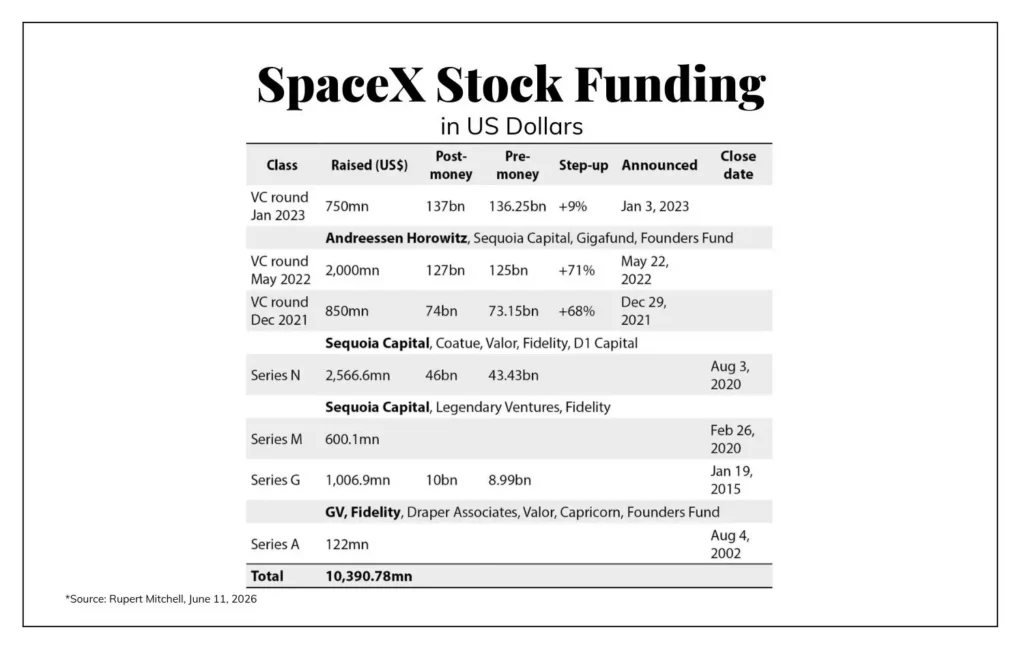
Quote of the Week
“A dead thing can go with the stream, but only a living thing can go against it.”
~ G.K. Chesterton
* * *
I really want to thank everyone for the feedback to last week’s Dividend Cafe. It was, by far, the most responses I have ever gotten to any Dividend Cafe, and it meant the world to me.
I am off to New York City today and will be there most of the summer. This has been an adventurous week in markets, and I will have more to say on Monday back here in the Dividend Cafe. Have a great weekend!
With regards,
David L. Bahnsen
Chief Investment Officer, Managing Partner
The Bahnsen Group
thebahnsengroup.com
This week’s Dividend Cafe features research from S&P, Baird, Barclays, Goldman Sachs, and the IRN research platform of FactSet