Dear Valued Clients and Friends,
In this week’s Dividend Cafe, I thought it was important to take a look at more than just one thing. The Iran military operation is the biggest story in the world right now, for markets, for oil, for the economy, and certainly for geopolitics. It is also not the only story. The first ten weeks of 2026 have been eventful, which is not the same as saying they have been “unprecedented” (almost everything that ever happens in markets, ever, is to some degree precedented). The eventful beginning to the year has offered four other major “market stories” besides the Iran war. Today, we will review all of them. So today, the Dividend Cafe will offer a quick tour of:
- The Iran War and its second week ramifications for markets and the economy.
- The state of tariffs in the aftermath of the Supreme Court’s decision and the economic impact (on jobs, prices, and more).
- The reality of private credit conditions and the impact felt throughout the financial sector.
- The latest and greatest with AI and how it is being felt in markets (for good or for bad).
- And finally, the “market rotation” theme that has seen certain “real economy” sectors dramatically outperform the rest of the market.
Let’s jump into the Dividend Cafe …
|
Subscribe on |
The Iran War
The second week of this military operation in Iran has not gone well for markets. On one hand, the takeaways I offered last week that it is not expected to go on for a sustained period of time, that day-by-day volatility will be significantly enhanced until this subsides, and that as oil goes, so goes markets (inversely), all remain the base case. This week, we saw a 1,200-point difference between the high and low prices on Monday, 800 points on Tuesday, 600 on Wednesday, and 600 on Thursday.
| Date | Open | High | Low | Close |
| Mar 13, 2026 | 46,689.24 | |||
| Mar 12, 2026 | 47,242.52 | 47,242.52 | 46,662.23 | 46,677.85 |
| Mar 11, 2026 | 47,690.76 | 47,711.26 | 47,185.89 | 47,417.27 |
| Mar 10, 2026 | 47,771.43 | 48,220.54 | 47,444.23 | 47,706.51 |
| Mar 9, 2026 | 47,371.28 | 47,876.06 | 46,615.52 | 47,740.80 |
*Yahoo Finance, March 13, 2026
And yet, with 3,200 points of up-and-down movement (volatility) over the last four trading days, the market is down (going into Friday) a net-net 800 points (a mere 1.68%).
Oil, on the other hand, is becoming a bigger issue. It remains heavily backwardated (the one-year futures contract is $71 while the one-month contract is $96), but that front end has toggled back and forth between crossing the $100 range and coming all the way back to the low-80’s, and still sitting around $95 as of press time.
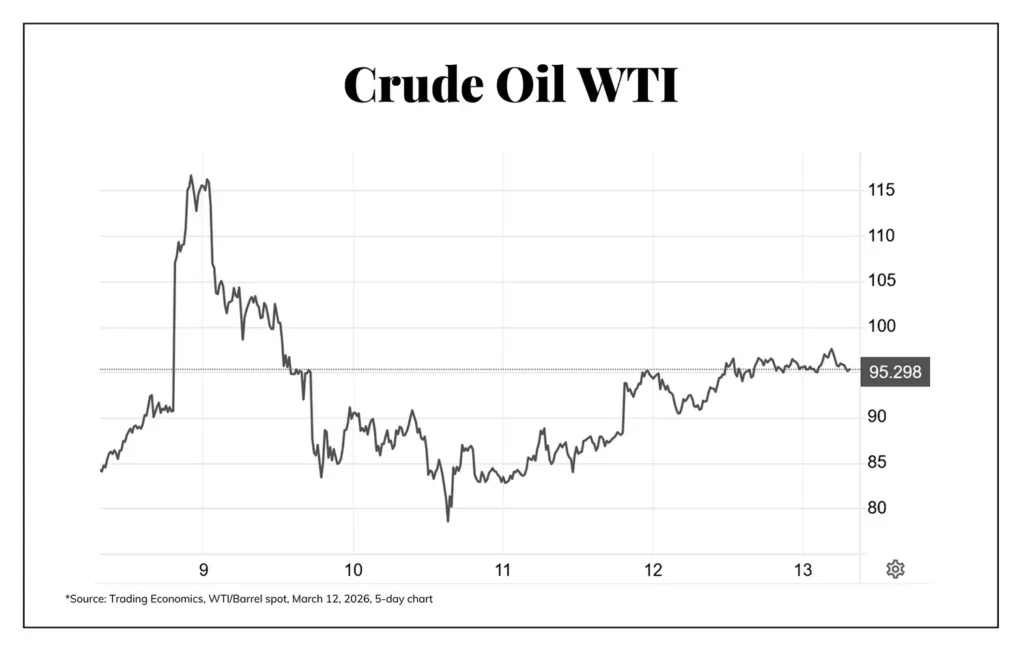
*Trading Economics, WTI/Barrel spot, March 12, 2026, 5-day chart
$95 oil will take a toll on the economy if it were to last for a week, two weeks, or a month. $80 oil, less so. Something sustainably over $100 becomes a major issue. But if all of this is going to end soon, and if, in fact, oil is going to settle back in the low-70’s as the futures curve suggests, why does it matter?
Stock market prices have to reflect whatever impact there is from whatever happens with oil prices over this period, as well as the uncertainty about what is happening and how it will all transpire – hence the volatility. A rule of thumb for markets: Bad news gets priced in, then responded to; Uncertainty just leaves us in exacerbated volatility.
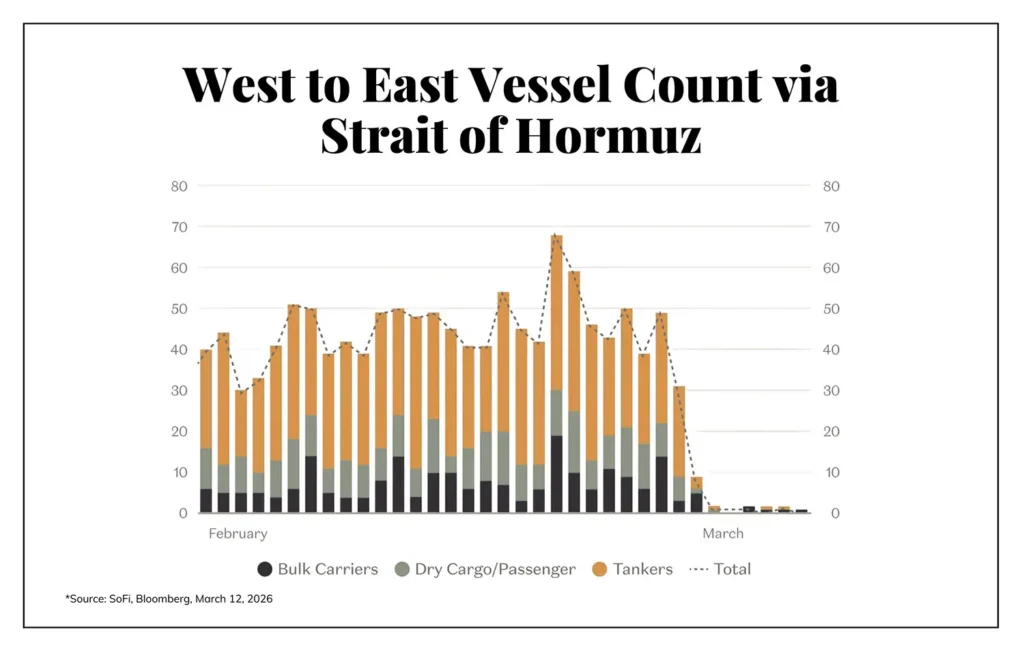
The oil issue is not currently about the mere “headline” reality of the war. The very specific issues in the Strait of Hormuz have raised concerns that commercial shipping faces a sustained headwind that had not been fully discounted when this all began. The administration can say what it wants to say about the success of the operation militarily, and it may very well be 100% right, but if operators, insurers, shippers, and those with commercial interests do not want to operate out of the Strait of Hormuz, it creates a massive marginal impact on economic activity and expectations. A substantial control and enabling of operations in that waterway is the major need of the moment for markets, and it does not appear to be imminent. This is not to say that this will not be resolved in three days or three weeks, but it is to say that it might not be, and it is certainly to say that markets now believe in week #2 that the state of the Strait of Hormuz was not anticipated to this degree when the strikes began two weeks ago. That creates a challenge of confidence.
A host of policy options remain, and if this were a straight-up bet on the U.S. military versus any aspect of Iranian success here, it would be a pretty easy bet for me. But it is not – it is a more nuanced scenario around the reality of the Strait of Hormuz that is in an uncertain position two weeks into this, and that was not expected one week ago, and certainly not 10-14 days ago.
I do expect a number of other announcements and countermeasures to attempt to offset the Hormuz impact. Ultimately, though, this will remain a source of volatility in oil markets, and therefore stock markets, until there is greater clarity. And the base case is no longer that such clarity will come in mere days.
It’s the Economy. Stupid
I actually hate that cliche line, which James Carville made famous over three decades ago, but I don’t have a copywriter to help with my sub-headlines, and it does seem to fit this next section.
A major theme of ours for 2026 was the need for humility around the economic outlook, believing there were push-pull factors likely to create a tug-of-war between forces of economic growth and forces of economic stagnation. So far, the latter camp is winning, at least marginally. The February jobs report was terrible. The Q4 GDP number came in below expectations. The PPI and CPI numbers have not shown predicted disinflation. And ironically, those inflation numbers (taking out the oil impact of the last two weeks) would all be headed in the right direction (from the high-2’s to the low-2’s if it weren’t for one thing: Tariffs. Services inflation has moved lower (moderately) while goods inflation has ticked up. The long-predicted lag in shelter disinflation has actually happened (and continues to), yet it is fighting against goods prices moving higher with automobiles, apparel, furniture, appliances, electronics, medical supplies, certain food items, and home goods. Tariffs have their fingerprints all over these things.
Ultimately, as I have repeatedly said, the larger economic impact of tariffs will come down to whether or not they impact capital investment and hiring decisions. That dynamic will play out in the next 3-4 quarters alongside the tailwind of new tax benefits for business investment (hence the tug-of-war analogy). The negatives are prevailing over the positives thus far, but it is very early.
The “half-full” part of the glass still shows very low weekly jobless claims and two months of improved ISM Manufacturing data (though less positive there, inside the tabs). Layoffs have not picked up yet, and I am not remotely predicting a contraction or recession. What I am suggesting is that “stagnant” or “subpar” growth is increasingly likely.
Private Credit and the Media Firestorm
I stand behind every single thing said in the Dividend Cafe I wrote two weeks ago about this private credit story. The idea that the media was going to let this go in two weeks is comical, and the media narrative behind all of this remains the biggest story here (i.e., that there is some slew of defaults universally distributed and unique to the asset class; and that the limited liquidity of the asset class is somehow a bug and not a feature). The narrative is wrong in that it is conflated as one story, and it is wrong in that both of those two individual stories are demonstrably false. Now, the first one has a chance to become accurate – I wouldn’t be interested in prognosticating about a default rate on bank loans, or high-yield bonds, or direct lending, or structured credit (CMBS, RMBS, ABS) for two reasons. (1) They are all different asset classes and will all have different default rates, and I wouldn’t want to join the chorus of people who appear to not know that, (2) I wouldn’t want to be as wrong as everyone else is in predicting such unpredictable things. But really, there is a third reason, too:
If there was a bucket of every private loan on planet earth mixed into one giant bowl and some smarty pants knew the total default rate of every loan in that bowl, it still wouldn’t tell anyone what the default rate was of the loans they owned in their particular investment, and it still wouldn’t tell anyone what the recovery would be on those defaulted loans.
Treating some modest default rate of a risky, premium asset class as “new” is so irresponsibly stupid that all I can do is shake my head at the current idiocy and allow the dislocation to play out. I hope it affords the time and opportunity for prudent investors to sensibly capitalize on it. And I hope the strong hands do what they are supposed to do vis-à-vis the weak hands.
And that brings me to the real story here. A media cascade event is not a one-and-done moment, and this narrative may take time. But I promise you that I am talking to very, very competent hedge fund and private credit managers every day who welcome the chance to buy paper cheaper, to find equity or debt investments whose prices do not match their cash flows, growth trajectories, and fundamental value, and to exploit such a dislocation. I promise you there are many who believe there is an opportunity created out of indiscriminate selling, and especially forced selling.
I believe the entire story here will be separating wheat from chaff once the smart money begins bifurcating between the two. When there is no bifurcation in sentiment between two things that are not the same, “dislocation” is that results. When smart money starts “buying dislocation,” a rally in the wheat is what you get.
AI Impact
Even one who has been as critical of the incoherent AI investing narrative as I have been is a little confused by the recent market action. On one hand, I very much get why Nvidia has been dead money for seven months or so, why Oracle is down over 50% from its 2025 high, and Palantir down 26% from its late 2025 high. And I get why Mag7 names are not all trading as one and the same anymore. But one can be forgiven for hearing two narratives that don’t seem to be intellectually consistent …
- The AI story is over-hyped, over-priced, and in need of re-pricing from a sensible market valuation standpoint (I think you know where I stand on this)
- The AI reality coming is so big and powerful it is going to make most software companies obsolete overnight
I do not think markets are fully dealing with all the revenue circularity yet (it is out there, but the entire dynamic is not fully comprehended yet in my judgment). I do not think markets have contemplated the possibility of a decline in capex that would come if certain hyper-scalers feel their ROI assumptions are, well, lofty. And yet at the same time, I am not sure anyone has really processed the nuances of where AI boosts some and hurts others. This will be the subject of a dedicated Dividend Cafe in two weeks.
Rotating not Hyper-Ventilating
Energy is up over +23% year to date and was the top-performing sector before the Iran war began. Utilities are up +11% (defensive) and Consumer Staples (last year’s worst-performing sector) are up over +6%. Meanwhile, Financials (a leader last year), Real Estate, and Consumer Discretionary names are all down about -5%, and Technology/Communication (the leader last year) is down -2%. The entire market is down about 2%, but the prior market leadership drop has been offset by a rotation to “real economy” sectors that are doing quite well. Call some of it AI fatigue, call all of it a valuation issue, but call it a rotation.
Chart of the Week
Quote of the Week
“As an investor in businesses, which generate enormous cash flows, my single most important issue to get right is what management will do with cash flow through reinvestment. Do they care about the owner, or do they care about themselves?”
~ Tom Russo
* * *
It has been a wild first ten weeks of 2026, and that is part of what we signed up for in our chosen line of work. It is also embedded in the nature of investing, but also the reality of the world. Unpredictability is the norm. And properly managing one or two narratives is important, but so is properly managing four or five narratives – because with the right principles and philosophy, all the new news stories take on a declining marginal significance. But sans the right philosophy, each new addition to the list in today’s Dividend Cafe becomes a new opportunity to do something unwise. We are against doing unwise things. To that end, we work.
With regards,
David L. Bahnsen
Chief Investment Officer, Managing Partner
The Bahnsen Group
thebahnsengroup.com
This week’s Dividend Cafe features research from S&P, Baird, Barclays, Goldman Sachs, and the IRN research platform of FactSet