Dear Valued Clients and Friends,
I think a lot of Americans want prices to stabilize. I also think a lot of Americans want to sell their home with a low mortgage rate and go buy a bigger and better home, but can’t do so because the interest rate would become too high. I think a lot of Americans want bond yields to drop because it might either boost their equity valuations or at least protect their already-elevated equity valuations. And the above sentences basically mean that a lot of Americans (and therefore Dividend Cafe readers) care about the Fed’s interest-rate policy and decision-making, even if they don’t know they do.
The Fed hiked rates by a quarter-point this week, as markets had told us it would. I hate writing a Dividend Cafe on Fed policy each time the Fed meets, but “this time it’s different” (see what I did there?). Today we are not diving into QE and various monetary abstractions embedded in Fed decision-making … We are looking at a very, very core understanding of markets that affect all of us and sits at the heart of what the Fed did this week (and why). And we are laying out a few thoughts on what is to come based on all that we know. So it isn’t just for the wonky, academic macroeconomic interests that we write this week – it is for those curious about mortgage rates, the price level, and the stock market – which I think is all of you.
Let’s jump into the Dividend Cafe …
|
Subscribe on |
Cutting to the Chase
I am going to elaborate on a lot of this and unpack it more throughout today’s Dividend Cafe, but I will lead with my basic summary and takeaway of what the Fed did this week: They acknowledged that they are following the market and not leading it. The way in which the short end and long end of the yield curve tightened over the last few months, even as the Fed did not tighten the policy rate, goes completely against the monetary policy function we have been so used to for a long, long time. Rather than markets responding to what the Fed has done, and to what the Fed has said it was going to do, and to what markets believed the Fed was going to do, markets led the way, and the Fed followed.
That is all I mean by this being a “performative” rate hike. It did not tighten financial conditions, and it was not intended to tighten financial conditions. It was intended to cosmetically match the public federal funds rate (i.e., the policy rate) to where market rates already were. It was a “catch-up” hike. It was a “do-over” from the December 2025 rate cut, undoing that cut and moving their perception of a more natural rate to the 375-400 basis point range (versus the 350-375 range it had been). We are now sitting at an 87% implied probability of another rate hike by year-end (this was well telegraphed in the Fed’s messaging this week), with a 50% chance of one more hike and a 37% chance of two more. So, with the message in markets being, “there needs to be two rate hikes to restore the policy rate to market levels,” why did they only hike 25bps this week when they could have just cut to the chase, done 50bps now and be done with it?
Because it was performative.
But the Politics of it All?
Many have felt that Chairman Warsh would not push for rate hikes because of political pressure from the White House not to. My view has been, all along, that the chairman may do something right and he may do something wrong (via action or inaction), but the rightness and wrongness and action and inaction would be owned by him and not by the White House. I also have come to believe in the last couple of months that the “political fallout” from taking a step with monetary policy that the White House would not like (i.e., “political fallout” here means “the President tweeting mean things about you”) could be mitigated by offering himself up as the scapegoat. In other words, the flexibility the President could have to take credit for good things that may happen while putting the blame for bad things that may happen on the Fed chair is a feature, not a bug, in what Chairman Warsh wanted to do. That optionality (heads I win, tails I do not lose) is attractive to the President, and I can pretty much guarantee you that Chairman Warsh couldn’t care less about being the scapegoat if it means conducting monetary policy the way he believes it should be approached.
So is this what happened? Did my imaginary tale of the thing play out behind closed doors? Well, first of all, I obviously have no clue. But what is really bizarre to me is not that the President didn’t attack Warsh for it – that it was a benign and even quasi-supportive stance from the President. It was that he basically said, “I told Kevin to go ahead and do it because everyone else was going to do it anyway” – as if Kevin Warsh himself did not support it. I mean, I suppose it is possible that the President really believes this (Kevin was the lone wolf who opposed a rate hike, but all the others were political animals insisting on doing it), but I can’t imagine he does in the face of Warsh giving such a public defense and explanation of the action. He even put on social media that:
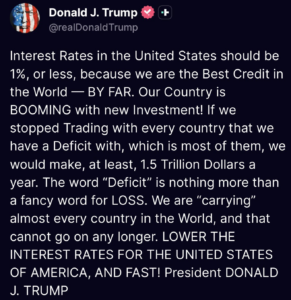
*Truth Social, September 16, 2026, 4:38 pm
Why do I bring this up? Well, credit spreads reflect creditworthiness, not the base rate itself. But then immediately changed the subject entirely to something that has nothing to do with interest rates – our trade levels with other countries. And then closed with a comment to lower interest rates … Many critics of the President jumped on this to say, “he really doesn’t understand how credit spreads, or interest rates or trade deficits work, at all.” And far be it from me to be his defender here, but upon further reflection, while I do not believe his views on trade deficits make any sense whatsoever (that we lose money when we buy things from other countries), I do not believe this response to the Fed’s rate cut is reflecting a potpourri of things he does not understand. I think it is the most supportive thing he can say about Warsh’s decision without being supportive. How is it supportive, you ask? Because it changes the subject multiple times, diverts attention from the actual thing we are talking about, and allows the impression to be that his focus is not actually on what the Fed did but on something else (trade deficits??), all the while saying he wishes rates were lower. It was a non-critical criticism, wrapped in two non-sequiturs. I mean, maybe I am overthinking it, but if I wanted to divert away from people looking for me to criticize my own Fed chair, I could think of worse ways to do it than this???
(I already know people are going to say I am being mean to the President, or I am being nice to the President, but I am being neither).
Bottom line: I think the Chairman got to hike rates yesterday and set the table to do it again, without inviting the wrath of the President. I also believe that what he suggested above (a scapegoat theory of the case for Warsh) is not to be ruled out, and we shall see how things play out in the near future. I also believe that the second rate hike now expected in markets is more likely in December than October, given the proximity of the late October meeting to the early November midterms. I also believe that is ridiculous and more or less incoherent (who cares when the midterms are if the right thing to do, theoretically, is to hike rates; and what votes could it possibly impact six days before the election), but I do think that silly narrative is presumed enough in Washington that it may very well hold.
Inside the Fed Reasoning
So it needs to be said that the decision to increase rates was unanimous (12 votes to hike and 0 to not). That itself is a big deal, as the July vote not to hike was 9-3, reflecting a surprising level of dissent and disagreement. To move to such collegial and unanimous consent so quickly seems constructive. Now, I do not have any inside information here, but I suspect at least one and possibly two Fed governors were not on board with the hike (Waller, particularly), but seeing the math of the vote aligned their votes with the thrust of the committee in the spirit of collegial unanimity. Regardless, it messaged to markets something less volatile and uncertain than we have seen in recent meetings and conversations.
The Fed’s statement and, of course, Chairman Warsh’s comments in the post-meeting press conference painted a pretty simple picture. They see the jobs picture as good (which gives the permission slip to hike given their dual mandate). And while the July decision referenced the supply shock context of our inflation (most particularly the impact of the Strait of Hormuz closure), that language was taken out this time. In other words, while I think it is incontestable that much of the upward price pressure we currently see is related to higher energy costs given the disruptions in the Middle East, and I am sure the Fed does, too, they removed that language from their consideration to simply isolate the fact that, regardless of the nuances behind it, the price level is too high.
Net-net, I believe the Fed’s message is, “look, financial markets are saying a higher rate is needed to try and cool prices, even apart from the supply shock considerations of Iran … and we think labor markets are healthy enough and the economy strong enough that we can do that 25 or 50 bps in the months ahead without impacting the other side of our mandate.”
So Does This Rate Hike Dampen Inflation?
No, not really. I am not even sure if Chairman Warsh thinks it does. I think it is a message of Fed independence and credibility. It is a rebut to those who question Fed independence. It is an attempt to rein in the long end of the yield curve. But the bottom line is that the Fed is paying banks 3.9% on their reserves (IORB rate), and that is right inside of the Fed funds rate target. To truly ease or to truly tighten would involve moving that rate outside of the Fed funds target rate. They have not done that, and they are not going to do that. The absolute rate, then, becomes what matters in terms of economic activity. And in this sense, the Fed really is handcuffed. One or two rate hikes cannot actually move the price level lower, and that which would be truly restrictive (i.e., tightening) would almost certainly be recessionary (a high enough policy rate and/or a disconnect between what is paid on bank reserves versus the fed funds rate that it actually did dramatically tighten bank lending).
So, like I said – performative.
Did Someone Say Bond Yields?
How did the bond market react? Well, in the immediate aftermath of the announcement, the 2-year Treasury yield did jump a massive 10bps, while the 10-year ended the day flat (had been down five then jumped five). You basically saw the 2-10 curve flatten by 7-10bps on Wednesday, and then saw the whole curve drop about 5bps on Thursday.
Let me get past the mumbo-jumbo. The long end of the curve came down a bit since the announcement, and the short end came up a bit. And yes, this is what the Fed wants, but they want more of it. They don’t want a flatter yield curve because they want the short end that much higher, but they want the long end lower. A 30-year at 5.3% and a 10-year at 4.94% (where both are as of my press time) is higher than they want to see. If showing some performative flex with the short end can help bring down the long end, that will be a victory for the Fed. Mortgage rates are back to 7%, and this is the issue that will end up mattering more than anything else to regular people – how interest rates impact home borrowing. But can the ten-year get back to 4.5% or lower with the Fed funds rate up around 4%? It is just an insanely difficult dance, and not something I am remotely confident they can pull off by design.
When it comes to monetary distortions and interventions, all you can do is get lucky, or see things you don’t want happen. But it is almost impossible to pull off desired policy aims without the trade-offs you are trying to avoid.
But There’s This
If we are going to note the immediate impact on the yield curve, it is worth noting that TIP spreads (that is, implied expectations for inflation) did do this after the announcement …
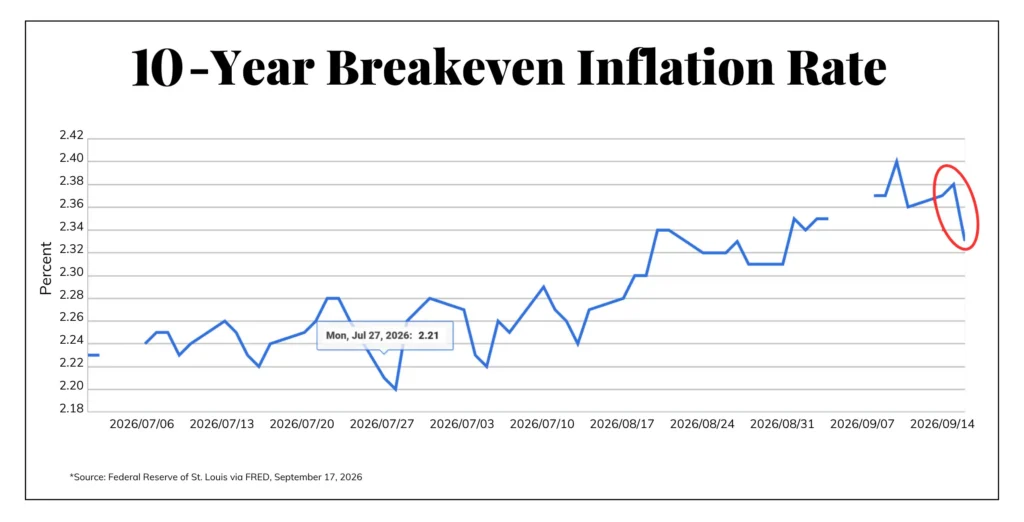
So if the 10-year yield came down 5bps or so and the TIP spread came down 5bps or so, that means all of the drop is on lower inflation expectations, and none of it on real growth expectations… Now, I am sharing about 24 hours of response – what will matter is getting inflation expectations lower than that, and over a more sustained period of time. But at least, directionally, the bond market did not price in any expectation of impact to real growth from the rate hike yet.
So the Stock Market Now is Going to ????
Markets dropped in the final 45 minutes of trading on Wednesday, and they were up as of my press time on Thursday. But is the market reaction Wednesday in the final 45 minutes indicative of anything? Well, yes, it is – it is indicative that our financial markets are filled with traders, hedgers, and speculators, and the immediate hour or so after a Fed announcement is not real life.
I studied the last dozen FOMC meetings and found that the average move from a high to a low (or a low to a high) in the short window after a Fed announcement to a market close is a stunning 0.83% per meeting. Looking at two dozen Fed meetings shows a median market move about 3x the normal amount for such a period of time.
It just isn’t real life.
Now, let me answer the question. What does it mean that the Fed has increased rates a quarter point and is likely to do so again for stock markets? I simply want to answer by pointing out that I don’t know a person, myself included, who would have guessed that a 4% Fed funds rate, a 4.5% two-year, and a 5% ten-year could sustain a 23x multiple in the S&P 500. But it has. So while higher yields do mean pressure on market multiples in conventional understandings of finance, it has not meant that for a while, so it has to be taken with a grain of salt.
I will not say that the Fed funds rate is irrelevant to stock markets right now, but I will say that it is much less relevant than (a) Earnings growth, (b) the AI business model, (c) Oil prices, and (d) Market valuations. In other words, if one wanted to have a [highly fallible] opinion on where stock markets are and will be, there are a lot more categories of information that matter than either the Fed funds rate or expectations of the Fed funds rate.
Just a Little Final Reminder
Every person who has ever borrowed money in history likes rates to be lower. The cost of their debt is lower when rates are lower and borrowers like paying less (versus the alternative). I can say this more slowly if need be. This applies to home borrowers taking a mortgage, commercial real estate developers building golf courses and hotels, and countries running massive fiscal deficits. There is nothing wrong with those parties wanting lower rates – it is simply obvious that it feeds their interests.
I just want to remind everyone that no dollar has ever been borrowed that wasn’t first lent. Again, I can say this more slowly if need be. For every debtor there is a creditor. And every dollar that is “interest expense” on one person’s P&L is “interest income” on someone else’s. Now, banks may like receiving more interest income, but they don’t like borrowing costs getting so high that it generates defaults. So there are market governors to all this. But when you hear media reports of a “home borrower paying more in mortgage” because of higher rates, remember there is also a saver with a CD, or bank account, or Treasury bond who now has more income. It is not my job, your job, the President’s job, or a central bank’s job to favor one party over the other.
Which I guess tees up the other reminder …. In a perfect world, borrowers and lenders, savers and debtors, party A and party B, figure all this out on their own. But in the meantime, we have a Fed to put its finger on the scale. And one day, rather than saying, “the Fed did the right thing in raising rates this week,” or alternatively, “the Fed was wrong to raise rates this week,” maybe we will not require anyone to tell us what the price of money ought to be.
I can dare to dream. And truth be told, a Fed catching up to the market is far better than a Fed trying its best to shape the market. Baby steps, my friends. Baby steps.
Quote of the Week
“Nothing is more senseless than to base so many expectations on the state, that is, to assume the existence of collective wisdom and foresight after taking for granted the existence of individual imbecility and improvidence.”
~ Frederic Bastiat
More to Chew on
- How much each college spent on their football team in this NIL moment
- Tariffs for thee but not for me
* * *
Wishing you all a wonderful weekend filled with football, fun, and family … I doubt the other F word (the Fed) will be a part of your weekends at all. As it should be.
With regards,
David L. Bahnsen
Chief Investment Officer, Managing Partner
The Bahnsen Group
thebahnsengroup.com
This week’s Dividend Cafe features research from S&P, Baird, Barclays, Goldman Sachs, and the IRN research platform of FactSet