
A little context is in order before launching into a review of “The Fourth Turning,” by William Strauss and Neil Howe. Why bother reviewing a National Bestseller that was published in 1997? What possible relevance does this have to investors who regularly read the Thoughts On Money blog?
Allow me to explain. As someone privileged to serve as a Private Wealth Advisor at The Bahnsen Group, I have the opportunity to speak with people who admire David Bahnsen’s unique thought leadership in economics, wealth management, politics, and culture. Last year, I was connected with an elderly gentleman with significant net worth who is considering delegating financial management to support long-term estate planning for his beneficiaries. Over half of his sizable portfolio is cautiously invested in short-term U.S. treasuries, and he was keen to learn what David Bahnsen thought about the impending “Fourth Turning.” He earnestly wanted to understand how TBG would manage his portfolio allocation in the face of a macro-level future crisis.
My first response was to attempt to connect this man directly to David so he could “hear it from the horse’s mouth,” as it were. But it also made me think I should educate myself about this point of view so I could be better prepared should it come up again. The reality is that many of the conversations I have with prospective clients touch on a similar issue: how does TBG think about the future and manage wealth accordingly? Many people may be unfamiliar with the specific Fourth Turning model and “prophecy,” but the urge to be thoughtful and prepared for an uncertain future is the same.
So with that context, I will use this enduringly popular book as a foil to tease out some answers. And while I do not speak for David Bahnsen, I have marinated in his thought leadership and worldview enough to hazard some answers. So as Trevor would say, off we go…
What is The Fourth Turning prophecy?
**Note: if you have little interest in the intricacies of this theory, please feel free to skip to the next sub-heading. Otherwise, read-on, intrepid reader!
Simply put, the authors propose an intricate philosophy of history with an eye toward its predictive and prophetic powers. They argue that human history is neither chaotic nor linear, but cyclical in nature. As Mark Twain famously said, history doesn’t repeat itself, but it often rhymes. The very epigraph of the book quotes Ecclesiastes 3:15: “That which hath been is now; and that which is to be hath been; and God requireth that which is past.”
That much of the Fourth Turning perspective is probably not particularly controversial for most people in the West. Unlike certain cultures that view the material world and the passing of time as something of a fleeting illusion, we embrace the passage of time as a necessary dimension of actually living in material space. And further, we recognize that our world runs on a physical-cyclical “clock” marked by rotating constellations and seasons. When it comes to the history of human development, we resonate with Mark Twain and the Preacher of Ecclesiastes that “there is a season for everything.” So far, so good.
The authors now start to press their thesis forward by positing that each macro cycle (saeculum) of human history is about the length of a human life, or eighty-ish (80~100) years. And each saeculum consists of four twenty(ish)-year phases of life (generations). The four internal generational phases match the flow of nature/human development: spring/growth, summer/maturity, fall/decay, winter/death. So each macro cycle has four “turnings”:
- Turning 1: Spring/Growth to Summer/Maturity (“High” season)
- Turning 2: Summer/Maturity to Fall/Decay (“Awakening” season)
- Turning 3: Fall/Decay to Winter/Death (“Unraveling” season)
- Turning 4: Winter/Death to Spring/Growth (“Crisis” season)
Hang in there with me, because their thesis is only getting started. They now postulate that there are four generational personas that rotate through different turnings:
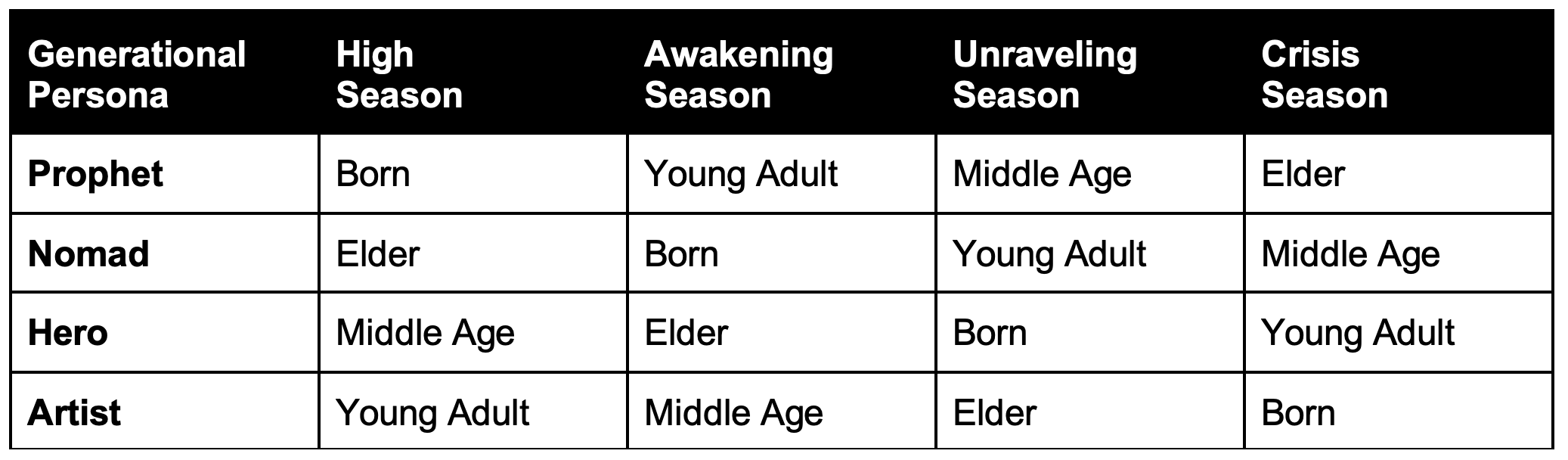
*for illustrative purposes only
Each persona cohort has certain characteristics that tend to be in reaction to the generation that preceded it. So for example, note that Heroes who are formed through and conquer seasons of crisis give rise to Artists who live on the spoils of the Heroic conquest. Artists then give rise to Prophets who decry the excesses of the Artists and hearken back to an age of Heroes. Nomads follow Prophets and mature in an age of spiritual disillusionment as the successes of the heroic age fade and crumble… thus giving rise to Heroes who consolidate a new order – a Fourth Turning to a new saeculum.
After laying all of this out in rather elaborate fashion, the authors then review the annals of Western civilization and demonstrate how history mirrors their theory. In painstaking and impressive detail, they present multiple matrices, personalities, and anecdotes to support their saeculum cycle thesis. They then narrow their focus to what they refer to as the
Anglo-American Saeculum and recognize seven macro cycles:
- Late Medieval (1435 – 1487)
- Reformation (1487 – 1594)
- New World (1594 – 1704)
- Revolutionary (1704-1794)
- Civil War (1794 – 1865)
- Great Power (1865 – 1946)
- Millennial (1946 – 2026?)
After discussing each of these in great detail, they come to our modern period and lay out the fourfold segmentation of the Millennial saeculum as follows:
- 1st Turning: American High (1946 – 1964)
- 2nd Turning: Consciousness Revolution (1964 – 1984)
- 3rd Turning: Culture Wars (1984 – 2005?)
- 4th Turning: ???? (2005? – 2026?)
Please believe me when I say this brief foray into outlining their proposal does not do it justice. They go deep in the weeds on each modern-Millennial generational cohort – from the G.I. (Greatest) generation, to the Silent generation, to Boomers, Gen-ex, Millennials, etc. They cite historical and cultural artifacts ranging from David Letterman to William F. Buckley, Jr., and the founding of The National Review, in support of their thesis. The level of supportive detail is impressive, stimulating, and… tedious.
The Cash Value of The Fourth Turning
But so what? Who cares? Why does this matter? I’m glad you asked.
This is where the rubber meets the road, and the authors do not shy away from their theory’s implications. They use this schema to prophesy that we now stand, in the year 2026, at the precipice of a Fourth Turning crisis that will alter the world as we now know it. Keep in mind that this was written in 1997, and they did “predict” that there could be a financial crisis in the early 2000’s and even a viral epidemic resulting in massive government interventions. The edition I read was reprinted in 2024 and included a preface from the author from December 2023, wherein he said that COVID and MAGA notwithstanding, the Fourth Turning was still yet to come…
And yet. When it comes right down to it, the authors hedge their bets. At the conclusion of their book, when they get to how to the practical “cash value” chapter on “Preparations”, they offer rather generic platitudes like,
- “Define challenges bluntly and stress duties over rights, but don’t attempt reforms that can’t now be accomplished…”
- “Treat children as the nation’s highest priority, but don’t do their work for them…”
- “Tell future elders they will need to be more self-sufficient, but don’t attempt deep cuts in benefits to current elders…”
- “Correct (economic) fundamentals, but don’t try to fine-tune current performance…”
- ”Return to classic virtues…”
- “Build personal relationships of all kinds…”
- “Diversify everything you do…”
And as if those generic principles weren’t enough, consider the possible outcomes to The Fourth Turning that they “prophesy”:
- “The Fourth Turning could mark the end of It could be an omnicidal Armageddon, destroying everything…”
- “The Fourth Turning could mark the end of modernity…”
- “The Fourth Turning could spare modernity but mark the end of our nation…”
- “Or The Fourth Turning could simply mark the end of the Millennial Mankind, modernity, and America would all persevere. Afterward, there would be a new mood, a new High, and a new Saeculum…”
Deep breaths. Ahem. I hope you feel a bit of whiplash and some frustration. I mean – just imagine if you waded through their 350-page book to have that kind of prophecy delivered to you? Forgive me for being a bit crass, but what in the actual heck?
What This Book Reveals
I don’t mean to be overly sour about the book – honestly. I think it offers genuine insights, and I feel edified by reading it. Thinking about the trajectory of human history and the
multi-variable roots of our culture is always worth doing. But if we pay close attention, we see the authors’ sleight of hand. Their elaborate structure is quite fascinating, but in the end, it is of almost ZERO predictive value at a tactical-practical level – outside of the fact that the world is a wonderful and risky place, so in their own analysis, we’d better live by our principles.
But before we dismiss this all out of hand, let’s ponder what takeaways this reflective exercise gives to us…
First, we should give careful thought to our understanding of human history and development because what we believe about the future has implications for how we invest. May I submit to you that there are a handful of historical-philosophical views available that most people choose from:
- Stalemateist: The best aspects of human development will get better, and the worst aspects will get worse, resulting in a kind of social stalemate. We cannot expect much in the way of real net progress or regress. We must resign ourselves to the never-ending back-and-forth of human crises and triumphs that exist alongside one another.
- Declinist: The world is becoming a darker place, and we should prepare for the worst – or maybe the rapture – or don’t spend too much time polishing brass on the Titanic. Take care of yourself and your kin as best you can, and hunker down for the storm. And don’t bother with Treasuries. Go long on physical gold. Maybe you can trade it for green beans in the post-Apocalypse.
- Triumphalist: Humanity will prevail in eradicating poverty, inequality, sickness – and maybe even death as we explore transhumanism and unlock the vast secrets of the universe. Mars, here we come!
But which one of those does David Bahnsen/TBG subscribe to? Are those the only options? No, they are not. For the purpose of simplicity, I will posit our philosophy of history as follows:
- Historical real-optimist: Humans live in an incredibly abundant and challenging world that we are uniquely called and enabled to steward and develop. Imperfect humans will always face risk/reward trade-offs and will never fully triumph at utopian levels. But we will make a progressive difference in this world as we seek to be fruitful in service to others. An honest appraisal of history bears out that virtuous liberty and free market economies are the surest path to optimal human flourishing.
What Can We Predict?
Well, for starters, we can’t predict the timing or nature of macro-level Black Swan events. If we could, they wouldn’t be Black Swans. What we do know for certain is that they have always happened and will continue to happen. Wars, epidemics, financial failures – check, check, check.
That doesn’t sound very optimistic, does it? That’s the realism part. Look, if you’ve followed David Bahnsen for any amount of time, you know he does NOT predict what “markets” will do. That is a fool’s errand for a million reasons. Our philosophy of history – and of investing – is based on what we can predict – which focuses on immutable dynamics of this world and human behavior. Namely:
- This world will always be a place of abundant opportunity and major risks, otherwise known as trade-offs
- Humans respond to economic incentives – always and forever
- Humans create value (profits) by serving other humans (through products and services)
- Math always wins (internal compounding/reinvestment of the profits of human enterprise)
This is why, dear reader, we are so committed to dividend growth as our North Star. It is not just a good investing idea in a universe of ideas. It aligns with our core understanding and philosophy of this world and human history. It focuses on first principles – predictable and unchangeable realities. It does not degenerate into vague platitudes or rely upon intricate matrices. It sees reality as it is and faces it head-on. It recognizes trade-offs, seeks productive human value creation, and diversifies accordingly. It is not declinist or triumphalist. It is not cynically stalemateist. It simply sees the world and humanity as they are. And then it does the math – internal compounding math. And it invests in that thesis.
In Conclusion
You can only imagine that I hope the wealthy man who reached out to TBG will read this and find something of value here. I believe to my very bone marrow that his beneficiaries would benefit from the investment management of TBG. But if I never hear from him again, it is okay because he taught me something. He helped me appreciate how much our view of the past and the future matters. And I was reminded once again that The Bahnsen Group is on the right side of history and the future.
Brett Bonecutter
Private Wealth Advisor