Dear Valued Clients and Friends –
It has been a wild start to February in markets, though today was a nice day to be a boring day. We go around the horn per usual in today’s Dividend Cafe.
Dividend Cafe on Friday did a deep dive on the President’s selection to be the new chairman of the Federal Reserve, Kevin Warsh. This topic bleeds into many other crucial topics around monetary policy, as well. The written version is here (my favorite), the video is here, and the podcast is here.
Off we go …
|
Subscribe on |
Market Action
- Markets opened down a hundred points or so this morning, rebounded to positive territory, and then stayed mostly level from there throughout the rest of the day.
- The Dow closed quite flat (up 20 points or +0.04%) with the S&P 500 up +0.47% and the Nasdaq up +0.90%
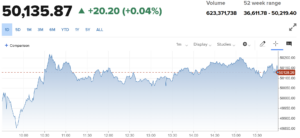
*CNBC, DJIA, February 9, 2026
- The Dow’s close above 50,000 on Friday was a momentous event. I recall the day the Dow first passed 10,000 back in the late 1990s, believing it was the coolest thing I had ever seen. I also recall seeing the Dow touch the 6,000s, a full ten years later, at the bottom of the financial crisis. And now here at 50,000, it has been a cruel set of decades to perma-bears (that is true of history). It may seem like just a round number, but the long-term significance is a big deal – markets are discounted values of future cash flows – and the human spirit generates future cash flows very, very well.
- In the rout of the software industry last week, the P/E ratio dropped from 28x to a still very frothy 23x. High-valuation stocks and sectors are always the most vulnerable when a repricing kicks in. And that is really a tautological statement.
- The ten-year bond yield closed today at 4.20%, flat on the day
- Top-performing sector for the day: Technology (+1.59%)
- Bottom-performing sector for the day: Consumer Staples & Health Care (-0.86%)
- The Nikkei was up a massive 4% yesterday (new all-time high) as Japan’s investors loved the results of their election over the weekend (more on that below).
- Two sectors have taken most of the hit so far this year: Software and Private Markets. Other things are down, but the bulk of the downside mathematically is in those two sectors. Only 7% of the software sector is trading above its 200-day moving average.
- While dividend stocks, health care, consumer staples, and midstream energy have been market leaders thus far in 2026, the huge rally on Friday saw breadth over a 5-to-1 advance/decline ratio. It is worth noting that in a down week in markets last week, the number of stocks at a 52-week high expanded.
Top News Stories
- Japan’s female Prime Minister, Sanae Takaichi, won a landslide victory this weekend and now goes into a full term with a broad mandate for her agenda. Japanese markets responded very favorably.
- The Seattle Seahawks won their second Super Bowl last night, soundly defeating the New England Patriots behind a suffocating defense, and a quarterback who never believed what idiotic reporters and know-nothing fans said about him, a quarterback whose entire story and journey can be summarized in two words: Fight on!
Economic Front
- Only 18% of U.S. jobs come from S&P 500 companies. In fact, only 25 million out of 160 million jobs come from companies with more than 500 employees. You show me a weak job environment for small business, and I will show you a weak job environment, period.
Housing & Mortgage
- The average 30-year mortgage rate remains above 6%. While 6.2% is much closer to 6 than 7%, the fact remains that the rate has stayed right around the low 6’s for quite some time. What the catalyst will be to something around 4.5-5.25% remains to be seen.
Federal Reserve
- Because I devoted so much time in Friday’s Dividend Cafe to my own critique of QE, I thought a “cut and paste” of this list/summary from my friends at Strategas Research was appropriate:
The Problems with QE-Forever*
1. It was regressive.
2. It led to a massive misallocation of capital.
3. It rewarded financial engineering over capital spending.
4. It changed the concept of risk for policymakers.
5. It changed the concept of risk for fiduciaries & investors.
6. It damaged bank profitability.
7. It Created Greater mistrust of political elites and technocrats.
*Investment Strategy Viewpoint, Never Let the Fed Be the Only Game Town Again, November 3, 2023
Oil and Energy
- WTI Crude closed at $64.43, up +1.4% on the day
- With all the market volatility last week, and both oil and natural gas down on the week, midstream again posted a positive print, rising +2% on the week and passing +10% YTD.
- The midstream space was aided by Enterprise Product Partners (EPD), perhaps the major pipeline company in the country, setting the stage with not only better-than-expected results but higher-than-expected guidance for 2026 (and 2027). The overall midstream sector results this earnings season have created a boost as more companies than not have beaten expectations, kept capex plans prudently reasonable, and indicated optimistic guidance for the year ahead.
Ask TBG
| “How would Kevin Warsh be able to reduce longer-dated bonds from the Fed’s balance sheet without causing market disruptions? Are you envisioning an “operation twist” scenario?” ~ Jason S. |
| I do believe he could let longer-dated “roll off,” and replace them with shorter-dated bonds (so no change to the balance sheet but a twist in duration to reduce the significance of the full yield curve in the balance sheet). I am not sure he will do that, but that is one option.
But I think the most likely scenario is that he will signal to markets his intention to change the duration of their portfolio, and then do so with “roll-off” over time, avoiding a shock-and-awe activity in markets, but allowing the tool of guidance (expectation setting) and incremental duration shift to do the work for him. It is important to note that this is the opposite of Operation Twist, but effectively accomplishes what I refer to – changing composition of maturities on the balance sheet without reducing the balance sheet. Finally, I have to say that I believe Warsh is going to coordinate with Secretary Bessent more than any Fed-Treasury Accord we have seen, and some coordination of Treasury issuance specifics with Fed open market activities could go a long way in this policy aim. |
On Deck
- I am off to Florida Tue-Thurs this week for a plethora of meetings and a couple of speeches. Dividend Cafe on Friday will be looking at the productivity promise of AI, and what the opportunities (and hype) all mean for investors
Congrats to the city of Seattle, and congrats to the Pacifica Christian Triton basketball team for their fourth consecutive league championship. When you cannot stand the news any longer, sports are there as the far healthier parts of life.
With regards,
David L. Bahnsen
Chief Investment Officer, Managing Partner
The Bahnsen Group
www.thebahnsengroup.com
The Dividend Cafe features research from S&P, Baird, Barclays, Goldman Sachs, and the IRN research platform of FactSet.