Dear Valued Clients and Friends –
There is a lot of meat on the bone in today’s Monday edition of the Dividend Cafe, with some extra focus in the Public Policy, Fed, and Energy sections. A true trip around the horn awaits.
Dividend Cafe on Friday looked at the March market correction, the reality of market corrections, historical ways to deal with them, and the definition of a bubble burst (in contrast to a correction). It asked if the current AI moment constitutes a bubble and made some predictions about different categories of AI companies. It concludes with a series of takeaways for all investors. The written version is here (my favorite), the video is here, and the podcast is here.
Off we go …
|
Subscribe on |
Market Action
- Markets opened down -200 points this morning, got near the even level an hour into trading, then fell -500 points and stayed down around that level throughout the day
- The Dow closed down -557 points (-1.13%) with the S&P 500 down -0.41% and the Nasdaq down -0.19%
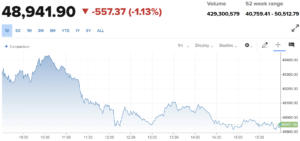
*CNBC, DJIA, May 4, 2026
- It is safe to say that today was perhaps the first day in several weeks when markets began to question whether the situation in Iran is really headed toward some sort of end any time soon.
- It is pretty unbelievable how much financial conditions have improved over the last month. Interest rates have stabilized, and capital markets have remained quite open and active.
- The massive +10.4% move higher for the S&P 500 in April pushed the market back into positive territory for the year.
- The ten-year bond yield closed today at 4.44%, up six basis points on the day.
- Top-performing sector for the day: Energy (+0.85%) – only positive sector on the day
- Bottom-performing sector for the day: Materials (-1.57%)
- The eleven days it took to recover from the 10% market drop caused by the Iran war? The quickest recovery from a 10% drop, ever.
Top News Stories
- President Trump announced new efforts to move ships through the Strait of Hormuz without involving naval escorts. The initial analysis across my desk in the first 24 hours literally varied from “this is going absolutely nowhere” to “this is a complete game-changer,” and both of those polar opposite readings came from very reputable firms.
- Iran says it attacked the UAE today; the UAE says it intercepted missiles fired at it; the U.S. says it sank Iranian boats in the Strait of Hormuz; the President says if Iran attacks U.S. ships in the Strait of Hormuz, it will “blow Iran off the face of the earth.”
Public Policy
- The government’s attempt to rescue Spirit Airlines fell apart Friday night, and the company has officially informed creditors it is ceasing operations. Commerce Secretary Howard Lutnick attempted a $500 million government loan that would become senior in the capital structure and give the government warrants for 90% of the equity, but of course, that would cramdown the current senior creditors, who have liquidation rights and believe they will recover more in an orderly bankruptcy.
- In 18 of the last 20 midterm elections, the incumbent party in the White House lost seats in the House. The expectations for the House of Representatives in November are not unexpected in markets. The area where markets may possibly face a surprise is not the House but the other chamber, where some wonder if majority control of the Senate is vulnerable. I admit by 90% probability of maintaining a GOP majority has come down, but I still believe the really challenging math, based on what seats have to be defended and what seats have to be gained, leaves it somewhere around 75%. Candidly, with Governor Mills out of the Senate race in Maine, I suspect the Republicans’ chances of holding the Senate are now higher than even 75%.
Economic Front
- The 190k print in weekly initial claims last week is the most interesting data point out there right now, as it would appear that job firings continue to be very, very low (even if hirings remain quite subdued, as well).
- ISM Manufacturing did not change in April, seeing the same 52.7 from the month prior. Employment in Manufacturing fell deeper into contraction, but New Orders and Production increased.
- Torsten Slok of Apollo had an interesting point regarding employment in the travel agency space that I think is useful for much of the AI discussion. Yes, online booking changed the travel agency space dramatically over the last 15-20 years, and yet cheaper travel booking enhanced demand, which led to increased hiring for complex or luxury travel, not to mention corporate bookings. The end result is that we currently have almost the same level of people working in the travel agency industry as we did in 2010.
- Few economic questions matter more than this for the remainder of 2026: Will we see business investment and capital expenditures in anything besides AI? I have commented in my last ten client talks and written about this at least a dozen times – that capex ex-data center/AI is essentially negative in our economy. For mega-large-cap companies (all of this being concentrated in AI hyper-scaler spending), capex is up > +20% year-over-year. For small and mid-size public companies, there has been no increase, and outside of public equities, the data is negative, especially for companies with fewer than 500 employees. According to NFIB, only 16% of small businesses plan any capex in the next six months at all (the lowest level since 2009). 50% of total S&P 500 capex is … in Technology (that number has been between 20% and 35% for most of the last 40+ years).
Housing & Mortgage
- The average 30-year mortgage rate is sitting at 6.25% (national average), after briefly getting very close to 6% in mid-April.
Federal Reserve
- Despite the frustration many in the administration feel about Chairman Powell’s surprise announcement that he plans to stay (for now) as a Fed governor when his chairmanship comes to an end in two weeks, there is an optimism within the administration from people I spoke with that he will agree to leave sooner than later, and that his posture was to assert as much leverage as possible to expedite bringing all the silliness to an end.
- But whatever people think about what Powell should do or not do, and what he will do or not do, the markets do legitimately question the math of how Fed governors will be able to do anything with rates the rest of the year. In fact, a 13% chance of a rate increase has worked its way back into the fed funds futures market, and the implied probability of no cut (or a hike) by the end of the year is up to 92%
- An interesting focus on the intentions of Kevin Warsh as new Fed chair – what he believes about a Fed role in coordinating currency swap lines with foreign countries. It is true that this discussion is quite relevant in terms of how the Treasury protects dollar liquidity and also what governors exist to limit excessive use of this policy tool by the Treasury, but this topic is now being used to evaluate the nature of Fed independence (that is, should the Fed provide dollar liquidity in currency swaps to foreign governments if the Treasury Department asked them to). This is certainly an element pertinent to monetary policy, or at the bare minimum, adjacent to it (impact on the Fed’s balance sheet and the fact that the FOMC has to vote on it). However, congressional and media interest in what this topic means for “Fed independence” appears to have come out of nowhere, as I certainly do not remember this being a great concern in past times of Fed/Treasury coordination around swap lines and dollar liquidity provisions.
Oil and Energy
- WTI Crude closed at $105.30, up +3.2%. Seeing oil at $105 and stock markets where they are is truly surreal.
- A major takeaway from Exxon’s earnings release on Friday is the context behind why the Strait of Hormuz’s closure has not made things even worse:
“I think we all know there was a lot of oil in transit on the water, a lot of inventory on the water that has been deployed in the first month of the conflict. Strategic petroleum reserves have been released. Commercial inventories have been drawn down. And so we’ve seen that play itself off and mitigate the impact as we move through March and then here through April. As you get to kind of minimum working levels of inventory on the commercial side, you’re going to lose one of these sources of supply. And so we anticipate as that happens and the Strait remains closed, that we will continue to see increased prices in the marketplace.”
- The decision by the United Arab Emirates (UAE) to leave OPEC+ is a big deal, and I believe will prove to be a positive one. It allows more oil to come on the market (theoretically) in that it removes artificial barriers to supply that cartels definitionally impose. The geopolitical implications are that it frees up the UAE to take its position on Yemen more robustly without the interplay with OPEC membership. Qatar left in 2019, and ultimately, I imagine more countries are to follow.
- Oil was up +11.3% last week (and yet the S&P was up almost 1%, further proof that the oil/stock market inverse correlation has broken for now). Midstream rallied +4% as the energy complex traded up and a largely positive earnings season broke out. My major takeaway from the earnings results from ~10 midstream companies I thoroughly digested: U.S. energy companies are seeing massive supply disruptions from Hormuz closure, more than is understood, substantially enhancing demand for domestically produced energy products.
- U.S. oil rig count in February, before the war broke out and oil was at $68: It was 407. U.S. oil rig count now: 408. U.S. energy producers do not believe these prices are going to last.
- Current average gallon of gasoline: $4.45
Ask TBG
| “If OPEC producers leave OPEC it means they will tend to produce as much crude as possible bringing up supply and bringing down prices over time. Wasn’t OPEC formed to keep prices from going too low by restraining production and keeping prices higher? How does the UAE leaving OPEC help American producers?” ~ Cliff G. |
| It is clearly not the case that OPEC’s objective (with or without the UAE) is to produce as much crude as possible and bring up supply (and prices down). OPEC has spent many years doing the exact opposite – curtailing production to maintain prices and profits at the sweet spot of their desired market share. The U.S.’s role as the marginal producer impairs OPEC’s ability to have the cartel effect on prices they want to have, but the premise of the question is false – OPEC is not there to always drive prices down; it is there to drive prices up or down, as they believe will maximize their spot in the crux of supply and demand (where prices lie). ~ David L. Bahnsen |
On Deck
- The longest Weekly Portfolio Holdings Report we have perhaps ever had will be in client inboxes early Wednesday morning as we report on our busiest week of the earnings season.
May you have a wonderful Monday night. I am looking forward to seeing many of you in Bend, Oregon, on Thursday night. I am also looking forward to the Knicks and Lakers having a good second-round playoff series. Reach out with any questions, any time.
With regards,
David L. Bahnsen
Chief Investment Officer, Managing Partner
The Bahnsen Group
www.thebahnsengroup.com
The Dividend Cafe features research from S&P, Baird, Barclays, Goldman Sachs, and the IRN research platform of FactSet.