Dear Valued Clients and Friends,
In this week’s Dividend Cafe:
- We look at the precedented moves up and down in markets year-to-date, with or without Iran.
- Where “drawdowns” have to be delineated from “bubbles.”
- How to think about the AI moment we are in and whether or not there is a “bubble” in that space
- And finally, a series of investment conclusions that prudently account for current market reality (and future market reality)
Let’s jump into the Dividend Cafe …
|
Subscribe on |
Something for all the Drama Queens
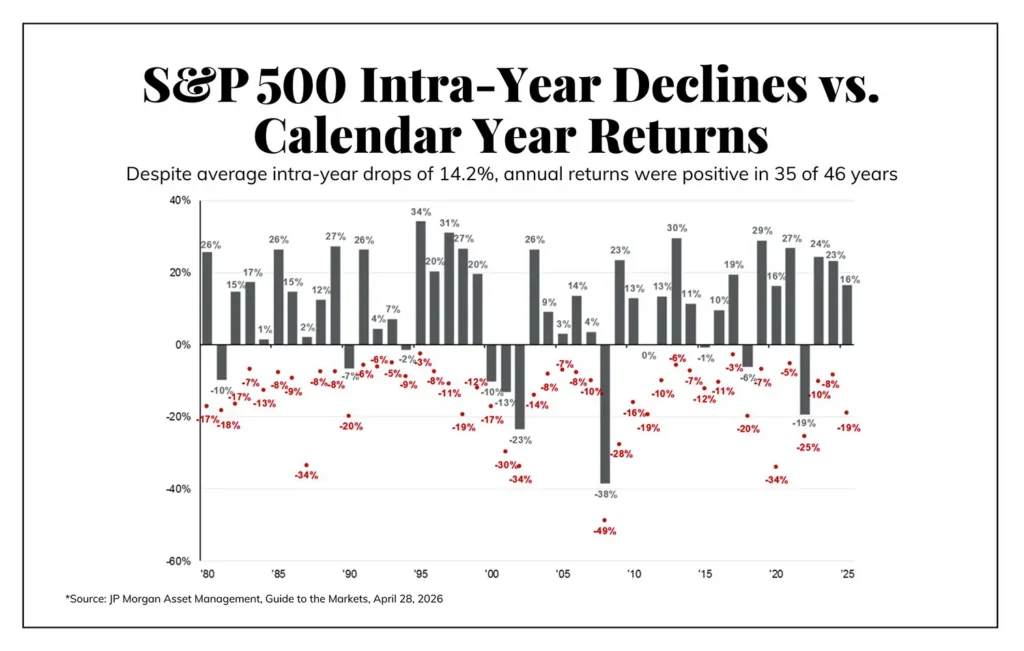
On January 28 of this year, the S&P 500 hit 7,002 in the middle of the day. It would close at 6,978 that day (same level at which it closed the day before). It would drop 100 points in February (just 1.4%) after puttering around up and down throughout the month, but never going above that January 28 high of 7,002. The Iran war would then begin, and while the market didn’t move a lot at first, by mid-March it started a modest decline, hitting 6,317 in the middle of the day on March 30, down -9.8% from its January 28 intra-day all-time high. It would close at 6,345 that day, down -9.1% from its all-time high on a closing price basis. As I type, the S&P is back to 7,162, up +13% in the thirty days from its 2026 trough closing price. Year-to-date, the S&P 500 is now up +4.6%.
Bottom line, the market was up, then down a tiny bit, then down more during the Iran war uncertainty, getting to about a 10% peak-to-trough drop, and has since recovered.
If a correction is market parlance for a 10% drop and a bear market is what we refer to as a 20% drop, I guess the market had a textbook “correction” in March, almost, and it lasted for about 12 minutes (maybe less).
For the Record
I use this chart a lot because I love it and because I believe all public equity investors need to be constantly reminded of what they signed up for. But before I get into the meat of today’s Dividend Cafe I would just point out that IF there was NO Iran war NO $100 oil prices, and NO fear of anything in the Strait of Hormuz or fear of any prolonged military problem, etc., and the market did exactly what it did in March with all of that stuff, you could be forgiven for just thinking it was totally normal… Because:
Opposite Ends of the Fear Spectrum
We entered the year wondering if there was a mania or speculative bubble in markets due to AI and big tech excess. Rather quickly, the narrative turned to a market correction and fear of some sort of sell-off. And before Duke could blow a last-second lead and miss the final four, we were back to talking about euphoric mania.
My friends, it really can’t be both. We can’t have a panic/correction/downside/fear event, and within the same time period as a lunch break, have a mania/bubble/upside/melt-up moment. I mean, we can have one, and we could have the other, but we can’t actually be having both (or have been at the threat of having both) at more or less the same time. It’s an intellectually incoherent concept, and I should add, intellectual incoherence that comes from a totally unstable market emotion. Some may call it bipolarity, but I think it is worse than that. Genuine bipolarity has actual extreme highs and lows in one’s impaired temperament. This perception of markets, that we were in bubble mode in January, but an apocalypse in March, and then bubble mode again about ten minutes after March ended, is not a reflection of truly perceived emotions or impressions – it is completely incoherent and contradictory insanity. And it leads to really bad decisions.
So What About Bad Markets?
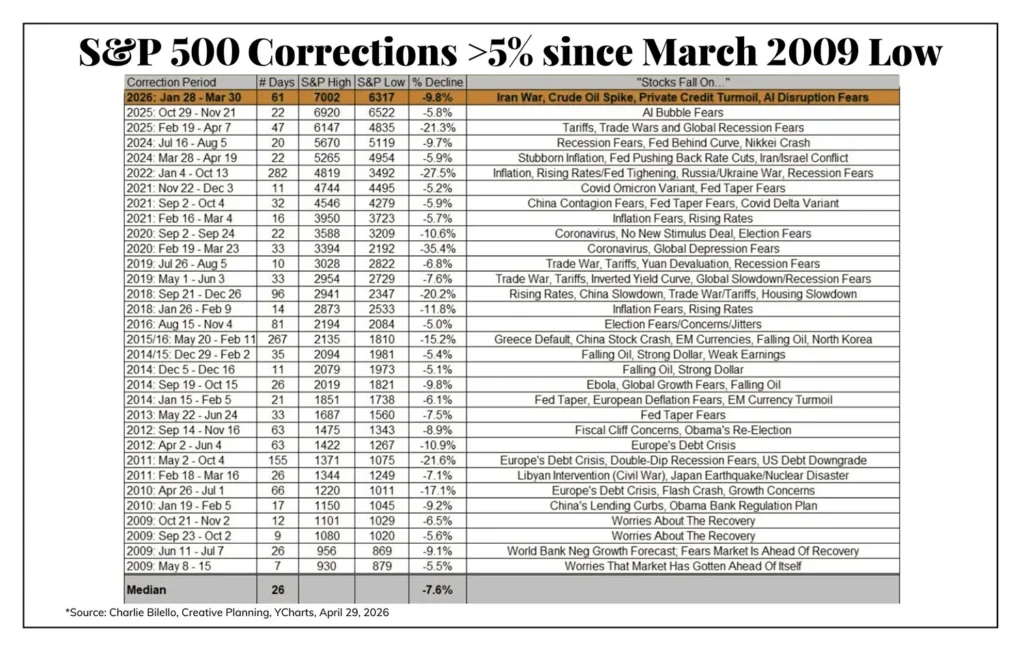
There most certainly are periods of “drawdowns” – whether they reach “correction” level (10%) or not – and they are a permanent part of public equity investing. In fact, there have been 26 moments of the market dropping over 5% since the financial crisis:
There are a few ways investors have traditionally addressed this basic reality:
- To try and trade around them – something called “market timing” – where an investor picks when to be in and when to be out, and attempts to improve their return by effectively pursuing a strategy of being in the market when it is going up and being out of the market when it is going down. There was a time in my career when I spent great effort trying to convince people who should have known better about the comical folly of this notion. Because the appeal of the strategy is so alluring, I have found that many people need to believe that it can be done, and so are not open to the basic reality of how brutal the results are in employing this tactic for dealing with the inevitability of market drawdowns. If you have a friend or bartender or Uber driver or golf partner or a co-worker who assures you that they have successfully traded in and out of markets to capture upside and avoid downside over the years, I have found one simple line that has been quite effective in putting that to bed:
“Can I see the confirms?”
(Confirms are industry parlance for “trade confirmations” that show the official, legal, operational reality of actual trade activity in a real account.) How do I put this gently? Some. People. Are. Full. Of. It.
But I said above that “there was a time in my career where I spent great effort” making my case here. I no longer do because I believe a lot of time can be saved by people who believe they can do it (or that they have found a manager who can do it), just giving it a shot, touching the stove, and then regrouping, a bit poorer (hopefully only a bit poorer), and moving on to reality. America’s greatest political philosopher, Edmund Burke, said it best: “Example is the school of mankind, and they will learn at no other.”
Drawdowns exist in equity investing, and those who believe they can trade around them will either learn from experience or, in an easier way, that they cannot.
- Another approach to drawdowns is to accept them in a “grin and bear it” kind of way – a “buy and hold” approach that repudiates the thinking of option #1 above – and instead views drawdowns as an acceptable price to pay for the long-term premium return of intelligent public equity investing. This really is the opposite of #1, and it has been pretty validated over time. In fact, the above chart with 26 market drawdowns gave investors 26 times to test their strategy, and the “buy and hold” camp is not complaining 17 years later, at all. But …
- The approach we take (and recommend) is much closer to #2 than #1, but with two very, very important caveats:
- We want the asset allocation designed for durability to truly, really, seriously account for the investor’s cash flow needs, liquidity needs, and actual comfort level with volatility. An intellectual embrace of strategy #2 is worthless without a reckoning of comfort, psychology, and temperament. If I am being more candid, I am referring to the fact that many, many investors in strategy #2 don’t make it because they give up. We have to design an asset allocation that allows the portfolio to function within a bandwidth of acceptable outcomes.
- What is missing in strategy #2 is an embrace of drawdowns. I understand the merit of tolerating them and not behaving badly during them. But we want to ensure good behavior by level setting a mentality that sees benefit – actual, indispensable benefit – from them. This is where dividend growth is so paradigmatically different. It turns the reality of market downturns from something to grin and bear to something to cherish, as the inevitable result becomes a greatly enhanced total return as heavy dividends across the portfolio are systematically reinvested during inevitable periods of drawdown, accumulating more shares with which to drive compounding at lower prices. It is a thing of mathematical beauty, and it is conscious, intentional, and anti-fragile (I actually have a whole chapter in my new book (coming August) on this very thing).
It is crucial to understand that a 9% drawdown when we launch a military operation in Iran is not more uncommon or unexpected or “market unique” than any of the other 25+ drawdowns you see in the chart above.
So the AI Mania is Fine?
Not so fast. Why did S&P 500 investors, or dividend growth investors, do fantastically well through 17 years of 26 market drawdowns, whether they addressed it via strategy #2 above or strategy #3? Why did Nasdaq investors in 1999 NOT fare so well (a 15-year recovery, and just a low/mid single-digit annual return despite the greatest technology progress in human history)? Concentration (which means the lack of diversification), and a true bubble in that concentration. Bubbles bursting are not “drawdowns,” at least not in the way I am using the term above. They are existential. They rip people’s faces off. They undermine actual financial goals, which is very different than saying, “they make your statement value go up and down a bit.” The Nasdaq bubble burst, like the Japanese property bubble, was not a “volatility” event – it was the difference between success and failure.
Differentiating between a “bubble” and standard-fare market volatility is not as complicated as some make it out to be. For one thing, it is mathematically rectified with standard diversification. A collapse of 60-80% lands differently when it applies to 10-20% of your portfolio as opposed to 100% of it. I use the number of 60-80% to be nice, but also to reference things like the 2000 Nasdaq and 1989 Japan market, as opposed to plenty of examples where bubble bursts saw drops of 90-100%. We have so many examples of overvaluation bubbles in market history that it is tempting to believe we have a plethora of examples of the same thing, when in reality, we have numerous examples of different things. Analyzing the possibilities for what happens with this AI moment is very hard by historical reference because (a) there is more than one way to skin the AI cat, and (b) there is more than one historical reference that may end up applying.
I feel very comfortable predicting, without arrogantly adding specificity that I do not know or have, that one or more hyper-scalers are going to have very sub-par returns in the years ahead as a result of misguided capex. Subpar may be catastrophic, or it may just be, well, subpar. One or more may be one, and it may be more, but it doesn’t have to be all. But should some hyper-scalers rationalize their AI capex and some not, and some see good stock price results while others lag, would hardly qualify as a “bubble burst.” But it will surprise some people, and I think this is maybe the least controversial thought I have about the hyper-scalers.
I also feel very comfortable predicting that some AI labs (the actual LLM’s that embody code and AI products) are going to combust, and some will prove to be world-changing. The part I am not comfortable predicting is (a) who will combust, and (b) what the path will be along the way for those who do succeed. I imagine some success stories will have moments of feeling like failures along the way, but I do not know.
I also suspect that there is an uncertain future for the pick-and-shovel companies that are integral to the computing power necessities of this story. I cannot predict that current valuations will not be rationalized, and I cannot say with certainty that growth assumptions will be tested over time. I lean in that direction in both cases, but I am hardly interested in making a short bet there … I am simply offering a risk/reward trade-off proposition – that there is a level of downside risk to the pick-and-shovel story that I find unattractive. Now, if you get past a couple of trillion or multi-trillion dollar chipmakers and expand the “pick-and-shovel” category to include all chip designers, fabricators, data networking plays, data infrastructure companies, compute providers, and storage providers, well, yes, I become very confident that somewhere in this story there will be a serious pile-up of dead bodies. But that may not seem too helpful without any specificity, and I have no specificity to offer.
To reiterate in the clearest way possible: Nothing said above predicts utter apocalypse for all; the worst-case prediction being offered is that there will be casualties amongst the success stories. I am sure things could get worse, and I also believe that narrative of “subpar returns” whereby some companies stay relevant and profitable, but just see the math of their elevated valuations at entry level lead to a disappointing result for investors to be more potent than many would admit right now. And it is hardly a far-fetched idea.
But things that go down 99% as a group are valueless things that were in a price bubble. You can look at a lot of shiny objects throughout history as examples – from Beanie Babies to many dotcom companies to many COVID-era laughing stocks (see what I did there). But groups that have value, but are in a price bubble, generally do not go down 99-100% – because there is some value there.
So Where Are We?
I am fond of Charles Kindleberger’s model for thinking about financial bubbles. He describes the five stages as:
- (Displacement – a legitimate development creates a legitimate opportunity
- Euphoria – the expectation of profits creates rising prices, and rising prices seem to validate the expectation of rising profits (similar to the Soros reflexivity theory)
- Bubble – what happened in stages one and two seems so easy that it begins to attract lots of [dumb] capital looking for easy capital gains. Speculation trumps fundamentals, and no one is really hiding it.
- Distress – more discerning investors begin to take profits, realizing that exorbitant prices cannot be justified by future expectations
- Revulsion – then the outsiders from stage 3 begin to sell in panic, and the bubble bursts
I think identifying which stage a “bubble” is in becomes a lot easier after it has burst. I also think it is a lot easier to look at pre-revenue and pre-profit companies caught up in stage two of the above model and identify them as such than it is to look at companies that (a) are wildly profitable, and (b) have gazillions of dollars from other revenue streams besides AI. I am trying very hard to treat this entire subject with the nuance it deserves. I am not ruling out that the entire space could find itself in this whole model, but I think it is certainly possible that certain sub-sectors will be, and others will not. And even if the entire AI ecosystem finds itself in this model (see: all of technology and internet in the year 2000), a post-revulsion stage whereby good companies can be bought at reasonable levels while bad companies never come back could be extremely opportunistic.
That last sentence scenario has many, many precedents in market history.
Conclusions
- Market action in 2026 has not been unusual or problematic – it has been normal. As the comedian Chris Rock once said of a tiger attacking a magician on stage, “That tiger didn’t go crazy, that tiger went tiger.”
- A broad market correction, more severe than the 10% one we just had, is not possible – it is inevitable. It is assured. It is going to happen. You don’t know when or what will catalyze it, and neither do I. And attempts to avoid it will do much more damage than embracing it.
- Dividend growth investors are well-positioned for market corrections because they are (a) Diversified, (b) holding higher quality companies, and (c) Set to benefit from downside volatility through dividend reinvestment that exists as a matter of mechanics.
- Standard market drawdowns are a good thing. Bubbles bursting are not. In fact, bubbles bursting are basically existential for investors in a non-diversified portfolio.
- The AI moment is hard to identify as a bubble because there are multiple layers and categories within the sector. Predicting that there will be carnage is much easier than predicting that the “whole space” will decline 70%.
- Limiting one’s exposure to (a) the higher quality components of the AI story, and (b) to a limited part of their portfolio, is prudent.
- Whatever “bad” does come in the AI story will very likely end up with an investible opportunity on a selective basis on the other side of the bad.
And in the meantime, prudent investors know what to do. And they certainly know what not to do. To that end, we work.
Chart of the Week
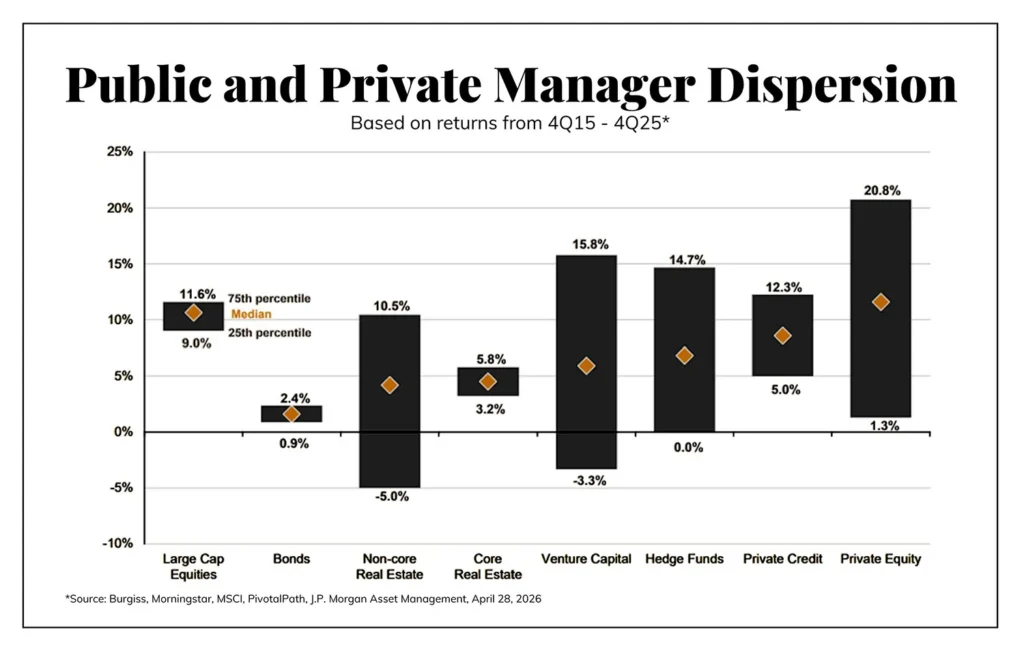
One of the most inane things imaginable is talking about “how private credit is doing” or “how private equity” is doing – divorced from the specifics of the manager. The dispersion of results within all alternative asset classes is substantial, negating the very idea of “beta” in these asset classes. Yes, in large-cap stocks and traditional bonds (the two far left asset classes on the chart), there is not a major difference between the best-performing and worst-performing exposures to those categories. But as you see in private equity, for example, when the very words “private equity” could be referring to managers up 21% per year for the last decade, or 1.3% for the last decade, we are very clearly talking about a category of investment that is manager-specific. Selection matters much more in alternative investing, and this is true across each silo of the asset class.
Quote of the Week
“The long and costly experience of mankind bears uniform testimony against gambling. It is a dangerous or unsocial form of excitement; it hurts character, demoralizes industry, breeds quarrels, tempts men to self-destruction.”
~ Charles F. Dole
* * *
I encourage you to send this to Dividend Cafe to anyone you want. Sometimes I get people asking for permission to forward it to others. It is “free” on the internet for a reason. The services we provide to our clients are not free, but the Dividend Cafe is, and you not only can send it to anyone you’d like any time, but we’d actually greatly appreciate it. The higher readership base we have, the more feedback we get, and I love the feedback, all the time.
Does it feel to you like we are already in the month of May? I am not old enough to start saying things like, “I can’t believe how quickly the years go by as I get older.” But actually, I just said it.
Have a wonderful weekend!
With regards,
David L. Bahnsen
Chief Investment Officer, Managing Partner
The Bahnsen Group
thebahnsengroup.com
This week’s Dividend Cafe features research from S&P, Baird, Barclays, Goldman Sachs, and the IRN research platform of FactSet