Dear Valued Clients and Friends,
We have arrived at the mid-point of 2026, and it has been a wild first half of the year. From a “rotation” to a “never mind” back to a “rotation” in the leadership of markets, there is not only plenty to unpack in the stock market, but a lot to analyze year-to-date around the broad economy. I am going to use some of the themes I started the year with to “check in” on, and I think you will find this analysis of what has transpired in the first half of the year very helpful in thinking about the second half. None of the takes are conventional. All of the takes are sincere. Hopefully, you find this perspective to be informative.
Let’s jump into the Dividend Cafe …
|
Subscribe on |
The Surprises of 2026 So Far
If I told you on January 1 that the Mag 7 (equal weight AND cap weight!) would be down -2% YTD in the first half of the year, what would you have guessed the market would be down? To have the S&P 493 (hopefully you get that this is just the S&P 500 with the Mag 7 taken out) up +15%, allowing the S&P 500 to still be up over +9%, even as the mega-cap darlings were collectively down -2%, has to be the biggest shock to most market watchers. That rotation into financials, industrials, utilities, and other value sectors created a broadening in the market that substantially defended against the weakening of Mag-7 (which was collectively down -13% in June).
But no matter what the surprise around Mag7 may be, I am not sure anyone appreciates the surprise embedded in how equities have performed despite the changing realities of interest rates. Again, if I had told you at the beginning of the year that the two-year treasury yield, then sitting below 3.5%, would pop up to 4.23% by the end of the quarter, what would you have guessed the state of equity markets would be? Not only did the 2-10 curve come in from about 75 basis points to below 30 (the spread between the yield of the two-year treasury and the yield of the 10-year dramatically tightened), but equity markets shrugged it off entirely. The role of short-term rates on equity multiples has been minimal, or at least is taking its sweet time in coming to fruition.
AI Melodrama
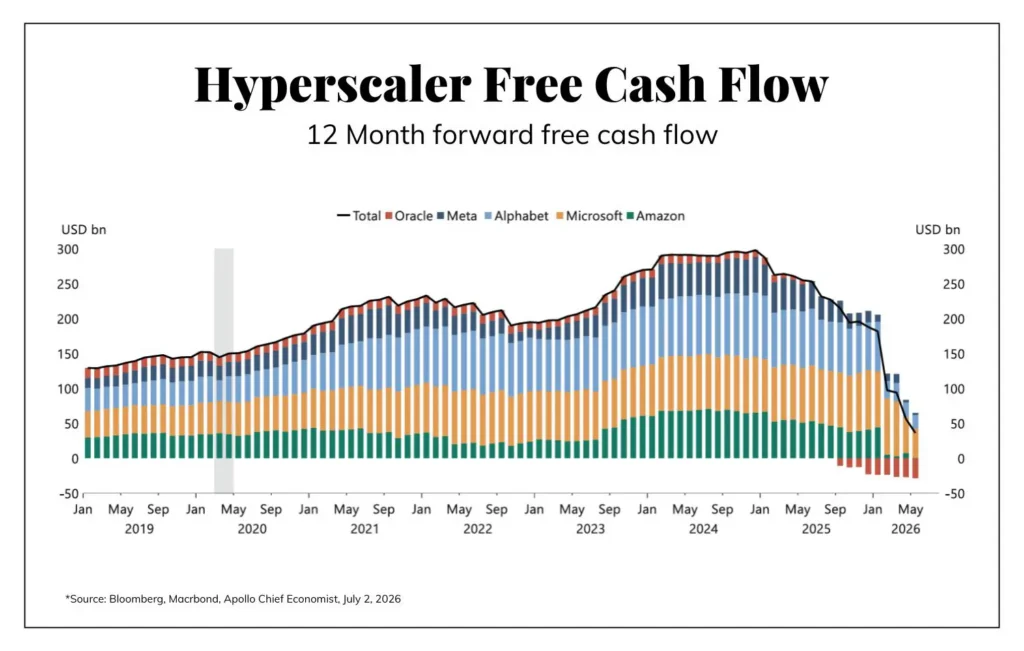
The tension within the AI story is rather fascinating, as well (and was certainly captured in theme #1 for 2026, “AI Vulnerabilities will become much more evident to the markets.” The companies spending the money have been highly volatile, as the diversion of cash flow to capex has created significant investor uncertainty as to how to think about it all. The percentage of cash flow represented by capex has more than doubled, financing activity has necessarily skyrocketed (debt and equity), and investors are processing what is a substantially different risk-reward profile than it has historically been.
Now, as you will see in the section below, the companies receiving the money have largely benefitted, but 2026 has thus far been an anomaly in that the leading “pick and shovel” company of them all, Nvidia, has actually not seen its stock rewarded this year, even as many in its sector have. If we had said at the beginning of the year, “Nvidia will be $10/share lower at the halfway point of the year than it was two months ago,” very few would have expected this kind of market action YTD.
When you get past the “infrastructure” companies of AI, the cloud platforms (hyperscalers), and the language models, you have some application companies where some would argue the real future has to lie. I would argue that, ultimately, it has to be the customers of those applications where the real future has to lie, but some high-profile operating system/application companies have had their biggest quarters ever to start off 2026, but seen their stock hit hard. Palantir, for example, was a $6 stock three years ago that went to $208 by late 2025, before dropping nearly 50% from that high. So, after a -48% drop, is the stock cheap? Well, it is at 240x forward earnings, after this particular collapse, making it the highest P/E ratio for a company this size in stock market history.
Does any of this mean it can’t go higher, or won’t? No. I am simply describing what has happened with some of the leading names in the AI ecosystem. I am not predicting anything. But I will suggest that the up-and-down volatility of names like these tends to numb people to what actually happens over time. That is, you wake up 6 months, 9 months, 1 year, 3 years later, and the “darlings” of the space have all enjoyed massive revenue growth – just as predicted – and the stock price performance has been either pitiful or shockingly unremarkable. It has happened so many times in history that I have lost count.
Let There be Froth
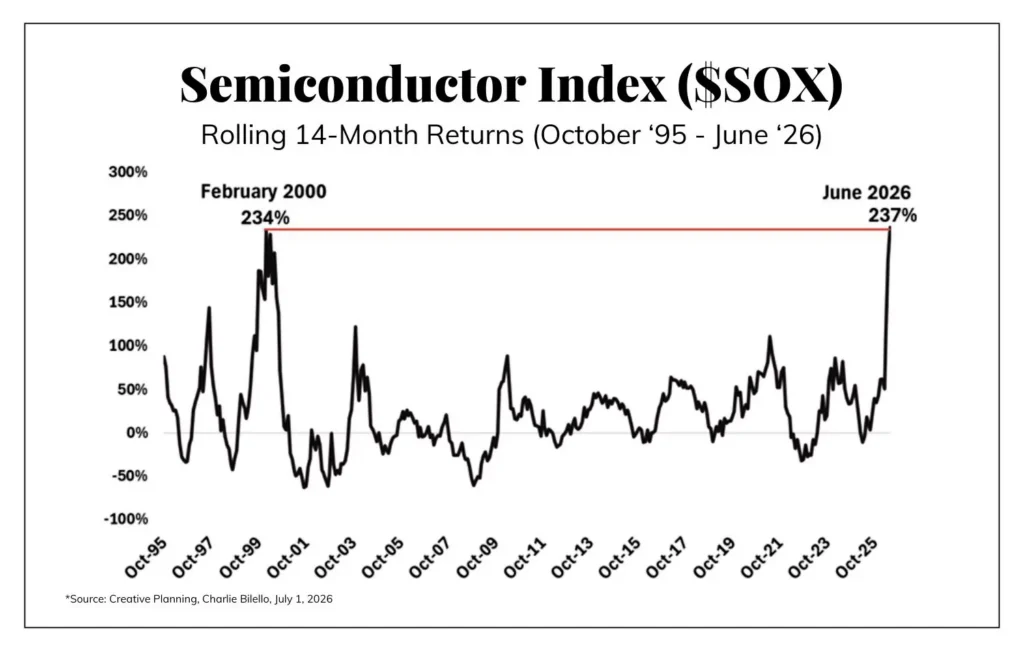
The semiconductor space is up +240% over the last 14 months, with a +90% move in the first half of the year, as markets rewarded the suppliers and somewhat punished the spenders. We last saw this kind of parabolic move in late 1999/early 2000.
The overall technology sector now represents a stunning 36% of the S&P 500, which may seem like it isn’t too high compared to the 34% weighting it was in 2000 (and by the way, that WOULD be significant enough if it stopped there). But actually, there was no “Communication Services” sector in the S&P 500 in 1999/2000 (it was created in 2018), so the actual apples-to-apples comparison is really closer to 50% (bare minimum 45%). The companies are larger, but it has to be said that the “technology ecosystem” exposure inside the S&P 500 is far, far higher than it has ever been.
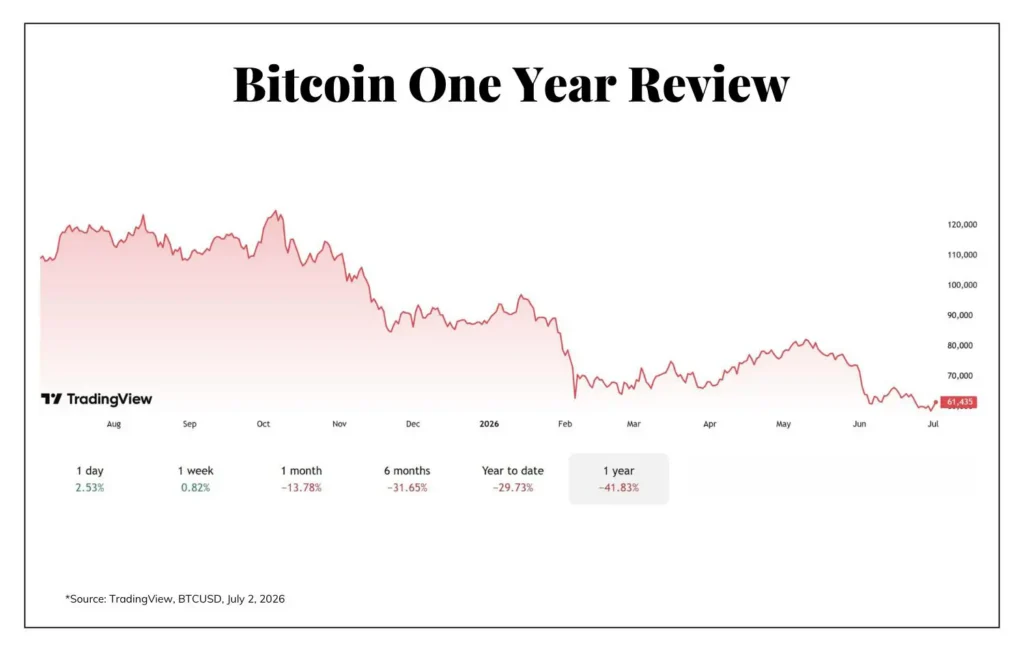
Is my only example of “froth” the parabolic rise in semiconductors? I wish. Now, in the past, I would look at the crypto/bitcoin space for some embodiment of the silliest excess and speculation in markets, but that slow, painful slide has continued, and bitcoin has most certainly not been the source of froth activity in 2026 (down -33% in the first half of the year and down over -50% from its 2025 high).
But we can find plenty of silliness if we are looking in the right places. The ETF for “meme stocks” is up +68% YTD. Momentum and Beta factors are up over +35%. There are now, wait for it, over 400 “single stock levered ETFs” … The gamification of markets is alive and well. IPO mania is here, and I won’t rehash the points made in the Dividend Cafe a couple of weeks ago on this very subject. I will just say that there is ample reason to believe that there are things in markets in need of a “purge.”
One can look at the unbelievable returns in 2020 for some of the past cycle’s shiny objects, and then see how that netted out when the 2021-22 reckoning came. Our philosophy has never been to “buy froth and exit before the downturn” – but rather, to “not buy froth.” History has been kinder to such an approach.
Shiny Objects Short-Term Record
| Company | Ticker | 2020 Return | 2021-2022 Return | 2020-2022 Return |
|---|---|---|---|---|
| C3.ai Inc | AI | 230% | -92% | -73% |
| Redfin Corp | RDFN | 225% | -94% | -80% |
| FuboTV Inc | FUBO | 214% | -94% | -80% |
| Chewy Inc | CHWY | 210% | -59% | 28% |
| DocuSign Inc | DOCU | 200% | -75% | -25% |
| Unity Software | U | 195% | -81% | -45% |
| Shopify | SHOP | 185% | -69% | -13% |
| Zillow Group Inc | Z | 183% | -75% | -30% |
| Five9 Inc | FIVN | 166% | -61% | 3% |
| Carvana Co | CVNA | 160% | -98% | -95% |
| Invitae Corp | NVTA | 159% | -96% | -88% |
| CRISPR Therapeutics AG | CRSP | 151% | -73% | -33% |
| Wayfair Inc | W | 150% | -85% | -64% |
| Roku Inc | ROKU | 148% | -88% | -70% |
| Teladoc Health Inc | TDOC | 139% | -88% | -72% |
| Chegg Inc | CHGG | 138% | -72% | -33% |
| GSX Techedu Inc. | GOTU | 137% | -95% | -89% |
| Palantir Technologies Inc | PLTR | 136% | -73% | -36% |
| Coupa Software Inc | COUP | 132% | -77% | -46% |
| Stitch Fix Inc | SFIX | 129% | -95% | -88% |
| Elastic NV | ESTC | 127% | -65% | -20% |
| RingCentral | RNG | 125% | -91% | -79% |
| Okta Inc | OKTA | 120% | -73% | -41% |
| PayPal Holdings Inc | PYPL | 117% | -70% | -34% |
| Spotify Technology SA | SPOT | 110% | -75% | 0.47% |
| StoneCo Ltd | STNE | 110% | -89% | -76% |
| Opendoor Technologies Inc | OPEN | 110% | -95% | -89% |
| Virgin Galactic Holdings Inc | SPCE | 105% | -85% | -70% |
| Wix.com Ltd | WIX | 104% | -69% | -37% |
| Lordstown Motors Corp | RIDE | 102% | -94% | -89% |
*YCharts, Charlie Bilello, 12/31/22
Economic Tug of War
My second theme for 2026 was the “economic tug of war between two unknowns” – largely centered around the push-pull of tax incentives for business capital expenditures on one hand versus the disincentives and uncertainty of tariff expense on the other. The picture has not gotten that much clearer halfway through the year, but here is what we do know:
- The Supreme Court’s ruling on the unconstitutionality of IEEPA has likely reduced tariff expense to the U.S. economy by $70 billion (roughly $120 -150 billion was invalidated, with about $50-70 billion replaced with alternative rationales like Section 122).
- The business investment levels ex-AI have been far lower than anticipated.
- Business investment levels in AI have been far higher than anything we have ever seen.
- Labor markets have marginally improved, and many of the fears of worsening layoffs have not materialized. Weekly jobless claims have stayed level, the unemployment rate has stayed level, and new job creation has modestly picked up. As I was writing this Thursday morning (July 2) we got a downward revision in the May jobs report and a June report below expectations, and one has to wonder if we are about to get another summer of revisions of what we had thought had been a positive period.
- Offsetting some of the other concerns and questions has seemingly been a pickup in entrepreneurship. Business applications and solo-founder start-ups have picked up, indicating the potential for AI opportunities working their way into self-employment in a way that may not be easily measured in the data.
Clear as mud, right? I will say this. I believe the economy is largely dependent on AI capex (data center, compute, etc.), yet the overall jobs and wages picture is stable. I do not think the tug-of-war is resolved. I do not think the economy is in bad shape. And I do not think we are enjoying the “strongest period ever.” What I think is that the tug-of-war continues.
The Recurring M&A Prediction
We are looking at $1.9 trillion of deal value across corporate activity in the last four quarters. You may be tempted to think that lower interest rates are creating a surge in deal appetite, but alas, we know it can’t be that (since rates are higher, not lower).
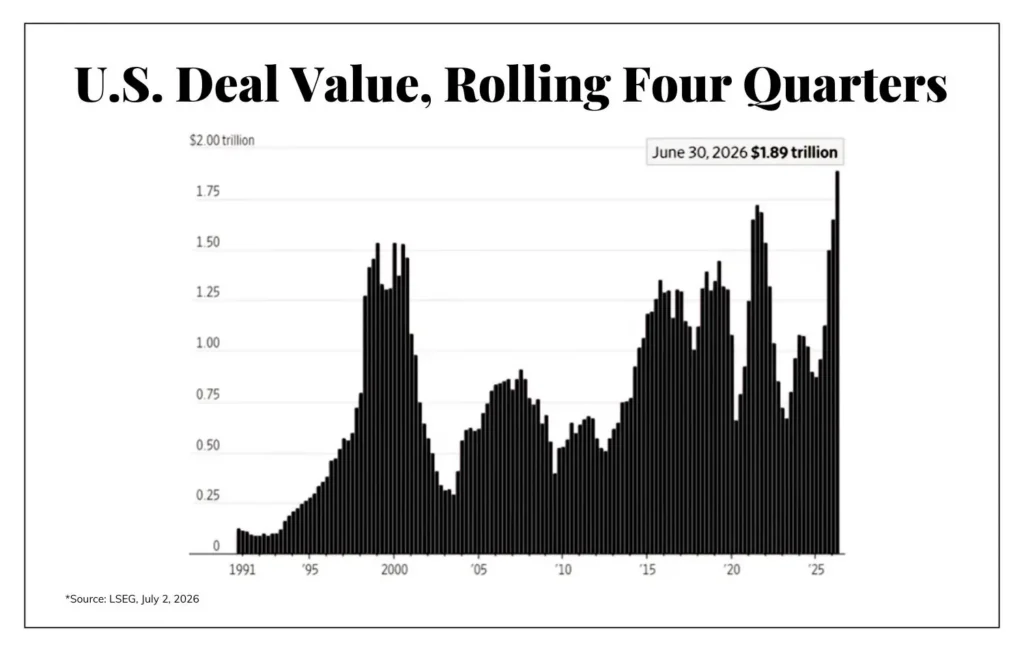
44 SPAC mergers have been announced year-to-date, totaling $37 billion in value. It was 33 deals worth just $15 billion at this same point last year. Another 359 SPAC’s have been formed with $57 billion in dry powder waiting to be deployed.
I felt this was a lay-up when I called for it at the beginning of the year, and there is still a long, long way to go for private equity to achieve the number of exits needed, but this theme has been abundantly true in the first half of the year.
Don’t Forget the Midterms!
I started the year by saying (and I quote)
“Midterm elections: The House will flip to Democratic control but the Senate will stay under GDP control”
I have held that view throughout the first half of the year, as has (for the most part), the consensus view and prediction markets. One could argue things got harder for the Democrats in the House (on the margin) with some of the final outcomes of redistricting, and one can argue that things are harder for the Republicans in the Senate with some of their primary outcomes, but net-net, I still believe that the math is such that it will be hard for the Republicans to hold the House, and hard for the Democrats to take the Senate.
I want to make a couple of points:
- The special elections held thus far have suggested the possibility of a blue wave. Special elections, though, are often not good at foreshadowing.
- The President’s approval ratings are very low, but so are the generic Democrat Party approval ratings. Like, very low.
- There are fewer races up for grabs in the House than ever. Partisan redistricting (from both parties) is a big part of that. “Split-voting” is less common than ever (a voter who voted one way for President two years ago but a different way for Congress now). And most pollsters have 15-20 races as “up for grabs” – not the 30, 40, or 50 we often see.
- The math in the Senate is as follows: The Republicans presently have a 53-47 lead. The Democrats are defending seats in Georgia, Michigan, and New Hampshire. The Republicans are defending in Maine, Ohio, North Carolina, Texas, Iowa, Nebraska, and Alaska. The Democrats may hold all three they are defending, but then to win four of those seven is a tough climb. My best guess is that the Democrats prevail in North Carolina and maybe one other state, but not enough to get the majority.
- The fundraising side no one is talking about: The RNC has $125 million in the bank; the DNC has $3.5 million of debt (negative). The NRCC has $82 million; the DCCC has $73 million. The NRSC has $49 million; the DSCC has $39 million. Those things matter on the margin in close races.
What does it all mean for markets? My objective, non-partisan belief is that divided government is what markets expect, and often where markets do best. The composition of divided government matters, though, and a Republican-majority Senate with a Democrat-majority House is likely a better market outcome than a Democrat majority in both chambers (committees, cabinet appointments, agenda-setting, etc.). I obviously respect that many have different visions of what they want for the country or what they personally believe in. My own leanings are towards traditional, conservative, Reaganite politics, so I obviously have no dog in this fight whatsoever (IYKYK), but I do feel I am being an objective commentator on the market response to the variety of possible outcomes on the table.
Our Other Themes
Energy as a solid contrarian play has thus far been the right call in 2026, but it is important to point out that my theme, my strategy, and my take have not been, and never will be, about one year (let alone one war). The small-cap take has played out as expected, though even more so than I would have guessed. Housing has begun to get cheaper, but has a ways to go. And I will address foreign appetite for U.S. securities later in the year (too much nuance to cram in here).
Market Recap
Small-cap stocks and emerging markets led the way in asset classes during the first half of the year. Most “boring” bond asset classes hung in there with slightly positive returns (Treasuries, Munis, TIPS, corporates, etc., all up, but between just 1% and 2% YTD). Value has substantially outperformed Growth. Commodities have done extremely well, though gold and silver have come into negative territory after their big peak earlier in the year. Oil had skyrocketed, of course, in the peak of the Iran war, and has largely normalized in the last few weeks.
Within equity markets, Energy, Industrials, and Technology were all up about +20%. Financials and Consumer Discretionary were each down but just around -1%.
Conclusions
I haven’t changed my mind on (a) the impossibility of timing when certain irrational things come to an end, OR (b) the inevitability of certain irrational things coming to an end. I stand behind both things.
Some irrationality has begun to face reckoning. There seems to be a lot more out there that faces some degree of normalization. 2026 so far has, counter-intuitively, not entirely rewarded froth and irrationality, but neither has it totally punished it.
I believe the market is acting as if it wants to avoid a total repeat of the 1999 excess and the 2000 correction, but there are just pockets of activity in various directions pulling in different ways. I find it to be a remarkably smart time to be removed from the direct contact – avoiding bad behavior, avoiding excess and momentum, and leverage, and sticking to the disciplines that make up a coherent investment strategy to begin with. The sensible has done modestly better than the excessive YTD, but there is plenty of room to go. And truth be told, plenty of room for a relapse.
Quote of the Week
“There is no truth more thoroughly established than that there exists in the economy and course of nature an indissoluble union between virtue and happiness; between duty and advantage; between the genuine maxims of an honest and magnanimous policy and the solid rewards of public prosperity and felicity… The propitious smiles of Heaven can never be expected on a nation that disregards the eternal rules of order and right which Heaven itself has ordained.”
~ George Washington
* * *
Happy 250th birthday to the greatest country on God’s green earth. May the American experiment live on, and may what those ideals represent be defended boldly and proudly in our thoughts, words, and deeds. Happy Independence Day – and enjoy whatever your weekend has in store!
With regards,
David L. Bahnsen
Chief Investment Officer, Managing Partner
The Bahnsen Group
thebahnsengroup.com
This week’s Dividend Cafe features research from S&P, Baird, Barclays, Goldman Sachs, and the IRN research platform of FactSet