Dear Valued Clients and Friends,
Some of you have 19-year-old kids. One of my three is 19 right now, so I have one, have had one, and will have one. Some of you had a 19-year-old a long time ago. Some of you haven’t had the pleasure yet, but will in the future. Some of you are 19-years old. And for many of you, it may just not be on your radar yet. When I was pre-married or even married but pre-kids, I spent very little time thinking about what it would be like to be the parent of a 19-year-old. But regardless of your relationship to the 19-year-old community, if you are reading Dividend Cafe and have a general interest in investing, I want to ask you a question:
Do you believe it makes sense to take your instruction from a 19-year-old?
Now, I do not mean by this, “have a 19-year-old tell you what investments are good” – because for all I know, there are some outstanding 19-year-old analysts out there! What I am referring to is more along the lines of the consumer habits, the fads, the vibes, the interests, the hobbies, and the various things (investment-oriented or otherwise) that interest 19-year-olds. Do you believe that you should select your investments based on what the 19-year-old population is talking about?
You can use age 16 if you want – or 22 – or whatever “young age” works for you. What I am going to suggest in this week’s Dividend Cafe is that many (and I mean, many) people are taking one premise that has some validity to it, and applying it in a way that is utterly incoherent, irrational, and in the context of history, dangerous. I think working through this issue the right way will re-focus us as investors, not merely away from a dangerous investment methodology, but towards a quite coherent one. And when it comes to investing, I think people of all ages should be laser-focused on that which is coherent.
So, with that said, let’s jump into the Dividend Cafe …
|
Subscribe on |
Father-Daughter Connection
I frequently ask my daughter what she and her friends like these days when it comes to well-known brands, choices, products, cultural categories, etc. For one thing, when I buy her concert tickets, I prefer to have heard of the artist before I buy the tickets, just so I don’t personally feel as old as I am surely becoming. But a lot of my questions are more targeted and transactional … I am fascinated by the constantly changing nature of teen and young adult appetites when it comes to brands, pop culture, and various elements of consumer choice. Sometimes her answers confirm what I have seen or heard elsewhere, and sometimes they mystify me. We are not just talking about her demographic liking Alo over Lululemon – the way they consume streaming, use their devices, and interact with peers – it is all a different universe from the one I live in. So whether I am just trying to stay connected to the world she occupies, or just trying to enjoy conversation with my daughter, these kinds of questions are useful for me.
What I have never done, ever, is even remotely think, “If Sadie tells me the cool kids like XYZ, I should go buy my clients stock in XYZ.”
Well-Intentioned
One argument I have heard for connecting investment advice to a sort of “young population survey” is that Gen X (me) or baby boomers (many, many investment managers) are simply not connected to the changes in preference and choice that drive consumer activity. When it comes to consumer discretionary products and brands, there may be some truth to this. When it comes to technology, it is even more pronounced. I live in my inbox and can’t stand DM’s on social media, and obviously, the younger generations feel the exact opposite (text and social drive their interaction, and they view an email inbox as equivalent to – gasp, writing someone a letter and mailing it!). This is not new. Different generations formed different habits, had different contexts in their introduction to a way of doing something or a product’s entrance to the market, and naturally apply and use it differently. Tastes change. And of course, for the most part, teens don’t exactly want to have their taste in music, TV, or cinema to be the same as their older, cringy parents. Fine.
For an investment professional, I think many view the “19-year-old survey” as equivalent to the old Peter Lynch adage about “investing in what you know.” People took what Lynch said to mean that if you see something in your own life and decisions, it must be a good investment (“I like XYZ and use XYZ, so I should invest in XYZ”). Many thought that was what Lynch was saying (it wasn’t), and so applying it through the intermediary of a 19-year-old kid or grandkid or neighbor is basically the same thing (“these 19-year-olds all like XYZ, so I should invest in XYZ”). For a moment, this may make sense. But not for long.
Clarifying Lynch
First of all, Lynch was abundantly clear that “liking a product” did not mean it was a good investment. His point about familiarity was always connected to the deeper truth of clarity – of knowing why you own something. His underlying point about “invest in what you know” was that familiarity with a company was a good starting point, but only a starting point – that meticulous research was needed to scrutinize the particular investment. Yes, he believed doctors might understand more about trends in oncology pharmaceuticals than laymen would, but even then, he was pretty aware of the track record of many doctors in picking stocks based on their own research access and prescription trends. A leasing agent at a local mall might know more about the popularity of certain stores, but that wasn’t a sufficient condition for portfolio selection. Leveraging expertise and familiarity = good. Not doing homework = bad. I have never forgotten this.
Here Today, Bankrupt Tomorrow
If all people were saying is that a 19-year-old knows better than a 52-year-old dad what brands and stores young people liked, I would be in full agreement. But even that is almost irrelevant when it comes to investing practice. In 2015, the most popular apparel store among late-teen girls worldwide was Forever 21. It did a massive $4.4 billion in revenue that year and had grown to over 800 stores.
In 2019, it went bankrupt.
Now, am I cherry-picking a particular example, or is Forever 21 the norm when it comes to the dynamic fads of teen apparel? I would challenge you to find me an example that isn’t like Forever 21. Now, not all of these companies go bankrupt (many, many do), but how many are still good investments 2-3 years after your teenage daughter tells you about it? I would suggest that the number there is not very large. The successful ones who acquired other brands to diversify their flagship brand (think Gap and its expansion into Old Navy and Banana Republic) have stock prices down -70% from where they were 25 or 30 years ago – and you could argue the fact that they even still exist makes it a success story.
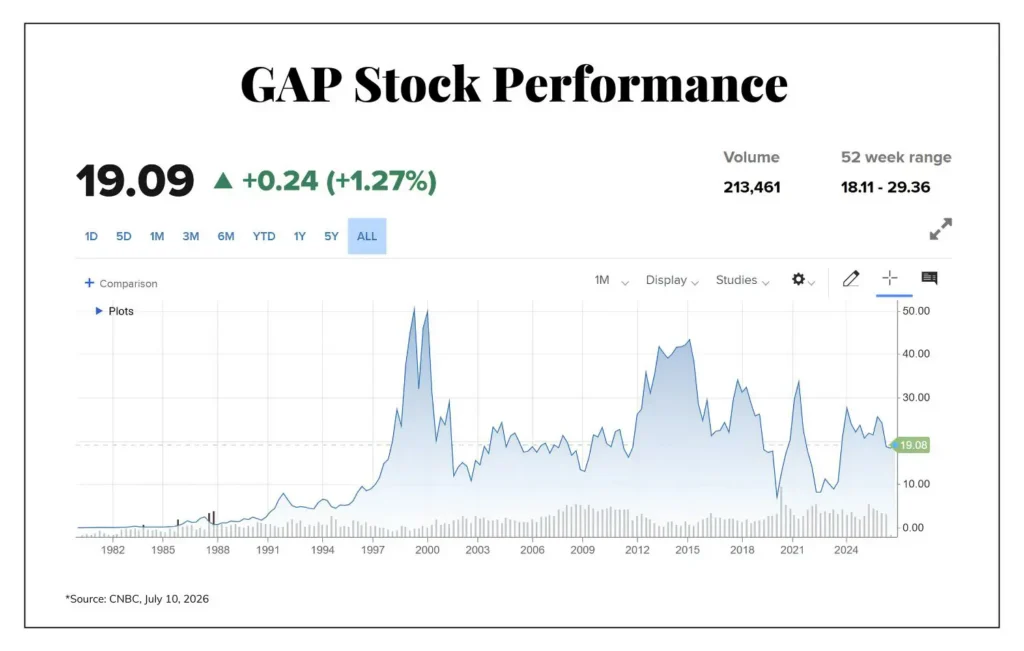
The reason is rather obvious: consumer discretionary companies change when consumer discretion changes (you are welcome to borrow that for your own purposes). Teen girls may be even more fickle than other demographics, but all discretionary choice changes over time. Some luxury brands build more durability than others. Some technology companies or consumer staples or product brands build lasting use, value, and proposition – but discretion means something inherently more fickle.
The limitations of 19-year-old selections for forecasting stock direction do not just apply to retail stores or even to discretionary apparel brands. On social media, teens loved Snapchat when it went public in 2017. It was $27 then. It hit $5 a couple of years later. During COVID, kids were on SNAP all day as they were locked down. The stock hit $83.

It is currently $4.85. And by the way, there are a lot more users now than there were then. Go figure, right? It’s actually not a mystery. Popularity, and usage, and the cool factor are less reliable investment indicators than many believe them to be. Clearly.
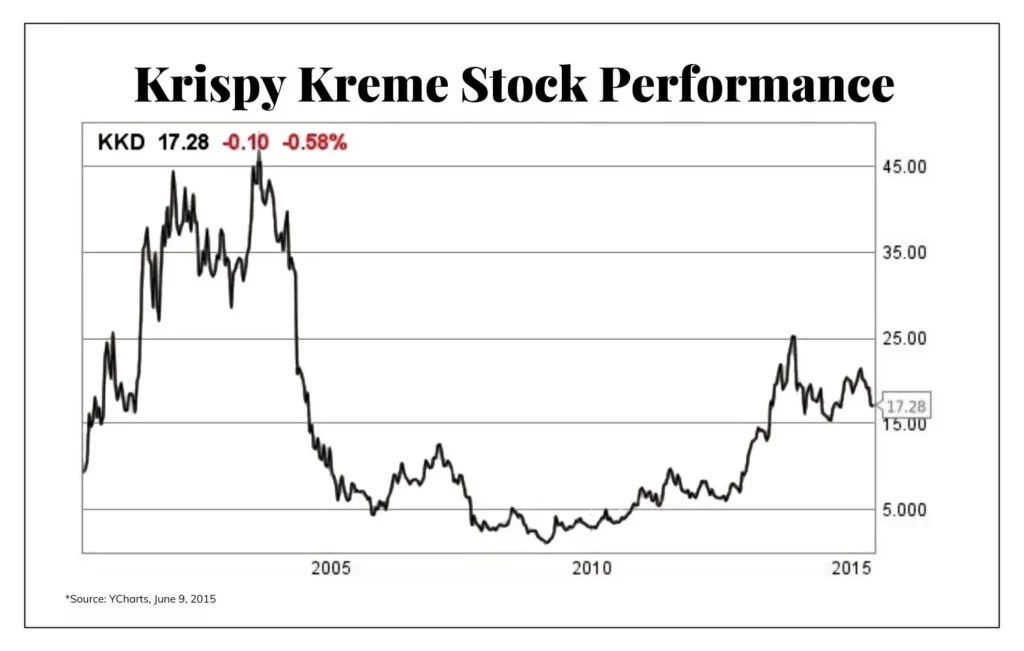
Donuts are not exactly the clothes young people wear as a fashion statement or the social media apps they use to communicate, but I remember a useful illustration of the disconnect between what seemed to be “street-level popularity” and “investment merit” over 20 years ago in my life as a professional investor. I had a client call me at UBS in 2003, livid that we did not own Krispy Kreme Donuts (then ticker KKD). It had gone public at $21/share in 2001 and was in the $40’s in 2003. The client called me from the parking lot of a Krispy Kreme, where the drive-thru line was going around the store. The store was as hot as a fresh-glazed donut coming out of the oven, and the stock was headed to a price close to the number of calories in one donut (okay, maybe that was not possible). Within a year or two the stock was below $5 where it would stay for the next decade.
What People are Actually Saying about the 19-year-old
I actually do not believe my greatest concern in this subject applied to investing is people mistaking consumer popularity for an investment opportunity. That is a big problem, and it is hardly limited to 19-year-olds. I assure you, the client who called about Krispy Kreme was not 19 years old. A misunderstanding of the Lynch principle, a general desire to sound cool and connected, and the non sequitur of believing a popular thing is a good investment are all forgivable mistakes. Now, that last one is a little less forgivable than some. I mean, what strikes you as more likely – that your 19-year-old is telling you about a “new trend” before it has become a trend, or after it already has become such (and therefore already reflected in the stock price). Short of those rare breeds who see around corners, having a 19-year-old tell you what is “cool” so you can buy the stock is like having someone read you the newspaper so you can predict what will be in the news the next day. It makes no sense. But again, I understand where it comes from.
However, I am hearing more and more lately from adult investors – professional investors – older and more seasoned people – saying, “Look, my kids and their generation want me to talk about crypto; I have to do it.” The AI world is especially prone to this – “the kids want that IPO; they want that shiny object.” It is almost a mea culpa: “If I mention free cash flow or intrinsic value, they look at me with eyes glazed over [not a Krispy Kreme reference] – they want to hear about investment themes relevant to their lives.”
And I think this is a very, very dangerous way to think when it comes to managing money for other people.
Captain Obvious
I have no doubt that today’s 20-year-olds are using products that will prove to be great investments. I also have no doubt that novelty, social signaling, and the general “fear of missing out” that are almost inherent characteristics to that age and stage of life are among the worst investment criteria on God’s green earth. Enthusiasm is not investment merit. My job is to have conviction based on something durable, fundamental, and defensible. I do not believe those things are aligned with that which animates younger adults. This, of course, is no slight on young adults at all. It is a commentary about human nature. And I would think it would be rather obvious.
I think (as best I can tell) that the “cool kids” do not use Facebook anymore (if they ever did). Its user base (in terms of engagement) is primarily Gen X and Gen Y, with Gen Z paying little attention whatsoever. But you know who spends money? You know who attracts advertising dollars? They may not be the coolest or most culturally relevant, but they do represent “where the money is.” How can a 19-year-old appreciate this?
Shiny by Any Other Name
When I hear professional asset allocators say, “We have to put 5-10% in bitcoin because that’s what the 19-year-olds are talking about,” I often wonder why they stop there. Do we really want a portfolio that mirrors ALL of the habits and interests of young people? I am not so sure that makes a lot of sense.
But here is what I will say: Believing that the interest level, the novelty, the socially attractive elements of investment categories in the pathology of young adults is legitimate investment criteria is nothing more than a subset of shiny object investing. And while there are always and forever going to be things that appeal to any demographic that do prove to be bona fide investments, the appeal itself is not something that makes it so! You may not want to hear the analogy to tulips, radio, Japanese real estate, Pets.com, beanie babies, 2006 condos, COVID stocks, and any number of other shiny objects that ended up in a graveyard, but the very mentality of shiny object investing is what drives the idea of aligning our decisions to what 19-year-olds are talking about.
Conclusion
I would pretty much go to the four corners of the earth to find conversation with my daughter. I have an advisor colleague (I won’t out him here, but he knows who he is) who told me a few years back when the Johnny Depp/Amber Heard trial drama was playing out that he got into it and watched it so he would have something riveting and contemporary to talk to his teen daughters about at night (it worked). And even beyond the fun of having something mutually interesting to talk to our teen kids about, I do believe there is interesting information in knowing the trends, preferences, and appetites of generations younger than us. If it wasn’t for me teaching economics to high school students, I would have never known how much they liked flavorless, disgusting chicken (IYKYK).
But my friends, investing is not a reality TV show, a fad, a store at the mall, or an app on your phone. And those of us who have a fiduciary obligation to clients have a responsibility to understand that what drives value in the process we call wealth creation is not about popularity or fads. In fact, history would suggest they may be better counter-signals than anything else.
Chart of the Week
I don’t think I need the take of a 19-year-old to know what to think about this chart. But I actually do think many 19-year-olds would intuitively know what to say.

Quote of the Week
“They haven’t repealed the laws of arithmetic … yet, anyways”
~ John Malone
* * *
I will soon find out how many 19-year-old readers I have, but do 19-year-olds really send hate emails anyway? As best I can tell, that is a practice reserved for men over the age of 55. =)
Have a wonderful weekend, and yes, I welcome feedback – no matter your age or temperament. Some may say I am impervious. I wonder if my daughter knows what that word means?
With regards,
David L. Bahnsen
Chief Investment Officer, Managing Partner
The Bahnsen Group
thebahnsengroup.com
This week’s Dividend Cafe features research from S&P, Baird, Barclays, Goldman Sachs, and the IRN research platform of FactSet