Dear Valued Clients and Friends,
In this week’s Dividend Cafe, let me first tell you what we are not going to do: Excessively and redundantly rehash all the salacious, juicy clickbait drama around the Jensen Huang/Nvidia scandal of the last two weeks. Now, we are going to mention it, but only to the extent it ties into the bigger message of this week’s Dividend Cafe. Indeed, the Jensen/Nvidia story was the catalyst for this week’s topic (the “inspiration,” if you will), but it is not the topic, per se.
CEOs, scandals, tragedies, markets, and you. Yes, when I put it that way, it does sound a little “click-baity.” But I didn’t create the environment in which we now find ourselves, one where CEOs are often celebrities and often deified to the point that company stock prices might, very well, be (rationally or irrationally) connected to the CEO … And if a stock price is connected to a CEO then, and you’ll forgive me, that might even include a stock price being connected to whom it turns out that CEO is sleeping with. What a world in which we live.
So today in the Dividend Cafe we are going to look at some past and present CEO action (not that kind of action), and we are going to evaluate how investors ought to think about these things. And if I can tease the conclusion a bit, we are going to separate perception from reality – especially when it comes to the types of companies you ought to be investing in.
Let’s jump into the Dividend Cafe.
|
Subscribe on |
Is Any Head Coach Worth Their Salary?
In sports, whether college or pro, it is very difficult to assess if a head coach is worth the money they are paid. On one hand, Bill Belichick won six Super Bowls as the head coach of the Patriots, and it would be rather absurd to assume he had nothing to do with that success. On the other hand, quarterback Tom Brady won another Super Bowl after leaving the Patriots when he joined the Tampa Bay Buccaneers (Belichick’s Patriots diminished each year and eventually became a 4-13, last-place team in the final year Belichick coached there). Now, do those “other facts” mean that Brady was the sole factor and that the head coach was no factor? Of course not. But it does mean it is all someone non-falsifiable – the type of subjective stuff that allows men to have something to talk about when they are forced to spend time together. At the end of the day, objective and intelligent sports fans know that there is a sort of “:both-and” to all of this – that good coaches are often needed and useful, but don’t (and can’t) do it on their own. And yet, there are certain magical situations where a head coach can be transformative. It is always impossible to do attribution (how much of a “good coach” was related to the program they coached in, or key players they had, or whatever – and how much a good program and key players were related to a wonderful coach). I have opinions in certain situations. So do the guys with whom I do my March Madness trip to Vegas each year. And yes, in that situation I am clearly right, and they are clearly wrong, but let’s stay focused here. These things HAVE TO involve subjective opinions and non-verifiable assessments, though some situations are likely easier to assess than others. That’s really the best we can do.
And I would suggest that CEOs are very much the same. That many are dramatically overpaid relative to the value they create, and many are dramatically underpaid relative to the value they create, and that in those two buckets lies a great deal of subjective, non-falsifiable, non-verifiable assessment.
Putting Nvidia Matter to Bed
I made the comment in a speech I gave at an investment panel in Washington, D.C., the day that the Jensen Huang scandal broke (and we knew less then than we do now) that it appeared to be the greatest “CEO scandal” of my lifetime. The sheer size of Nvidia (an insane $5.7 trillion market cap at its top) and its massive significance in the current global economy, alone, put this in a much bigger place than we can imagine. Adding in things like global espionage (potentially), a honeypot situation (allegedly), violation of U.S. export restrictions (this appears to be indisputable), and even potential political implications (who in the administration knew what and when) – well, it all makes a made-for-streaming movie moment.
Nvidia’s stock was under plenty of pressure before the Jensen Huang scandal broke and before he resigned. And it is not exactly clear how much of the stock pressure since the resignation is directly attributable to the resignation versus the broader sector challenges that have hit many other company stocks where the CEO did not resign in an “extramarital affair with a potential spy” scandal
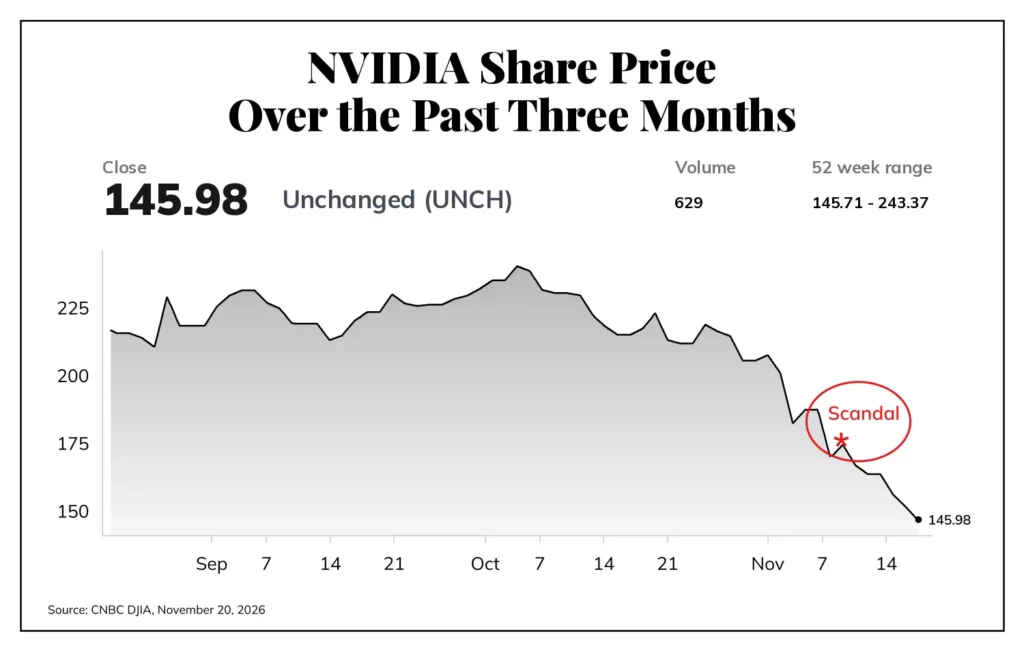
Reasonable people can agree that the noise around Nvidia since the scandal broke has hurt the stock price, as part of a “tandem” with other lingering questions about funding, export controls, capex growth, and so forth. In other words, it is a big story, and many feel strongly that Jensen is vital to Nvidia’s success, but the immediate noise around his departure is not necessarily fundamental, sound, or indicative. There is a lot of noise and a lot of nuance around it.
Tragedy vs. Scandal
Perhaps the most famous (or certainly top five) CEOs in American history left their company a little over a decade ago, and at the time it was also among the largest companies in world history. It was also about a founder and someone who was inextricably tied to the company’s identity and vision. I am, of course, referring to Steve Jobs at Apple. In that case, the issue was not an affair or scandal but rather the tragedy of Steve’s cancer diagnosis. Markets already knew of his cancer diagnosis from 2004, and the surgery was largely believed to have cured it. But in 2009 he took a six-month leave and markets knew things had gone a bad direction. He came in and out for a couple of years, and in 2011 took another leave, eventually resigned, and passed just two months later. The stock dropped 6% when the 2011 medical leave was announced, and it dropped 5% when he resigned a couple of months later.
But Tim Cook serving as interim CEO when his cancer returned in 2009 had “prepped” markets to some degree. The total 2011 response was really not severe. Apple was up on the year in a year that the S&P 500 was dead flat. No one denies the brilliance of Steve Jobs in bringing Apple to where it was, but the fact of the matter is that by the time his cancer returned and ultimately (and tragically) took him, the company was on a different footing, and the succession and vision lined up were well planned and executed. And we all know what Apple has done since. That whole story is, all at once, a testimony to three things that are all true at once: Steve Jobs was a brilliant CEO who brought Apple to a point of transformation, Tim Cook was an amazing heir who led the company through a period of the greatest market cap increase in world history (from $500 billion to $4 trillion), and a baked potato would have probably done “ok” as Apple’s CEO in that time period … No, a baked potato would not have been as good of a CEO as Tim Cook – he was a brilliant CEO. But a baked potato would have still seen Apple grow a couple trillion, because, you know, Apple. Yes, the CEO founder was brilliant. Yes, the heir was brilliant. And yes, the company was stacked for success.
When Strategy Matters
Some CEOs are there to execute on a set (and intelligent) strategy. If the strategy is good and the CEO is diligent and proficient at execution, that can generate extraordinary market rewards. Others are there to change strategy, and to do so with boldness and brilliance.
Lou Gerstner fundamentally changed IBM’s strategy when he arrived in 1993. He refused to break up the company. He shifted from a product focus to a solutions and consulting focus. His changes to IBM’s culture and economics were massive and resulted in one of the great turnarounds and success stories in corporate history.
Steve Ballmer, on the other hand, pursued a different approach at Microsoft. He preserved Microsoft’s Windows and Office legacy and experimented (mostly unsuccessfully) with other expansions (mobile devices, Xbox, consumer devices, etc.). He held on to the past but began expanding into the future (cloud, mobile, etc.). His successor (current CEO, Satya Nadella) would run more aggressively into cloud and reap the benefits of some of the early investment and directional shift Ballmer began.
Which brings me to an easily ignored reality of CEO assessment: Luck and Timing.
Presidential Fortune and Misfortune
Ronald Reagan did a lot, and I mean, a lot, to aid the growth of the U.S. economy. Deregulation, marginal tax rate slashing, and energy independence were a potent policy mix that grew the supply side of the economy. He was also President after the stagflation of the 1970s. He both contributed to the economic recovery of the 1980s and benefited from it. Bill Clinton was President in a period of extraordinary innovation and economic growth. He was a strong-dollar president; the Cold War ended right before he took office, and that internet thing was kind of a big deal. But he also cut capital gains taxes (remember when that was a policy plank of Democrat Presidents, including the two most popular ones of the postwar era – Kennedy and Clinton), passed welfare reform, expanded free trade, and was generally considered more market-friendly than some of his same-party predecessors. Like Reagan before him, Clinton both enabled some of the 1990s growth and was a beneficiary of it.
On the other side of things, George W. Bush came into office just in time for a tech bubble burst and then the 9/11 terror attacks. He left office just in time for the 2008 financial crisis. I would argue that he did some very good things from a policy standpoint and that he did some very bad things from a policy standpoint, but I would not argue that his economic legacy is entirely of his own making. The timing mattered. I would hope that even the most ravaging partisans among us could appreciate the objective sensibilities of what I am saying about Reagan, Clinton, and Bush … Timing and luck matter.
Do we think it is any different with CEOs? Was Jack Welch one of the great CEOs in American history, as measured by market cap expansion, value creation, and competitive results against General Electric’s peer group? Of course he was. Did Jack Welch benefit from being CEO of a great American company during a period of massive deregulation, economic growth, and inflationary moderation? Was GE quite levered to the things that would jump higher in the 1980s and 1990s when Jack came in? You bet. Was his exit timing equally fortunate (right before the 9/11 attacks and their impact on aviation, and then before the financial crisis and its impact on the GE Capital business)? Also yes. In fact, Welch may be the luckiest CEO in human history in terms of the timing of both their start as CEO and their exit. But that cannot take away from what he did. One just has to hold the immeasurable parts of this in tension. He was fortunate. And he was good. And both things can be true at once.
Scandals Can’t be Good, Though
Steve Ballmer’s strategy decisions and Steve Jobs’ cancer and Tim Cook’s succession planning and Jack Welch’s timing issues are all separate from good old-fashioned “scandal,” though. First, there is “fraud” – and let’s just go ahead and go on record as saying that fraud is not good (you have my permission to print and post that). In fact, I can say it slower for those in the back. What Jeff Skilling and Ken Lay were convicted of at Enron revealed two things: (A) They didn’t have as good a company as people thought to begin with, and (B) They made it worse by, you know, cheating. The whole escapade would bring down the company in what was then a massive bankruptcy. The Bernie Ebbers matter at WorldCom, the Elizabeth Holmes deal at Theranos, the Sam Bankman-Fried crypto implosion at FTX – these were situations of sham companies simply getting revealed to be frauds. They weren’t good companies that fraud brought down (though WorldCom would be more in this category than the other two) – they were fraudulent companies that got caught as frauds. I hope I don’t ever have to write a Dividend Cafe about why I am against fraud, though every time I get emails about crypto I suspect that day is coming.
But outside of fraud – accounting issues, flat-out cheating, faking that your product works when it doesn’t – there are “scandals” – those things that take out a CEO for “off-field behavior.” They weren’t cooking the books, but they did something that resulted in the board taking them out. Travis Kalanick, the former Uber CEO, never got to preside over Uber as a public company when he got removed for, well, being a jerk. We all know of the CEO who got caught kissing his HR chief (one he was not married to) at a Coldplay concert (I won’t put in the link because it is all just too painful to watch). Nestle and McDonald’s both fired CEOs in recent years for consensual relationships with employees that they did not disclose.
The reality of human nature is that no one is immune from the possibility of some scandal, some embarrassment coming to light, some moment that takes them out. That means that investors are exposed to this possibility in some way, whether they know it or not.
So What Does Matter in a CEO?
I am not going to lie. I prefer CEOs that are faithful to their spouses and that do not yell at their Uber drivers. But I also understand that a lot of CEOs may not be the high-character people I wish them to be in their personal lives. I can only know what I can know. There have been really, really bad CEOs who were very admirable people in their personal piety and character. And there have been really good CEOs who did not go to charm school and who were not good family people. These realities of a fallen world are not lost on me.
Marital infidelity is not a perfect correlation to failure as CEO, but it certainly is not a perfect reverse correlation, either. All matters of character are, in my estimation, very, very good practices, habits, and indications. My company may be a lot smaller than many of the publicly traded behemoths we are talking about today, but I know that my fidelity to my wife and the priority I put on my family are correlated to the kind of person I try to be and to the kind of character I want to bring to the office every day. I have a hard time compartmentalizing all of this stuff – separating one’s judgment, wisdom, and morality as if they were all totally independent components of who they are in their business role.
And yet history is clear that more than a few “bad folks” have proven to be pretty “effective CEOs.”
But are we missing the bigger point when it comes to what matters to us as investors? Let’s bring this to a conclusion.
Conclusion
I am not going to be able to make one group happy by saying, “I have to know my company’s CEOs have no skeletons before I invest.” I can’t know what I can’t know, and my fiduciary duty constrains this investigation to a large degree. But I also cannot satisfy another group by saying, “I don’t care what they do in their personal lives.” All things being equal, I do care – in that I believe personal character and serving the needs of one’s stakeholders are correlated. Managing personal scandals in your own life not only reveals character, but also distracts you from serving your shareholders. And I am in the service of shareholders’ business.
So what is one to do when this stuff matters but you can’t know what you can’t know?
I thought this was what a Board of Directors was for? I thought this was what governance was for. I thought this was what due diligence and vetting and accountability and basic checks and balances around behavior and standards were for. And this is where an investment process can be connected to the world of scandal avoidance – albeit imperfectly.
CEOs that wax and wane about not caring for profits and being solely focused on effective altruism are not for me. I do not believe them, and if I did, I would still question their public self-righteous Pharisaism.
And CEOs that are autonomous, unaccountable psychopaths are not for me, either. But that is not a statement about the CEO – it is a statement about the company’s own governance and board of directors. These things never happen in a vacuum. Culture matters. And companies reap what they sow.
It is so hard to compete, win, create value, and demonstrate a perpetual ability to grow earnings for shareholders that I prefer to be invested in companies that facilitate these objectives with as few distractions as possible. We all know fraud and accounting shenanigans get in the way. But boards that pay no attention to succession – a CEO who is accountable to no one – I am sorry, but I think that is all just as bad (or at least near it).
Every human being who has ever served as a head coach, a President of the United States, or a CEO is replaceable. NO ONE is indispensable. Not Steve Jobs. Not Ronald Reagan. Not Bill Belichick. And not Jensen Huang. But what is of unbelievable value – the kind that provides profound premium to value creation – is wisdom, character, and diligence. And to that end, we work.
Quote of the Week
“Graveyards are filled with indispensable men.”
~ Lloyd Blankfein
I will see you all in the Dividend Cafe on Monday, and then again on Wednesday (not Friday) of next week for my annual Thanksgiving Reflections. Reach out with any questions or comments, enjoy your weekends, and get ready for the greatest holiday of the year.
With regards,
David L. Bahnsen
Managing Partner, CIO
This week’s Dividend Cafe features research from S&P, Baird, Barclays, Goldman Sachs, and the IRN research platform of FactSet