Dear Valued Clients and Friends,
In this week’s Dividend Cafe:
- We look at the AI disruption thesis and evaluate the profound growth and progress in AI in so many ways.
- We analyze the opportunities as well as the threats this creates.
- And we suggest an entirely more constructive framework for thinking about all of this as investors.
Let’s jump into the Dividend Cafe …
|
Subscribe on |
The Second Biggest Story of the Year (to date)
If it were not for the Iran war, the biggest story in markets year-to-date would be the debate about AI’s disruption in the software space. A year ago the impact of AI was considered to be this rising tide effect that was lifting the customers of AI computing power (hyper-scalers), the pick-and-shovel companies that provided the parts needed for said power (chipmakers as the leading example), and the makers of large language models (the mostly-private companies that basically “make AI” – that is, program, train, and distribute generate AI applications). Along the way, the whole tech space, more or less, lifted on this narrative. Talk about a win-win-win-win … The narrative a year ago could be summarized as:
“The people paying money for future AI use – winners. The people they are paying the money to – winners. The people who need to make the things – winners. The products and services they will come up with – winners. The competitors to those products and services – winners. The users of the products and services – winners.”
It never seemed to occur to folks that a couple of these assumptions might possibly undercut some of the other assumptions. I suspect the next revelation to hit investors will be that not only are entire categories listed above adverse to one another, but within categories, there are adversities that cannot result in everyone winning (I have written about this before). But I digress. Today, the question is whether AI is currently on a path to destroying the business model of, well, the entire software-as-a-service industry (for example). And I should add – some of the most dramatic language in this camp does not say “on a path” (future tense), but rather phrases it as a fait accompli – a present tense reality that is irreversible.
Walking and Chewing Gum
I do not believe there is any mistake being made in the entire AI discussion right now, larger than this: Confusing utter awe over what these tools have become capable of doing with a comprehensive understanding of commercial implications. Let me word that more succinctly: The AI products can overwhelm you with their capability, but then applying that to real-world commercial impact (positive commercial impact on one hand and presumably negative impact for someone else) is a separate part of the calculus. Too many believe that you have to either: (a) Believe these AI products you are witnessing are incredible, and therefore that A, B, and C are all dead ducks (A, B, and C presumably being companies that do some of the things that the AI tools do); OR, (b) You have to disparage the AI products that we are al witnessing with our own eyes. I reject the false dilemma as a matter of investing wisdom. I believe that there are nuances here that don’t allow us to simply say it is “either AI is awesome, and everything is dead,” OR “AI is not awesome.” In fact, in investing, it is never that simple. And I can prove it.
“The internet will destroy all other media”
No, it didn’t. It made it stronger.“Social media will destroy all advertising and marketing.”
No, it didn’t. It created an entire new outlet for it.“E-commerce will destroy all retail shopping experiences.”
No, it didn’t. Price per foot on high-end mall rents are higher than they have ever been in history, and vacancy is lower than it has ever been.
But were the premises behind the hyperbolic assertions wrong? Of course not. What was missed, always and forever, is the dynamism of markets to adjust, adapt, incorporate, compete, and any number of other verbs that get applied to the wonderful world of the marketplace. Disruptions sometimes create new business models. Yes, they sometimes destroy old ones. But they also create new markets that are not easily visible when people are looking only to the initial two-step process of a new disruptive trend or event. AI as a supplement, AI as a competitor, AI as a tool, and AI as a threat – or all of the above. The declarations of high-functioning AI capability do not tell you enough to sort through, on a company-by-company, sector-by-sector, and tool-by-tool basis, what to expect. And then incorporating adoption timelines, revenue reality, margin compression or expansion, and any number of other variables to the mix becomes a vital addition to the entire assessment.
I am a firm believer that the data synthesis of language models exceeds expectations, as does their “reasoning” capability. I believe that AI model training will continue, that the limitations will remain (a non-human can never be trained to do things only a human can do, but that is simply a tautology), and that we will be surprised by the output AI becomes capable of in the future. None of this is remotely AI-skeptical as I define AI-skeptical.
Believing both in the AI story, and the complexity of commercial application is not Luddite – it is sensible.
Agentic, Autonomous, and other A words
There is plenty of discussion about the limitations of AI, and I, myself, have strong convictions in the philosophical debate. But as Howard Marks recently reported, Claude told him:
“Even if you accept, philosophically, that what I do is ‘merely’ pattern matching and not ‘true’ thought – the economic implications are identical. … It does not matter to the person paying the bill whether I’m really thinking or merely pattern matching? What matters is whether the work product is reliable enough to be useful. And increasingly, it is. The philosophical debate about machine consciousness is fascinating. But the economic question isn’t ‘does AI truly understand?’ The economic question is does AI do the work?”
We are well past the point of questioning if AI can become a research tool (check) or a generative tool (check). The disruptive conversation of 2026 is about its autonomous ability – what the cool people are referring to as “agentic” AI whereby human supervision is not needed and AI not only does the research and work, but perceives, plans, and acts on what needs to be done all on its own. This is the phase of AI that is believed to be disruptive in a way that will leave every software company on earth obsolete. AI writes the code, develops the thing (call it an app), and even fixes itself. Many have seen agentic AI in the last few months at a level of proficiency and sophistication that transcended their expectation immensely.
I have no doubt that some will underestimate AI’s capabilities going forward, while many will overestimate them. Some limitations will be addressed with additional coding and time. Some are part of the known “training” process. And I am quite sure that some are unsolvable. I will spare you the philosophical debate here, but AI is not going to change “the nature of things” – and because I believe that is the objective of some of the grandiosity behind the more self-assured personalities behind all of this, I would not be long their objectives. This is a metaphysical declaration – I do not believe we are headed to the alteration of reality, even as I do believe the capabilities of these tools will continue to confound. It pays to have a worldview, or more accurately, to know that you have one.
But beyond all of these higher-level considerations is the current question for investors: Is the AI disruption taking place in software, most particularly, a path to AI profitability and a death knell for the massive part of the global economy known as SAAS? Are investors in need of significant reallocation because of this?
Disruption by Any Other Name
What I believe is indisputably true is that AI will make coding easier, faster, and better. What has impacted the software sector over the last two months is understandable. If a software company’s value proposition and revenue model were entirely connected to the code that drives its product, and that code can now be replaced or improved by a quicker and cheaper alternative (AI), this threat seems clear and significant. Combine this with the fact that AI has potentially lowered “switching costs” – that the migration from one software solution to another is not only cheaper but easier than it has ever been – and you have the seeds of real disruption.
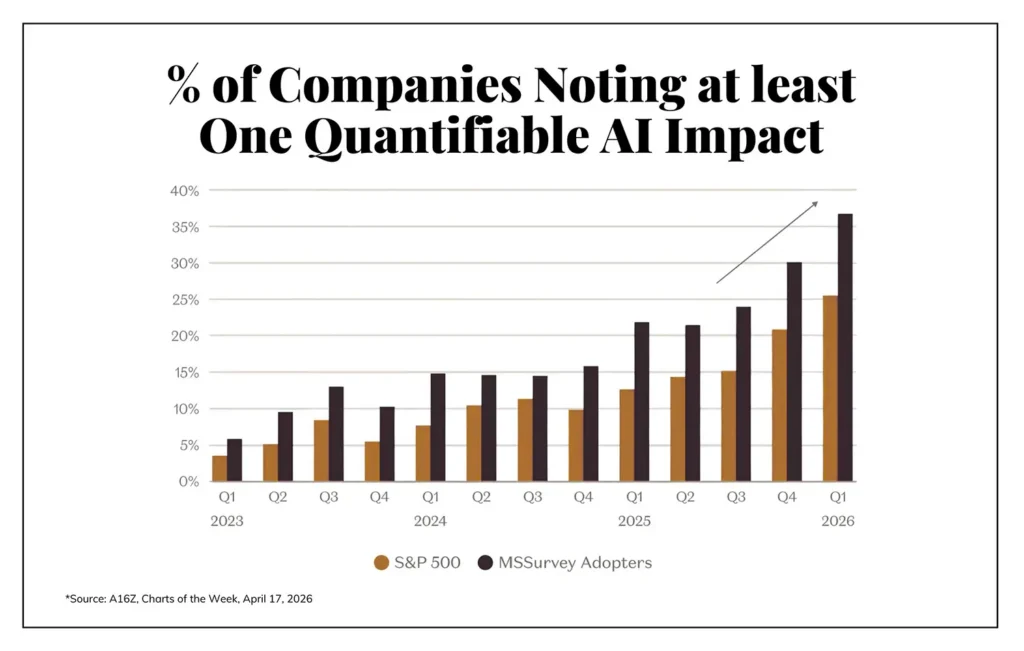
The numbers have been reasonably low since the Chat GPT launch in terms of companies claiming AI has had an impact in their business, but it has certainly trended higher as of late, roughly doubling in both the S&P 500 and the Morgan Stanley Research Survey over the last year.
I am hesitant to make the circular argument that “we know AI is proving disruptive because the AI companies keep acting like it is” (massive investment in new computing power to keep up with demand), but it is certainly true that demand currently outpaces supply. This is the fundamental boost for the pick-and-shovel companies that has maintained their valuations and margins in such a historical manner. But when it comes to the specific claim of AI disrupting certain businesses (especially vertical software companies), I truthfully find it so obvious that I barely think the argument needs to be made. It is just that “to disrupt or not disrupt” is not the right question, or at least not a sufficient one.
The Limitations of Disruption
With all of the above understood and conceded, a few things have to be understood to properly contextualize the moment.
The strength of processing data and doing pattern recognition, combined with the application of such, is backward-looking. New situations that do not provide past material to discern are outside the scope of their “judgment” (and a lot of that has to do with the fact that it isn’t actually “judgment” we are talking about with AI, but I don’t want to parse words or concepts right now). There is a vast array of decisions that people will turn to AI to make that require discernment, taste, and wisdom, which are subjective in nature, and not within the scope of AI’s training. Howard Marks pointed out recently that many of the greatest human intuitions come from a risk aversion we have as a result of “skin in the game” – and AI simply cannot feel that, because, well, it doesn’t.
But where AI generates decisions, exercises superior objective data processing, and grows in its capabilities for “reasoning,” I believe this disruptive capacity is marginally constrained by some need for human checking of the soundness of the conclusions. Not in all cases. Maybe not even in most cases. But in a lot. And while much of the concern about software disruption is properly framed as “marginal,” it is the totalistic assessment I am pushing back on, that which ignores a scope where final human validation is warranted.
This element of human validation is the heart of the matter. I am firmly in the camp that AI is a complement to, not a substitute for, human labor – with particular relevance to the software space. The masterful rebuttal from Citadel Securities to the Citrini Research Substack, which sounded many alarms about AI disruption in software, floored me in its analysis of software engineering job postings.
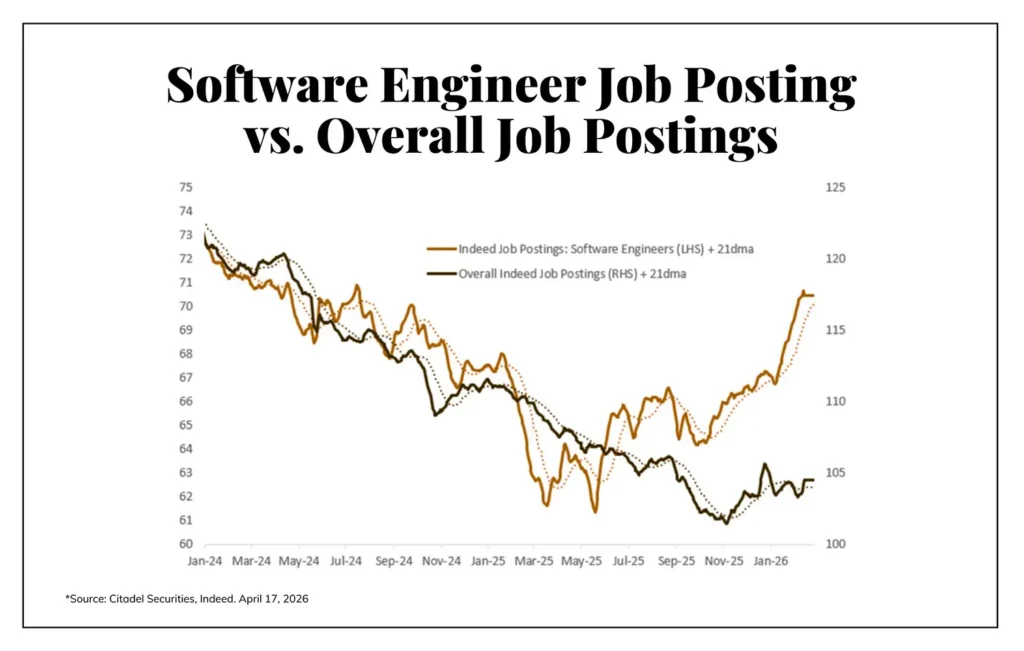
The Citadel argument deals with more complex points about speed and “diffusion.” Essentially, the notion of AI-driven automation across all the functions we are told it is coming would spike demand and marginal cost, meaning that cost serves as a natural decelerant. The computing power and energy required to be as disruptive as some are suggesting would come with a cost that would prevent this disruption from happening (certainly at the speed that is suggested). The argument is compelling, but more importantly, it helped me to understand the reality of technological diffusion. Assuming a linearity in the adoption of AI with capability, capacity, and cost is unwise. The capability of AI can and will grow faster than adoption and integration.
Citadel’s argument provides an important consideration in understanding the relationship between the technological aspects and economic realities of the current moment. But I think that, in addition to understanding the timing limitations to disruption, there are fundamental limitations as well. There are companies being thrown out with the bathwater that have multiple competitive advantages that have ample time to adapt, compete, utilize, implement, or otherwise react. They will be competing in a much bigger space, and the “disruption as death” argument always and forever presupposes something zero-sum. Companies that have a current edge, which has proven durable, will have a chance to earn even greater advantages in the period that lies ahead.
Commercializing the Disruption and the Limitations
When it comes to actionable investment theses around all of this, I have been arguing all year that the nuances and particulars require bottom-up, company-by-company due diligence – that investing in a scattershot way against an entire sector would prove just as dangerous as investing scattershot for something. The “baby-bathwater” approach to investing is one that bottom-up, fundamental investors (of which we are at The Bahnsen Group) tend to repudiate, but it is perhaps more worthy of repudiation in this AI and disruption context than even most other situations.
That “not all companies are created equal” goes without saying, but what does it mean when it comes to this AI moment? One approach is to look for the companies that have “moats,” which better defend themselves against the AI threat to their model. If a company does something that AI can do cheaper and better but has a “moat” that protects it, or at least marginally protects it relative to the impact on other companies, that sounds like a good thing. Network effects are a primary example. We all have examples of software solutions or other technology applications we use that we may not be in love with, but they are so intertwined with other elements of our work that we cannot let them go. Interconnectivity in a way that is really sticky is what we mean by a network effect, and many companies have such deep stickiness with their customers that the customer’s interaction has gotten connected to a plethora of other services and tools, so that the initial enterprise relationship is not nearly as threatened by the introduction of a cheaper or better product as one might think.
This is not my favorite thesis, though. Saying that a company has held its customers hostage is a poor business thesis (well, maybe it isn’t a poor business thesis, but it isn’t the one I like the most).
What I would suggest is that businesses that have a durable brand have a massive advantage here. The variety of vulnerabilities that exist (cybersecurity, compliance, service, implementation) is all better served where customers and vendors trust the underlying brand. Not only is a brand strength a constant benefit of business reality, but it is amplified in the reality of this AI particular moment.
Perhaps the most obvious example (in the software space) of where AI disruption will be altered by certain incumbent companies is where proprietary data exists. Put differently, companies that have a headstart of years (or decades) of data that they own built into their value proposition cannot be replaced any time soon. What they can do, though, is attach AI capabilities to their enterprise application that combines new technological innovation to their data, making 1+1 = 3.
Following this story over the last few months has made me think that many who said, “software as a service” (SAAS) never meant it. Identifying the entire economic value of the software companies to the software and not to the service is shortsighted. Companies that know, touch, and are integral to their customers are not merely providing a tech application, but rather a solution attached to a tech application. The consultative element of this cannot be understated. These companies attach knowledge, experience, customer relationships, and niche expertise to the utilization of new AI products and services in ways that are irreplaceable.
So when I say that some companies are so integrated in their customers’ enterprises that they will not be disrupted easily, I am not making a great argument for buying them as investments. Negative market sentiment may be overstated for them, and they may not face an existential fatal crisis, but that is hardly a compelling Buy thesis. What I am stating, though, is that some companies are going to become more anti-fragile with AI by actually partnering in adoption in a way that maximizes unique strengths towards the end of optimal value creation.
The Investment Lessons
There is absolutely nothing contradictory about believing in the transformative and disruptive reality of AI, while also believing that massive malinvestment is taking place before our very eyes. I am aware of no precedent in human history, none, where this has not been true. Where an ROI will materialize for the hyper-scalers, and/or the pick-and-shovel companies, and/or the AI labs (LLM companies), and/or the customers of the AI labs (enterprise buyers and app developers) remains to be seen. How the business dynamics between hyper-scalers and AI labs will materialize is a huge open question, where they are all at once the biggest customers and the biggest competitors to one another. Believing that the technology that comes out of this already is remarkable is one thing; believing that the total commercial story is opaque and highly uncertain is another. I believe both.
Do I believe the software sell-off in February/March was overdone? For many companies, it was dramatically overdone. For some, I suspect it will prove to be prescient. But what I would strongly caution investors about now is this idea of conflating all elements of the technology space as if they were a monolith. When I read sophisticated research reports from sophisticated analysts at sophisticated venture capital firms (as I did at 4:00 this morning) suggesting that all of this has created a massive buying opportunity (implying something indiscriminate), pointing out high levels of insider buying in the tech sector, or superlative earnings growth in the tech sector, or deep discounts in the valuation premium of the tech sector to the broad market, I want to throw my laptop at someone. You have 20% of information technology companies saying that “AI adoption has had a quantifiable positive impact in their business,” and 12% saying “AI has had a quantifiable negative impact in their business” – should we treat those two things the same? Some companies in the sector trade at 100x earnings, some have massive negative EBITDA, so have a negative P/E ratio, and some trade at 13x earnings – should we view all of those things as the same? What I am suggesting is that more than any time in my career, opportunities in the technology sector have to be understood individually, divorced from a mega-narrative or a mere factor, and evaluated fundamentally on the unique realities of that business, its price, its valuation, its forward-looking dynamics, and, yes, its AI impact (positive and negative).
Conclusion
As usual, I have gone on too long, but I will conclude with the following:
- We do not yet know where productivity gains are. Believing there has been “disruption” is important, but insufficient. In the end, AI will create productivity gains, or it will disappoint many (investors at the top of that list).
- The investment into AI capex is going to work out well for some and be catastrophic for others.
- AI is not a future tool for augmenting knowledge – it is a present tool, and future tool, for doing so.
- Where the agentic elements of AI are creating vast new opportunities, incumbent companies of brand, scale, data, and durable competitive strengths will effectively partner and incorporate.
- The disruption thesis speaks to risks and opportunities in a vast array of software companies. The various other questions related to AI persist, not waiting to see if AI is disruptive, but already knowing that it is. In other words, it is inadequate as a theory of the case to formulate an investment thesis on the pick-and-shovel companies, the hyper-scalers, and the AI labs (LLMs).
And in the end, I promise you this: the people most guilty of the most reckless hyperbole in this whole era will never be held. accountable. They never are.
Chart of the Week
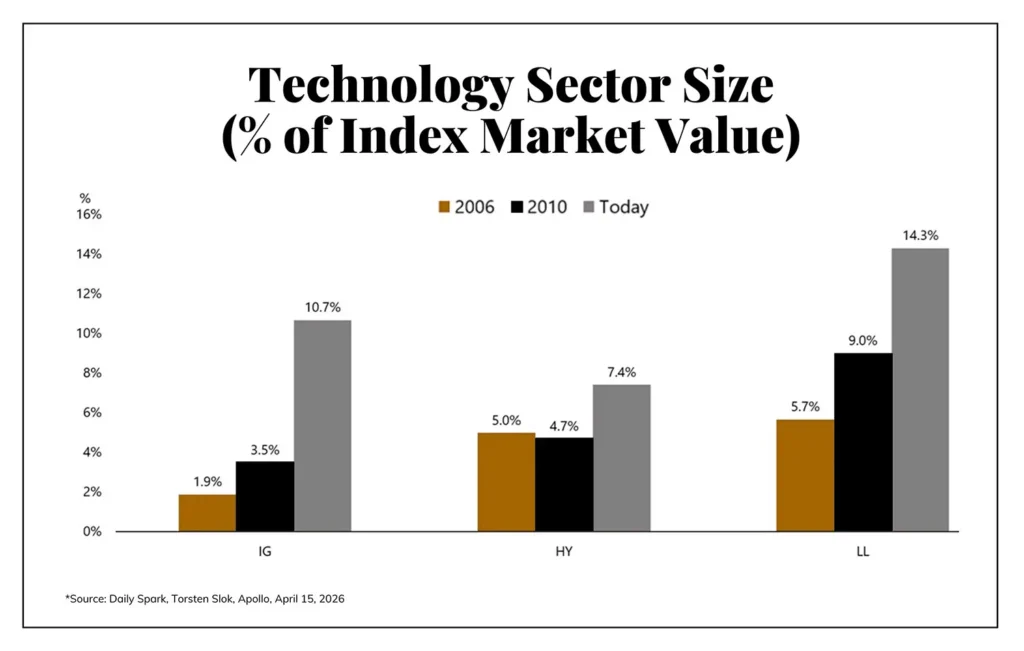
It is interesting to consider the actual message implied by those who say that software exposure in private credit is a hidden piranha, filled with future defaults. As senior-secured, first lien loans, the predictions of those private credit impairments mean the equity will get wiped to zero. So it is far more of a stock market prediction (and private equity prediction) than perhaps those prognosticators seem to understand. But it also goes beyond private credit. Investment-grade bonds, high-yield bonds, and especially levered bank loans all have seen far greater software exposure than in times past. But defaults in these credit categories have not risen either. Putting aside what will and will not happen, the logic of the prediction should be consistent, and the logic would suggest that, if what they are saying about software exposure in the loan book of private credit is true, the impairments would be across the credit spectrum. No one seems to be saying the logical part.
Quote of the Week
“I don’t know what the rest of the year or decade will bring. I suspect we won’t exactly be starved for news. And I am looking forward to changing my mind as often as necessary.”
~ Derek Thompson
* * *
This morning, after I completed this Dividend Cafe, the President announced the reopening of the Strait of Hormuz, and markets are rallying accordingly. I am already excited for the Monday Dividend Cafe. Back to Newport Beach from New York City Sunday night, and in our new Silicon Valley office for a day or two next week. The beat goes on. Markets never sleep. And I will tell you, I really don’t much either. And I wouldn’t have it any other way.
With regards,
David L. Bahnsen
Chief Investment Officer, Managing Partner
The Bahnsen Group
thebahnsengroup.com
This week’s Dividend Cafe features research from S&P, Baird, Barclays, Goldman Sachs, and the IRN research platform of FactSet