

Dear Valued Clients and Friends,
In this week’s Dividend Cafe, we are going to talk about rising interest rates, the kind that matter. We are not talking about the Fed or the fed funds rate or the overnight rates at which banks borrow money. We are talking about the 10-year and 30-year Treasury bonds, both of which have seen yields basically jump 75 basis points in three months’ time. It is worthy of its own Dividend Cafe.
I do believe that yield pressure on the long end of the curve is the biggest challenge in markets right now, though I will say, the Thursday report that OpenAI’s revenue appears to be $20 billion less than previously anticipated, a company already expected to have negative cash flow of nearly $300 billion for the next few years – no typo – was almost worth me pivoting topics. The revenues they will do, with the massive revenue growth they do have, are a pittance compared to what is needed to understand and make sense of that whole story, and talk of underachieving those numbers seemed like a big deal to me. But alas, those stocks in that world got hit Thursday, and then by the time I was typing this pre-market Friday, they seemed ready to move on. Nothing to see here.
But the interest rate story deserves coverage, understanding, analysis, and projection. And in today’s Dividend Cafe you will get all of that and more. Understanding what is causing it (if that can be understood) is useful. Understanding what can be expected going forward is useful. And most of all for investors, understanding how to apply it in your portfolio is useful.
Let’s jump into the Dividend Cafe …
| Subscribe on |
Let’s Talk about Debt
One of the main suggestions in various circles since bond yields moved higher over the last few months was that “too much debt” in the system was doing it. I’ll put my bona fides in critiquing the excessive national debt of our country against anyone, but this particular explanation at this particular time for this particular event is, shall we say, suspect.
We know that public debt-to-GDP is essentially at 100%. We know this is projected to keep rising. But are bond yields a by-product of only government debt or all debt in the system? Naturally, it is “all of the above,” and what does the total debt story tell us?
As Jim Bianco has pointed out, total debt-to-GDP, when combining private and public debt, is the same as it was twenty years ago. Combined private and public debt was 370% of GDP in 2006 and combined is 370% now. The difference is the composition …

Even combined interest expense (in this higher rate regime) is well below historical averages as a percentage of GDP. Even besides the fact that there is nothing happening with governmental borrowings, current deficits, and total governmental debt that is remotely new news to anyone on earth, the pricing transmission for interest rates has to factor in the big picture of debt-to-GDP, and those metrics simply point to less productive debt and crowding out of the private sector – but not more total debt or interest expense in the system relative to the total economy.
Let’s Talk about Inflation
One of the hardest things to parse out in this subject is the distinction between “inflation” and “inflation expectations.” One would think the two are the same or at least very similar, but when it comes to interest rate sensitivity and the bond market, I would argue that “inflation expectations” are all that matters. Now, of course, inflation expectations, themselves, are highly informed by current levels of inflation (in most practical senses), but when people talk about “bond investors demanding more yield to compensate them for inflation,” they are referring to compensation for what is believed to be the case, not for what has been the case.
Why does this distinction matter? Because many of the things that impact the price level are, in fact, “transitory.” And while the 2022 use of that word may have been exploited in the annals of history, it doesn’t mean the word has no validity when applied to certain price increases, and, in fact, with some degree of high frequency! We inherently understand that a price spike caused by a remediable supply shortage is “transitory” … (“we are out of XYZ product right now so the scarcity of it means the available supply is expensive, but once the new shipments come in the prices will normalize”).
Other things may be transitory, too, but not as “short term” as a mere “weekend shipment delay.” While the whole world has to wonder what the timeline is around the Strait of Hormuz, getting oil to the refineries and globally online, the fact of the matter is that the entire 2026 Iran story has been largely understood to be “transitory” (even if that period of $90-110 oil has proven to last longer than what initially hoped for and expected). The six-month contract for Brent oil is currently 10% below the current spot price, and the 12-month contract is 20% below it. WTI crude sits at $90 as I type, but it is $78 to secure a price one year from now. It should be said, this still prices in higher expectations for oil 6-12 months out than we saw before, but directionally it still reflects the belief that current prices will fall, not rise, as the “supply” issues out of the Gulf increasingly find some resolution.
A lot has been made about the impact of tariffs on prices, and this is where some of the silliest stuff gets said, usually out of a politicized agenda. It should be self-evident to anyone that an increased tax on an item raises its price. You may believe the tax is a good thing, or some underlying motive makes it a smart move in the end, but there is obviously some price increase when, well, a price is increased (you may quote me on that, with or without attribution). But it is equally true that if a tariff makes a product go from $90 to $100, the next year the $100 does not go to $110 if the tariff is the same. In other words, one can believe (as I do) that tariffs raise prices on things, without believing that they will raise them “year over year over year over year.” The New York Fed published a fantastic piece this week showing that tariffs increased prices on goods by 2.9% from implementation through the measurement window earlier this year, with some price increases being applied and felt quicker than others. They also demonstrated that goods prices were actually declining before this, so the price impact is likely worse than what mere increases reflect. I would argue that these tariffs hurt those they are supposedly intended to help, that they constrain production, that they invite cronyism, and that they reduce economic growth. But those criticisms do not change the fact that the price impact from tariffs is not in the same category as what bond yields measure and assess.
In other words, the two supply shocks of the last 18 months (tariffs and the Iran war) may be politically relevant for the President; they may contribute to higher prices that impact many things in the economy, but they are not a reason to believe that the bond market has decided they represent a persistent, long-term inflation pressure. In fact, we know exactly what the bond market has said:
TIP spreads are up 12 basis points in the last three months – but the 10-year bond yield is up 75 basis points!! I am sorry, but the inflation theory doesn’t cut it.

The Explanation that is too Complex for Soundbites
One thing I do know is that, in recent months, a flood of new corporate debt issuance has competed with Treasury bonds for investor capital. This is the most obvious and understated thing (both at once) I have seen in a long time. Very strong corporate borrowers have issued $200 billion in new debt in 2026, and hundreds of billions more is anticipated. We throw these numbers out there now so cavalierly that we fail to appreciate what they mean for supply and demand, which you may have heard is an important concept in economics.
If we were talking about a B-rated corporate junk bond, a new long-dated bond would not be competing with Treasuries, because these are entirely different investors and buyers. Junk bond buyers have a different risk profile and investment objective, and are pulling from different pools of vehicles. But when you start talking about Microsoft, Google, Amazon, Meta, and Oracle, these are creditworthy borrowers issuing debt whose buyers also buy U.S. Treasury debt.
But the demand can only be what it can be, and when supply overwhelms said demand, you can only clear the market one way: Lower prices, higher yields (that is not two things – it is two ways of saying the same one thing). And those higher yields (as spreads widen to entice the demand needed to meet the bulging supply) force Treasury yields higher, because they are the same buyers competing for the same pool of capital. Default risk is not the issue in any of this conversation, just the math of supply- and-demand dynamics in a long-dated maturity bucket of debt issuance.
But wait, there’s more … In addition to the fact that the above has played out (lots and lots and lots of new bond supply which has pushed yields higher), there is also the fact that even this issuance of high-grade corporate debt has to be bought by selling something else, and that something else is very likely Treasury bonds. And to really top it off, some need to hedge their duration risk, so while they become a buyer of the “AI bond” they also become a short a U.S. Treasury to hedge rate risk. You couldn’t make up a more perfect storm if you tried.
The chart may give some of you headaches to look at, but it is a brilliant encapsulation of the money flows and activity that are behind this spike in yields.
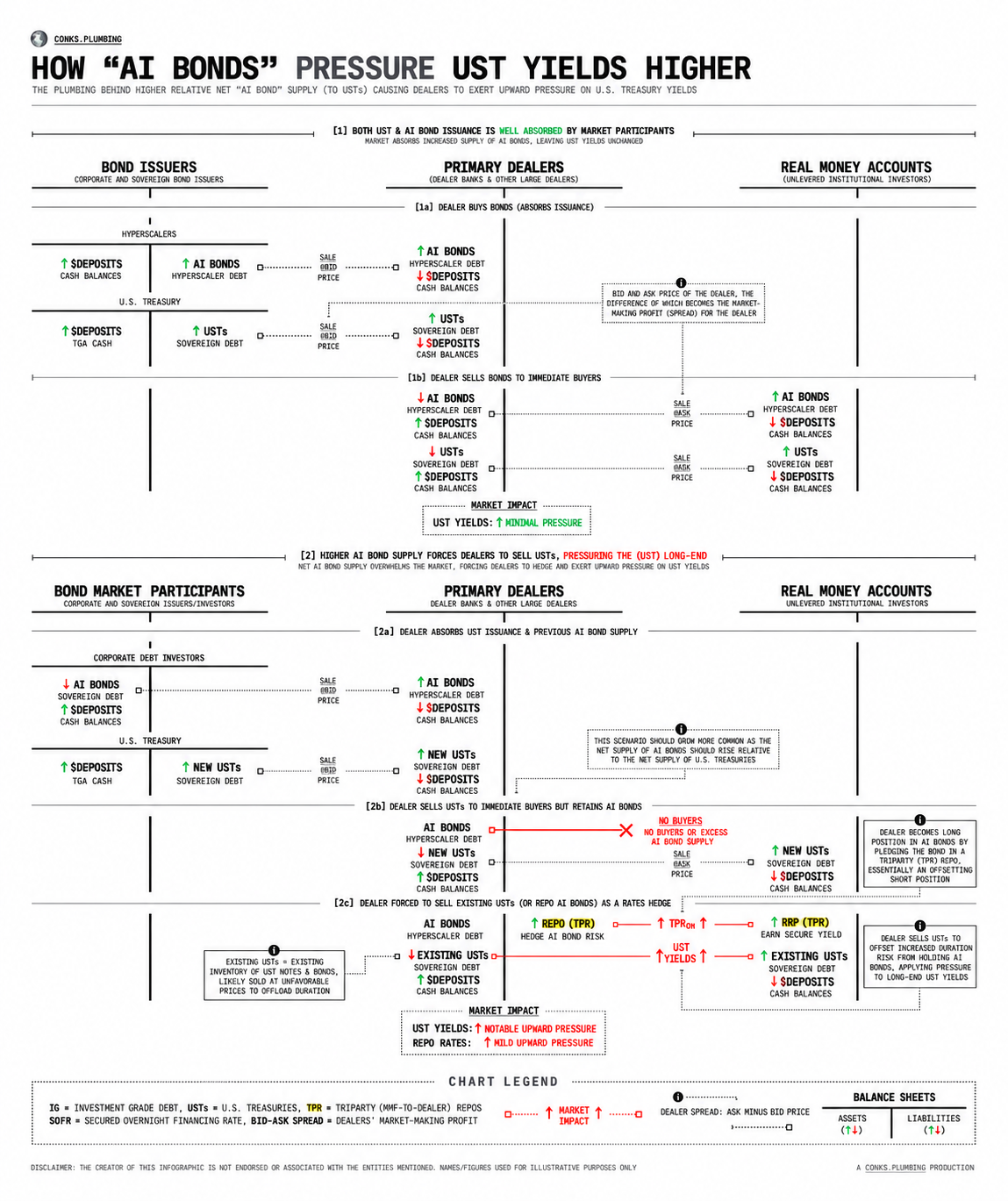
*Conks.Plumbing Substack, Sept. 30, 2026
I do not want to oversimplify the case. We are not just talking about “Microsoft” (et al.) in this hyperscaler debt issuance. They may be the most creditworthy borrowers and are admittedly at the top of the food chain in all this, but there are plenty of utility companies needing to issue debt, data center developers, and other AI-adjacent players in the same boat. From infrastructure to power to real estate, the debt-fueled compute story has created a huge supply of issuance that has led to a substantial increase in yields.
$200 billion of this new debt was issued by the middle of the year, and surely another $200 billion is hitting the market in the second half (the Dallas Fed estimated this at the beginning of the year!) Goldman Sachs believes just the five major hyperscalers will issue another $400 billion in 2027. Credit spreads have widened 30 basis points year-to-date. I can’t say with certainty how much hedging and portfolio re-composition has worked its way into Treasury yields, but I can say that it is not insignificant, and I do believe that it is, by far, the most significant contributor to the move higher in yields we have seen over the last few months.
Two Theories of the Above Section
One could say that this is all very positive – that this all reflects a productivity boom increasing demand for real capital, and that higher yields are the logical market mechanism for allocating savings to this investment. One could also say that this borrowing binge is crowding out other private and public-sector borrowing, resulting in a troublesome spike in financing costs for other parts of the economy. And one could actually say both at the same time.
I would say that the latter is rather obvious and not speculative, and that the former is “to be determined.”
Long End, Meet the Short End
The 75 basis points of expansion in the long end of the yield curve over the last few months has been matched by 75 basis points in the short end (using the 2-year). There has been a lot of volatility in this “steepness” as the delta between the short and long end has moved around, but there is simply no doubt that much of the nominal yield move on the long end is not term premium but rather higher expectations on the short end. The bond market is expecting a 3.8% fed funds rate (or higher) for some time to come. The Fed, anticipating higher rates in the short term, expects much less. The bond market is looking at the Fed tightening in this supply shock moment and expecting “higher for longer” on the short end.
But. What. If. That. Is. Wrong.
I believe that it will prove to be so. A Fed that hikes when markets don’t want it to is also a Fed that doesn’t hike when bond markets predict they will. And this flat of a yield curve is not merely a prediction from bond vigilantes about what the Fed will do, but it is a message from markets about a policy mistake. And I believe this Chairman takes market signals seriously.
Of course, I could be wrong, too.
What Does it All Mean for Investors?
At the end of the day, many (most?) investors do not care why bond yields are doing what they are doing – they care what it means to them. And sometimes what it really means to them is not the same thing as what a few weeks of market action may indicate. Let’s unpack this more before we close.
One reason for this Mag-7 rally over the last month is the idea that there is “less rate sensitivity” in the mega-cap tech names than there is in traditionally rate-sensitive sectors. The market has not liked the spike in bond yields, but the index’s cap-weighted nature has hidden that in a way that is almost surreal to comprehend. Across the Russell 3000, so a much broader index than the S&P 500, a stunning 89% of stocks are down 10% or more in the last three months. But 54% are down 20% or more, and 29% are down 30% or more. This “lack of breadth” story is real, and explains why so much under the hood of the market has been problematic even as a few mega-cap names have held the cap-weighted index up. The earnings growth expectations for just three or four companies have embedded a vulnerability (some call it a “high bar”) that dramatically changes the risk profile of many investor portfolios.
This Dividend Cafe is not about the concentration risk in a cap-weighted S&P 500 or the interconnectedness of an AI story that seems to be prolonging the inevitable while simultaneously intensifying it. That investor reality has been covered here and will continue to be. But where bond yields fit into all of that is in these three things:
- That “hyper-scalers can do no wrong story” is connected to bond yields (even if markets have not yet reflected that)
- When valuations become very high and need to become higher to maintain expected returns, a higher cost of capital and higher risk-free rate poses a much, much, much higher risk (even if markets have not yet reflected that)
- The last month has been a story of, “higher yields are a concern for financials, industrials, consumer staples, and REIT’s … I’ll go hide out in the safety of … AI big cap tech” … That may not be a story that ends the way some think it will.
I would suggest the higher bond-yield story is not a safety enhancer for AI but a threat to it, even as it is substantially being created by it. And I would suggest that the higher bond yield story has been largely (maybe not completely, but largely) priced into many aspects of the market, and not at all priced into others.
Some areas of the market are down amid rising rates, which historically are not. Banks, for example, are down -7.5% in the last month even as their net interest margin should be expanding in this moment. Is it fear of a Silicon Valley Bank balance sheet/duration-mismatch problem? That seems improbable. There may be unrealized losses in some banks’ bond portfolios, but there have not been deposit outflows, and one or two highly expected short-term rate hikes are not exactly the same thing as 300-400 basis points of excess rate hikes (see: 2022). I cannot say when the sentiment weighing on the sector will let up, but I can say that well-managed banks seem to be a candidate for recovery when that misconstrued sentiment subsides.
You have a term premium in the long end of about 125 basis points, but more significantly, you have a short-term rate of about 4%. Will various rate-sensitive sectors, left, see immediate recovery with this yield curve in place? Maybe not. But I have no intention of waiting for it to be too late. A steeper yield curve will come, or there will be other problems to deal with, and those problems are even more constructive for my base case.
Higher fixed-income allocations make more sense right now than at any point in my career. I do not expect that to last. But I want growth-of-income that promotes a growth-of-underlying asset, and when you look into the market dynamics that assume bond vigilance is here to stay, I would say that the areas most prone to benefit from that thesis changing (in six months? twelve months?) are the same things that have sold off the most. From REIT’s to Industrials to Financials, there are plenty of things to be excited about.
It just requires not believing the biggest fallacy in all of investing – that what just got done going up is the thing most likely to go up next. Avoiding that fallacy, and taking advantage of it, is the end to which we work.
Quote of the Week
“Every basis point of artificial yield suppression is a subsidy to procrastination. Suppressed long rates sugarcoat the interest-cost projections, shrink the apparent urgency.”
~Stanley Druckenmiller
More to Chew on
I really am excited to make my notes from this week’s meetings available to those who ask for them. But in the meantime, next Friday’s Dividend Cafe will provide the needed summary and high-level takeaways from a week that has left me more conflicted than I have been in a long time. I have a lot on my mind this weekend. I love my job so much.
With regards,
David L. Bahnsen
Chief Investment Officer, Managing Partner
The Bahnsen Group
thebahnsengroup.com
This week’s Dividend Cafe features research from S&P, Baird, Barclays, Goldman Sachs, and the IRN research platform of FactSet


