
In 1720, Isaac Newton, the man who had already mapped gravity and the motions of planets, held shares in the South Sea Company. As the company’s stock soared, he sold, pocketing a tidy profit of ~7,000 pounds. Then, he watched it climb higher. He watched friends and rivals grow richer on paper, and, unable to bear the sight, he bought back in near the peak. When the bubble burst, he lost some 20,000 pounds, a fortune worth millions today. As the historical recollection goes, he later remarked that he could calculate the motions of the heavenly bodies, but not the madness of men.
The arithmetic was not the problem. The greatest quantitative mind of his age was undone not by a failure of calculation but by a failure of temperament. Three centuries forward, the mechanisms of markets have been rebuilt beyond all recognition. That one variable has not.
From the Price to the Person
That variable is us, and it poses a puzzle at the heart of modern investing. If markets are as efficient as decades of evidence suggest, and if prices absorb available information almost as quickly as it appears, then why do informed, intelligent, well-resourced people lose money in them with such reliability?
My resolution is that “efficient” describes the mechanism, not its participants. The market is an aggregation engine, compressing millions of expectations about future cash flows into a single price at a speed at which no individual can match. What that efficiency does not promise is that the people transacting at that price are themselves behaving rationally. The inefficiency was never eliminated; it was relocated from the price to the person standing in front of that price.
That distinction organizes everything that follows: first, what the market gets right, and then, more instructively, what we get wrong.
What the Market Gets Right
The efficient market hypothesis (EMH) holds that prices already reflect what is publicly known. By the time you have spotted an opportunity, so has everyone else with a brokerage account and an incentive, and their buying or selling has moved the price to absorb it. The market is less a scoreboard than a continuous referendum on the future, and the ballots are counted in real time.
Academics divide the idea into three strengths: weak, semi-strong, and strong, all distinguished by how much information they assume is already priced, from past prices alone to every piece of public knowledge to private information as well.
The useful takeaway sits beneath the taxonomy: Consistently out-guessing this mechanism is extraordinarily rare, and what looks like skill is often luck wearing a convincing disguise.
This is an approximation, not a law of nature. Manias and panics are real, and we’ll turn to one next. But for the individual investor, the practical truth holds firmly enough: The machine is very, very hard to beat.
What We Get Wrong
This raises the question: If the mechanism is this formidable, where do the losses actually come from?
They come from us, as we, humans and investors, all have behavioral biases baked into our nature: Loss aversion is the notion that a loss is felt roughly twice as intensely as an equivalent gain is enjoyed, which means a falling portfolio generates a pain that demands relief, and the relief on offer is selling, almost always at the worst possible moment.
Recency bias quietly persuades us that the last six months are a reliable preview of the next six. Herding bias claims that when prices climb and everyone around us appears to be prospering, the discomfort of standing apart becomes unbearable, and we buy what has already run. This is precisely the trap that closed on Newton—not ignorance, but the inability to watch others get rich without joining them.
Each bias is individually forgivable. Collectively, they produce a documented and remarkably durable pattern: The average investor in a fund tends to earn less than the fund itself because money arrives after the gains and departs after the losses. Instead of being extracted by the market, the shortfall is surrendered by the investor, on schedule, at the points of maximum emotion.
And nowhere is that surrender more visible than in the market before us right now.
The Paradox, Live
The S&P 500 has climbed to record highs, yet consumer sentiment, as measured by the University of Michigan, fell to 44.8 in May—the lowest reading in a survey that stretches back to 1952, beneath even the depths of the 2008 crisis.
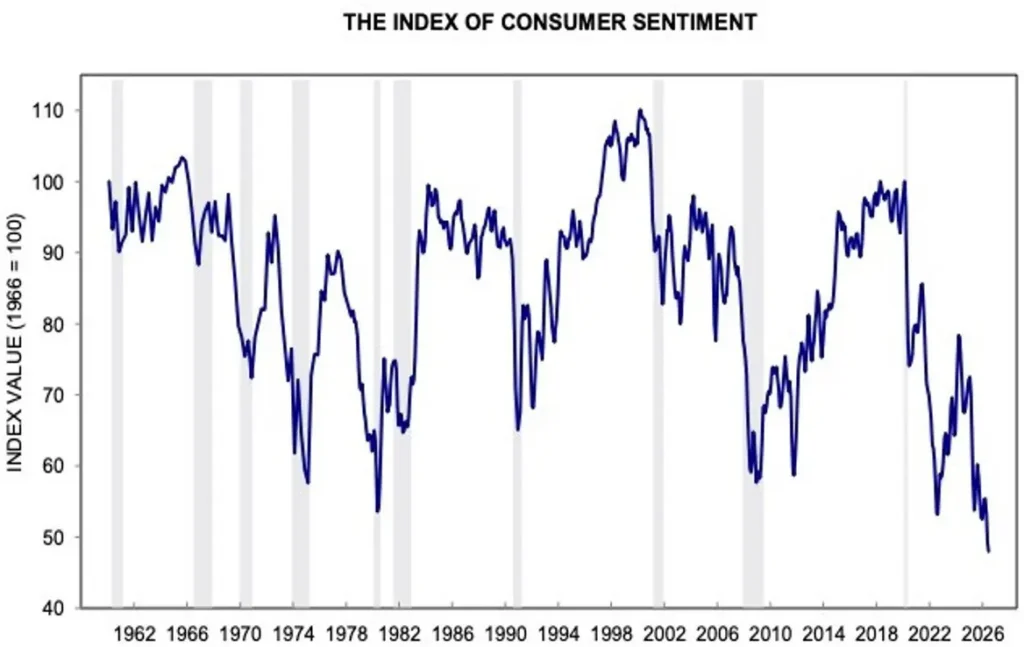
*Source: University of Michigan, July 6, 2026
Record highs in prices and record lows in sentiment, printed in the same season. The reconciliation: Sentiment captures how people feel, while the markets reflect what investors collectively expect about future earnings. The two are not the same instrument, and right now they are playing in different keys.
The narrative continues: While households report historic gloom, professional positioning tells the opposite: Goldman Sachs’ risk appetite work has also pointed to unusually elevated investor appetite for risk. Fear and avarice, at once.
Earlier this year, the pattern turned almost comic: Sentiment bottomed, and the index then delivered one of its strongest two-month runs in memory, rising >10% in April and another 5% in May.
Anyone who sold the despair forfeited the recovery.
Meanwhile, the enthusiasm has narrowed to a single story: the AI complex, where the bellwether reported quarterly revenue of $81.6B (+85% YoY), and management described demand as having gone “parabolic.” Narrative crowding of this intensity is herding with a balance sheet attached. The machine, throughout, did its job; the humans inside it swung from one extreme to the other, sometimes within a single week.
Where the Work Is
That swing is the oldest quarrel in modern finance made visible. Eugene Fama, who built the efficient market hypothesis, and Richard Thaler, a founder of behavioral economics, spent their careers as friendly antagonists a few doors apart at the same university—Fama insisting prices are right, and Thaler showing how reliably people are not. The discipline never resolved the argument. The 2013 Nobel was shared among three economists, two of whom, Fama and Robert Shiller, had made their names on opposite answers: one on how efficiently prices absorb information, the other on the bubbles where they spectacularly fail to.
That unresolved seam is the active manager’s workspace. If the machine is so hard to beat, why does an actively managed fund pay analysts to try? Because the thesis of this piece, turned over, becomes a job description. If inefficiency has migrated from the price to the person, then the person is precisely where the work is. Efficiency is the rule; the exceptions are behavioral, and they are neither rare enough nor random enough to leave alone. When fear compresses a sound business to a distressed multiple, or a story inflates a weak one, the distance is the residue of the very impulses that drain the impatient. Passive capital accepts the market’s price, and is wise to. Active work is the narrower discipline of judging when the crowd has, briefly, offered a worse one. Both, it bears noting, rest on the one trait Newton lacked.
The Only Edge That Lasts
This exercise does not ask that you grow smarter than the market. That contest is largely unwinnable, and the evidence of three centuries says that even genius does not guarantee a win. Instead, it asks something harder yet more attainable: that you out-behave yourself. The edge that remains is not prediction but temperament, and temperament is the one advantage no one can arbitrage away, because most people will not keep it. For most investors, that temperament is defensive, the discipline not to become the crowd at its worst. For the professional, it is the same trait aimed outward, the nerve to buy what the crowd is discarding and to distrust what it is chasing. The virtue is identical; only its direction of travel changes.
In practice, this means binding your future self before the moment of emotion arrives, when judgment is least reliable, precisely because conviction feels strongest. Decide in advance what will not change when prices do. Know why you own what you own, what would actually invalidate that thesis, and what is merely volatility wearing a costume. Treat a written plan as most valuable precisely when it feels least comfortable to follow. Volatility is the toll the market charges for its long-run returns; it is not a malfunction to be escaped.
Newton could not calculate the madness of men, and the loss it cost him was real. But the lesson he paid for is available to us for nothing. The market has been efficient for a very long time, and the opportunity has always been the same: Be the rare investor who is, too.
Ishan Chhabra
Analyst, Equity Research
Trevor Cummings
PWA Group Director, Partner