Dear Valued Clients and Friends,
I recently watched a four-part documentary on Netflix called Dynasty: The Murdochs, and read Gabriel Sherman’s little 200-page ditty, Bonfire of the Murdochs. I read the book first, and largely did so out of curiosity regarding the complexity of the internal family estate dispute, but then that drove me to watch the documentary (which also is what I do for fun on weekends, in case you are jealous of my view of an exciting nightlife). The book was a great and informative read, and the documentary was very well done and loaded with interesting information.
What the book and documentary did that inspired today’s Dividend Cafe was cause me to look deeper into a certain business strategy and decision, and to decipher what it has to teach us about dividend growth, about cash flow generative businesses, about capital intensity, about risk/reward trade-offs, and yes, about business models in this era in which we are living and investing.
It is one of the most significant transactions in American business in the last 25 years, and today, it is the source of our Dividend Cafe message. Let’s jump into the Dividend Cafe…
|
Subscribe on |
A Controversial and Reviled Guy, but as a Businessman…
I am sure readers of the book and viewers of the documentary will be tempted to their own psychoanalysis of the family and of Rupert Murdoch himself, and obviously, plenty of people have strong opinions (in favor of or in opposition to) the media empire that Murdoch has built. If the Dividend Cafe ever becomes a place offering you juicy takes on which media figure we should idolize or demonize this week, something has gone drastically wrong. It is not that I am unaware of all the controversy around Rupert Murdoch, or the Fox News brand, or anything else – it is just that here in the Dividend Cafe, I do not care.
Putting aside all of the drama around Rupert, his family, their internal squabble, and yes, the highs and lows and goods and bads of the Fox News empire, Rupert Murdoch executed one of the most significant business transactions in media history in March of 2019. Disney acquired a significant amount of content from Murdoch’s 21st Century Fox and paid $71.3 billion for it. I should probably mention that that price tag was much higher than originally bid, because, as we have well-documented in the Dividend Cafe, all media transactions seem to come with a bidding war, and God forbid anyone ever walk away without being bid up into the stratosphere by a competitor. In this case, Comcast was the competitive bidder, and Disney wasn’t having it. But Rupert was having the $71.3 billion Disney paid for these assets. Anyways, the major film and TV studios of Fox were sold to Disney, encompassing the lion’s share of the entertainment assets. The news and sports networks were spun off separately and formed a separate company (Fox Corporation), which the Murdoch family still controlled.
I want to suggest, in this week’s Dividend Cafe, that something very particular about investing was embedded in this transaction, and that it might even apply to us. I am happy to say that I am not writing with any skin in the game about these two companies, per se. We do not own Disney and did not own it when this transaction took place. We do not own Fox or News Corp, either, and never have. I do not have a positive or negative thing to say about any of the stocks that I mention in this commentary – and if I did, those positive or negative things are not the subject of this week’s piece. Rather, I want to extract lessons from a given strategy or mentality that I consider instructive.
My ask of you this week is to put aside your opinions of Rupert Murdoch the man, whether you love him or hate him, and to put aside your feelings about Fox News (which you may have heard generates a lot of intense feelings in both directions) and to allow me to simply use Rupert’s story for analysis into a business direction, totally divorced from the content that is involved. I think it is a fascinating story, an informative and illustrative one, and one that has a lot to teach us as investors as we think about the years ahead in this present investing landscape.
The Easy Part
It is not accurate to say that this transaction was simply a matter of Murdoch selling at the top or getting out of the content business. The story is just as much about what Murdoch kept as it is about what he sold. But yes, the 2019 transaction saw Murdoch fetch $71 billion for the movie studio (an iconic and legendary studio founded in 1915), their stake in Hulu, FX Networks, National Geographic magazine, and a plethora of regional sports networks. The intellectual property included in these business assets covered everything from Avatar, the Marvel characters, The Simpsons, the Planet of the Apes, and distribution rights for Star Wars. But what was not included in the deal was Fox News, Fox Business, and the Fox broadcast network (which included significant sports rights with the NFL and Major League Baseball).
The easiest way to summarize the deal is that resilient content, believed to be durable, was kept (news, live sports, opinion) while the most vulnerable, cyclical, and entertainment-oriented content was sold. This is not about the nature of the content, per se, but the business perspective associated with the content. Allow me to put it this way: For right or for wrong, Murdoch believed that sports and news were less disruptive than scripted content and the entertainment that filled American living rooms. That strategic consideration was then applied as a business decision that we will unpack at greater length.
Before We Evaluate Why
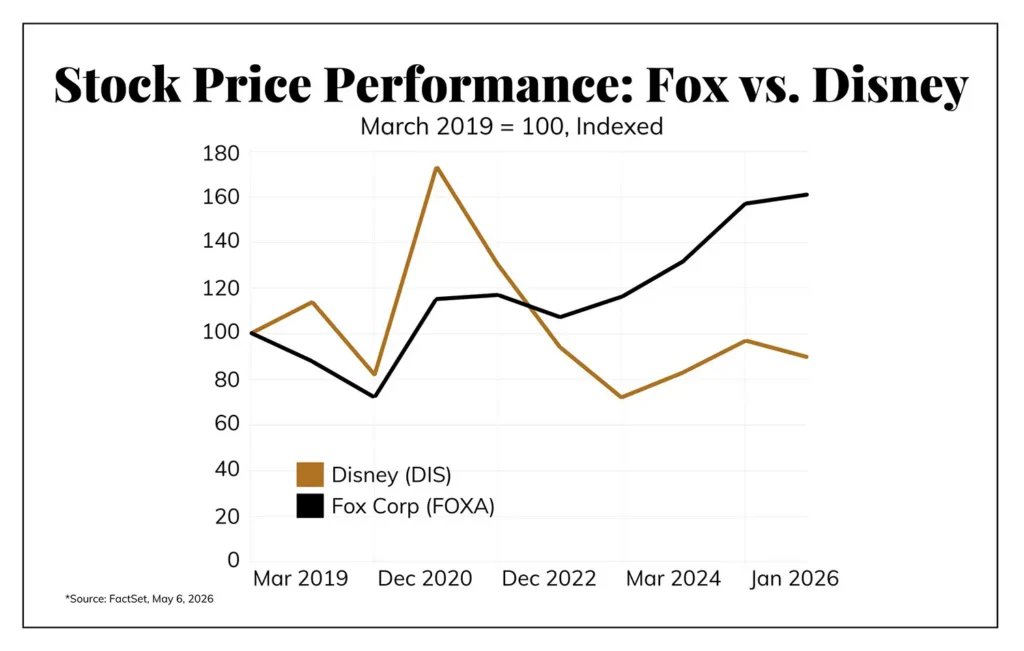
We can look at why this seems to have been such a prescient move and what it means for us as dividend growth investors, but let’s first look at how the transaction has played out in stock prices. Seven years later, in a time when the stock market is up over 250%, Disney is down since the transaction occurred. The spun-off Fox assets, which hold the news and sports assets Murdoch wanted to keep, are up substantially. The comparison between the buyer (Disney) and the seller (Fox) is clear as can be.
But why?
(Note: For those who might suggest that Disney’s challenges in this period may have been COVID-related, since you know, they shut the world down, please re-look at the chart; paradoxically, the one period where Disney appeared to be the relative winner in all of this was in the height of all the COVID shutdowns.)
Inside this Particular Industry
No one can really argue with the success Disney has largely enjoyed in buying intellectual property over the last few decades. What seemed like very expensive acquisitions when they happened (Pixar, Marvel, and Lucasfilm) became wildly profitable moves that gave Disney huge integration advantages in their media empire, but also their theme parks. The value Disney has generated from those high-profile acquisitions in toy licensing, merchandising, theme park expansion, and box office exploitation is no lower than 3x (Lucasfilm) and closer to 6x (Pixar). The late Sumner Redstone said “content is king,” and Disney has proven it, albeit in a vastly more profitable way than Redstone ever did. But there is nothing so permanent as change when it comes to the media and entertainment sector, and Murdoch seems to have understood that better than Disney did in this particular transaction.
At the end of the day, the old cable economics that drove so much of home entertainment were completely upended and disrupted by the streaming revolution of the last 10-15 years. Murdoch and Disney both knew that, and ironically, it drove both of them in this transaction. How could two parties understand the same thing but draw opposite applications and decisions? Disney believed the shifting grounds meant they needed more scale and more content to survive and thrive in the new streaming world. Murdoch believed that everyone pushing for more scale and content would:
- Give a price premium to him to sell it.
- Put downward pressure on the profitability of said streaming.
- Create a feedback loop of capital intensity that would be extremely unattractive.
In other words, the changing business dynamic that was making Disney want more content was exactly what would pay Murdoch the most for it, all the while creating a new paradigm where the cost of surviving in new media entertainment creation was going to explode. This capital intensity was exactly what Murdoch wanted to avoid.
And it may very well take more money than ever to make the next blockbuster sci-fi movie, or to create a new series or fictional series that will be worthy of binge-streaming. But what content was not going to explode in capital intensity and had a far more reliable and predictable market than any scripted entertainment content? News and Sports. It is less shiny, that is true – but the cost of production is pretty well known, the audience loyalty is extremely high (and less fickle), and the exposure to disruption and disintermediation via streaming is much more muted.
In other words, Murdoch could keep the assets he liked best anyway, which happened to be the ones most durable and repeatable, operationally simple, and were also the least capital intensive, and at the same time receive a massive premium on the assets that were most fickle, complex, and generationally unpredictable.
It is not accurate to say that this was all a “no-brainer.” Disney could not have known how quickly and dramatically streaming economics would blow up, nor how weak the theater business would become. I have to think they knew how much more expensive content creation was going to be, and it is quite clear that Murdoch knew it, but one can sympathize with their strategic thinking that “content had to be bought to achieve scale, no matter what the price.”
But the “no matter what the price” part of that is problematic, as history has taught us over and over again.
Where Are We Now
The “real-time attention” nature of news and sports creates different economics and assumptions than everything else that demands our attention these days. There may very well be a reward in the future for the higher risk profile of entertainment (legacy content and the burden of new content creation), but it is much more subject to the volatility of technological disruption and certainly economic turbulence. Where we are now is that one bucket of assets has great IP value that may be able to be monetized over time (I would not bet against Disney doing this), but lacks durability, predictability, consistency, and is exposed to a wide variety of risks and interruptions along the way (economics, capital intensity, technology, and shifting preferences) … And then another bucket of assets that is not entirely de-risked (even Murdoch’s side of this ledger was not immune from an intense internal family drama as well as the famous Dominion lawsuit) but is removed from many of the deteriorations and risks of the entertainment business while spinning off extraordinary cash flows without a need to feed the dragon more and more capital to keep it all coming.
Disney’s revenue is 6x higher than Fox’s. Their revenues were $69 billion in 2019 and are $95 billion now. Fox, on the other hand, did $11bn (top line) in 2019 and is doing $16bn now. The difference? Disney functions at an operating margin just a bit over half of Fox’s due to the aforementioned cost realities of their respective businesses. And more importantly, the Free Cash Flow margins are nearly double, as well. The streaming buildout, massive content spending needs, and, of course, debt service have created an extremely expensive business to build, run, and maintain. It is worth mentioning that this is hardly because of excessive debt on Disney’s part. Compared to other media peers I have highlighted over the years, Disney is a beacon of financial responsibility when it comes to their debt profile. The challenges for Disney’s Return on Equity entirely lie with CapEx – the need for more and more of their cash flow to be used for the business.
Applying it to Us
The lighter asset base Fox carries, along with higher free cash flow generation and substantially higher cash flow productivity, is a by-product of a conscious decision made by Rupert Murdoch. Higher margins, a lighter equity base, and a strong ability to produce cash flow available to the owners of a business – these were the things Murdoch envisioned in selling the crown jewel Fox assets at a massive premium, while keeping the assets he believed were more insulated from the disruptions taking place inside the media and entertainment world he had spent decades in.
The summary here is NOT that Disney made a bad decision and Fox made a good one. Disney made a long-duration decision, that’s for sure. They made a very, very expensive decision, and that is also true. They made one that requires heavy reinvestment, likely for years and years to come. And they made a risky one. They have to execute to achieve the scale they are after, and they have to compete against formidable competitors, while continuing to spend massive amounts of money. But there very well could be a payoff for Disney, though the longer the time it takes to capture ROI, the lower the internal rate of return will be (because of math). Murdoch has already done what he wanted to do for himself and his family (and therefore for his shareholders). My concern here is not what this transaction meant for investors in this transaction, but what it tells us about the very pursuit of investing we crave at The Bahnsen Group.
Long-duration growth plays can pay off well for investors. And they can end terribly. What cash flow generative investment stories do is shorten duration, which intrinsically means reducing risk. Here I actually mean risk in the way it should be used – the actual risk of failure or a sub-optimal outcome – but I also mean risk in the way it is most often used – volatility along the way.
Every investing decision we make contains risk. Every business decision that large operators like Disney and Murdoch make contains risk. What we are after as investors is a return of our cash in a way that meets our own goals, and can be done reliably, dependably, and with a growth rate that satisfies our needs and wants.
Sometimes we like chasing a blockbuster. Hit movies are a lot of fun.
But when it comes to investing, sometimes we just need the news and our favorite sports teams. They can be fun, too, and those dividend checks don’t ever get lost in a box office flop.
Chart of the Week
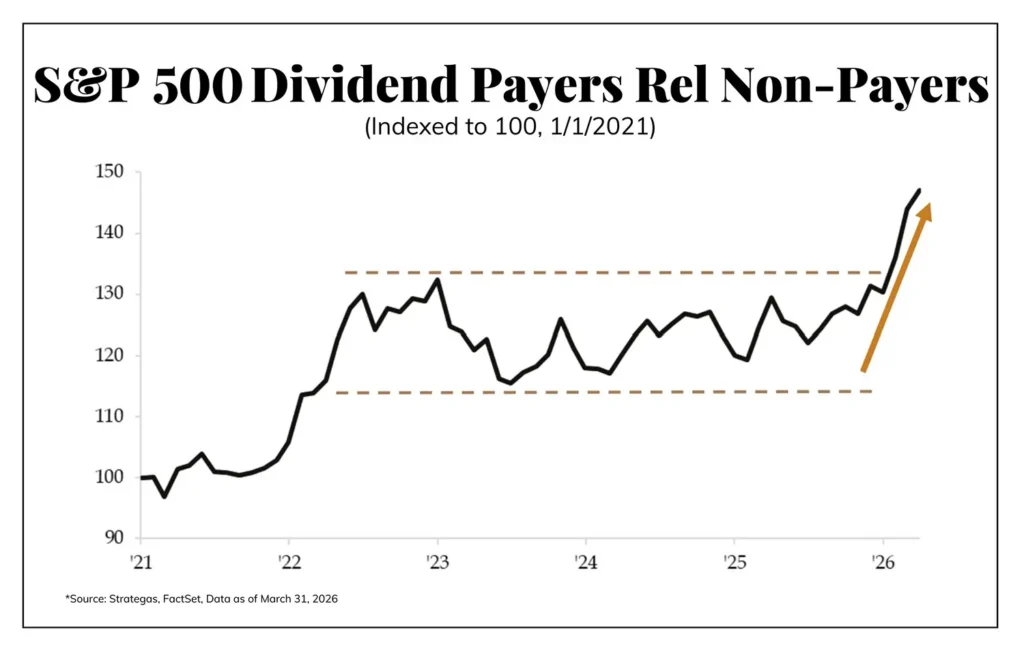
Our investment philosophy is not merely about those who pay a dividend, but rather those who have the ability to pay one that they can grow year over year over year. That said, the ability of a company to pay one at all – and in some cases, not the ability but the simple decision to do so – is becoming more and more of an indicator of the quality worth owning in this environment.
Quote of the Week
“To the extent we have been successful, it is because we concentrated on identifying one-foot hurdles that we could step over rather than because we acquired any ability to clear seven-footers.”
~ Warren Buffett
* * *
I look forward to being with you on Monday in the Dividend Cafe for a new look at the state of Iran, oil prices, and interest rates. Many are loving what is going on in markets. Many are confused by it. We are neither. We are focused on repeatable cash flows and what they mean for the companies we own. To that end, we will continue to work.
With regards,
David L. Bahnsen
Chief Investment Officer, Managing Partner
The Bahnsen Group
thebahnsengroup.com
This week’s Dividend Cafe features research from S&P, Baird, Barclays, Goldman Sachs, and the IRN research platform of FactSet